
Not being a smart @$$ here but what are you using a kill switch for? Momentary dead air as part of a song? If so, how often do you do this? Enough to warrant modifying a bass?
I guess I’ve never really seen a kill switch for anything other than swapping guitars in which case a mute pedal, tuner or cable would work just fine.
Hoping to be enlightened....seriously.
Thanks!

Enjoy the benefits of a premium membership!
Upgrade Account
-
TalkBass has been independent since 1998. Add your voice.
Create a free account to reply to discussions, view embedded media, and browse with fewer display ads.
Join free Log in
Want zero display ads or expanded classifieds tools? Compare plans.
You are using an out of date browser. It may not display this or other websites correctly.
You should upgrade or use an alternative browser.
You should upgrade or use an alternative browser.
Kill switch
- Thread starter Tobias Sullivan
- Start date
More options
Who Replied?Not being a smart @$$ here but what are you using a kill switch for? Momentary dead air as part of a song? If so, how often do you do this? Enough to warrant modifying a bass?
I guess I’ve never really seen a kill switch for anything other than swapping guitars in which case a mute pedal, tuner or cable would work just fine.
Hoping to be enlightened....seriously.
Thanks!
It’s for more of a stutterish sound, tom morello uses it in rage (albeit he’s on guitar) but I think it can be utilized on bass as well.
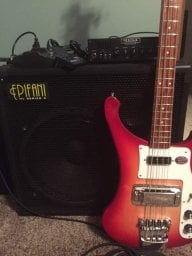
As far as modifying I’ve already done a few mods to this bass... it originally was active which I didn’t need and the Asian electronics were notoriously bad in this bass.... swapped it to passive EMG geezer butler pickups and now have this hole just making an eye sore of the bass... Using Pinch on pedals is dicey cause that’s hard to dial in on stage...so I’d rather just be able to kill it as needed or use it as a stuttering effect


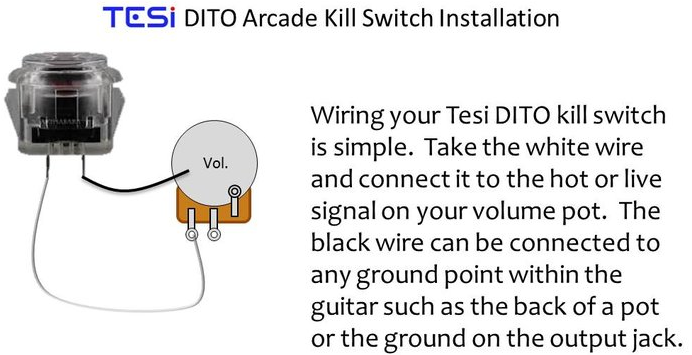
The best way to install one is to wire it so it's shorting the output signal with the ground wire, right before it gets to the output jack:
View attachment 2814466
I found many switches that would work, but none with gold hardware:
https://www.amazon.com/SPST-BUTTON-SWITCH-MOMENTARY-NORMALLY/dp/B006M3GEOA
View attachment 2814468
I don't think that drawing will work. Switch is not doing anything in that example.
You need to take the green wire to the switch, then wire the other side of the switch to where the green wire is landed on the output jack . That breaks the path.
You do not need to do anything with the other wire to the jack. Can stay as is.
As an Amazon Associate, TalkBass may receive commissions from qualifying purchases made via links on this site.
You don't want to break the path, you want to shunt the signal to ground.
This has already been discussed on page 1.
Here's another way to do it, remember this is a Normally OPEN switch:
This has already been discussed on page 1.
Here's another way to do it, remember this is a Normally OPEN switch:
I don't think that drawing will work. Switch is not doing anything in that example.
You need to take the green wire to the switch, then wire the other side of the switch to where the green wire is landed on the output jack . That breaks the path.
You do not need to do anything with the other wire to the jack. Can stay as is.
This is specifically the WRONG way to do it. Please read the thread.

I know I’ve seen multiple kill switch questions on here, but I need it put into more layman’s terms... I can’t read a schematic so that’s void... pretty much I have a passive P/J bass with 2 volumes and a tone knob. (More specifically Geezer Butler Emgs with “solderless” technology) so my questions....
Where can I find a Push Button momentary on/off switch that is relatively inexpensive that doesn’t sacrifice effectiveness? Gold/Bronze color made of metal is preferred. And I’ve attached a picture to get a general size of where it’s going.
Anyone have a good How to video or know of one so I don’t fry anything when I install it?
I know I’ve seen multiple kill switch questions on here, but I need it put into more layman’s terms... I can’t read a schematic so that’s void... pretty much I have a passive P/J bass with 2 volumes and a tone knob. (More specifically Geezer Butler Emgs with “solderless” technology) so my questions....
Where can I find a Push Button momentary on/off switch that is relatively inexpensive that doesn’t sacrifice effectiveness? Gold/Bronze color made of metal is preferred. And I’ve attached a picture to get a general size of where it’s going.
Anyone have a good How to video or know of one so I don’t fry anything when I install it?[/QUO
I bought mine at Radio Shack, I don't honestly know if they sell parts anymore.

This is a thread derail, but I have questions regarding another kill switch, the one on the Gretsch 6070/6072 basses. Since these basses have a master volume control I have always regarded the kill switch on them as redundant and have wanted to re-purpose it to be like the factory "tone" switch, only with different cap values. Here is the link for the wiring diagram:
GRETSCH G6072 WIRING DIAGRAM Pdf Download.
Is it feasible to re-purpose this switch in the manner I wish? If so, what cap values should I use to differentiate from the caps on the stock switch?
Is it possible to mix 'n' match both switches at the same time?
Would I be better off just removing the kill toggle and installing a varitone switch instead?
Thanks in advance for any insights offered.
GRETSCH G6072 WIRING DIAGRAM Pdf Download.
Is it feasible to re-purpose this switch in the manner I wish? If so, what cap values should I use to differentiate from the caps on the stock switch?
Is it possible to mix 'n' match both switches at the same time?
Would I be better off just removing the kill toggle and installing a varitone switch instead?
Thanks in advance for any insights offered.
This is specifically the WRONG way to do it. Please read the thread.
how is the switch doing anything in the original sketch? there is still path to jack regardless of switch setting.
how is the switch doing anything in the original sketch? there is still path to jack regardless of switch setting.
The switch is shunting the jack, to reduce its impedance to 0. In other words, when the switch is closed, there is a direct path from signal to ground. There cannot be any sound (signal, noise, or otherwise) when this happens. By contrast, if you don't do this, it is as if you are leaving your instrument cable wide open, because there is not a finite impedance to load it. Think of how your amp hums when you plug in a cable, but don't hook it up to a bass.

The switch is correct as KBD drew it; It shorts the signal to ground.
Perhaps more useful would be a remote mute switch located in the audience. If the listeners feel they don't like the bass player's efforts, they can shut him down with a simple press of the button.
Perhaps more useful would be a remote mute switch located in the audience. If the listeners feel they don't like the bass player's efforts, they can shut him down with a simple press of the button.
Last edited:
The switch is shunting the jack, to reduce its impedance to 0. In other words, when the switch is closed, there is a direct path from signal to ground. There cannot be any sound (signal, noise, or otherwise) when this happens. By contrast, if you don't do this, it is as if you are leaving your instrument cable wide open, because there is not a finite impedance to load it. Think of how your amp hums when you plug in a cable, but don't hook it up to a bass.
Yeah, I missed the ground part....nothing to see here. Move one. You don't have to go home, but you can't stay here.

“Perhaps more useful would be a remote mute switch located in the audience. If the listeners feel they don't like the bass player's efforts, they can shut him down with a simple press of the button.”
I was in a band that had “volume control issues” where I said something similar. That everyone should have a volume pedal connected to someone else’s amp.
I was in a band that had “volume control issues” where I said something similar. That everyone should have a volume pedal connected to someone else’s amp.
If I really wanted to setup for that stuttered effect, I would place a magnetic reed switch just under the pick guard in the control cavity.
To activate it, the musician would wear a ring with a magnet set into it. Moving the magnet near the hidden reed switch would mute and unmute the audio simply by moving the hand.
To activate it, the musician would wear a ring with a magnet set into it. Moving the magnet near the hidden reed switch would mute and unmute the audio simply by moving the hand.
There is no pickguard on the OP's bass.
Great way to avoid having to install a visible control, but people wear rings when they're playing?
I never would.
Great way to avoid having to install a visible control, but people wear rings when they're playing?
I never would.
It took me awhile to get used to playing with my wedding ring when I got married, but I don't even notice it now. Good thing too, because it doesn't come off anymore.
The reed switch could be installed in a routed cavity close to the top surface too, if it doesn't use a pick guard.
The reed switch could be installed in a routed cavity close to the top surface too, if it doesn't use a pick guard.
If I really wanted to setup for that stuttered effect, I would place a magnetic reed switch just under the pick guard in the control cavity.
To activate it, the musician would wear a ring with a magnet set into it. Moving the magnet near the hidden reed switch would mute and unmute the audio simply by moving the hand.
Dude what the hell are you smoking... I appreciate the reply but that seems extremely hard and impractical... I have to do all this poopie, plus buy a ring? What if I forget the ring?
All I need is a 5 dollar easily installable Button. Not some kakamainy ring magnet hidden switch get up.
I suppose connecting the reed switch across the output jack would be very difficult for some.
You're missing the point: If you want to reproduce this effect without having to use a clunky mechanical push button, the reed switch is an elegant solution. However, it's your instrument, and you can install whatever you want. Seems like a lot of trouble though, for something that would have limited use.
You're missing the point: If you want to reproduce this effect without having to use a clunky mechanical push button, the reed switch is an elegant solution. However, it's your instrument, and you can install whatever you want. Seems like a lot of trouble though, for something that would have limited use.


