On stage!Now what?
What in the world are you trying to make a point of?

TalkBass has been independent since 1998. Add your voice.
Create a free account to reply to discussions, view embedded media, and browse with fewer display ads.
Join free Log in
Want zero display ads or expanded classifieds tools? Compare plans.
On stage!Now what?
... black shirts and white ties? It's been done to death.
...
Conversely, projecting the wrong image can be perceived as very jarring, and can result in the audience writing you off before you've had a chance to impress them with your music. And if they expect one thing and get something else, their reaction might be very unfavorable indeed. Remember how long it took for Metallica to live down their collective trip to the barber?
We have a simple rule. Dress differently than the crowd. Always wear pants.
... Victor Wooten in the '90s looked like Surf Magazine met the Cosby Show.
Whatever; anything can work.
I don't think you are supposed to wear jeans either. Unless they look exactly like pants.
...
What's kind of unreal is that I rarely spend money on clothes that don't come from the ladies section of a thrift store. I realize not everybody can pull that stuff off, but the gals section has clothes that are way more colorful and don't look big and boxy on me. I get a lot of compliments from girls, in particular


Totally agree!! You're onstage, essentially an employee of the venue you're playing in, and everyone's looking at you. DRESS NICELY!!!

Post#111What in the world are you trying to make a point of?

Years ago the BL of the country band I was in said "you are the performer" So in other words don't dress like the crowd...stand out.The country bands I played in always wore vests (except the drummers). Didn't have to be leather. None of the audience wore vests, so it let people know you are in the band. So I bought one.
I still wear a vest to gigs. With a plain, black t-shirt.
He dresses the same on stage or in some ones living room.
The point is:Higher playing ability trumps stylish clothing any day.
His stage clothes have nothing to do with anything.
Stage or street corner.
A pretty excellent explanation of costumes and uniforms and the relationship between performer and fan! I feel like I just took a class on the subject.Oh, but that's just plain old not true.
I see what you're trying to say, but I think you're missing the same point that many others in this biz miss: He's wearing a costume, and you don't recognize it as such.
He's dressed like a professional jazz musician. In both shots. Why? Cuz that's what he wears to work. And he's working in both cases.
All clothes are costumes. They send a message, intentional or unintentional, about the wearer to anyone that sees them and understands the cultural context of the clothes. Metalheads get caught in this all the time: they think Metalica dresses "normal" without realizing that everyone that isn't "metal" sees the costumes plainly. They dress like teenage boys. Guess who their audience is? ERgo, normal is perceived, not actual.
People who routinely dress publicly in cargo pants and black t shirts with rock band logos see a band on stage dressed just like them, and they think the band is dressed like "normal guys". Put one of the band members in a lime green polo shirt and the audience would jar at the iconoclasm and the player himself would feel like his manhood might have been stolen. This has nothing to do with the quality of the music. Same thing with Manring, he's dressed casually fashionable, in muted colors. This is a step more relaxed than business casual, but more "up" than denim and t shirts, true casual. To jazz fans, especially other musicians, this _is_ normal. Not for Metalica. If he showed up in ripped jeans and a black Iron Maiden t shirt, his audience would be disaffected regardless of the quality of the music because his costume would send a message out of context with the expectations of his audience. Take the image further: imagine him in an open gold lamé sport jacket, no shirt, bell bottom doubleknits, and platform shoes. Add medalions on chains around his neck. Different message, huh? But the BeeGees looked exactly how their audience expected: Like them. Why isn't Manring wearing sweatpants and a tanktop in those two shots? Because he didn't just get back from the gym - he's working, which involves projecting an image consistent with the occupation. It's just that you equate that image with "normal" as opposed to the other ones I listed.
Pete Townshend didn't want people to associate his music with the conceited rock star image, so he iconoclastically appeared on stage dressed as a plumber. The idea was to invoke that cognitive dissonance described above. Amusingly, English plumbers don't dress like Amercian plumbers, so showing up on stage in the US in a white jumpsuit and Doc Martins became as much an iconic rock look as Townshend had hoped it would not be. Context is everything.
 ;
; ;;
;; );
);
 No CHOPS!
A pretty excellent explanation of costumes and uniforms and the relationship between performer and fan! I feel like I just took a class on the subject.
Well said.
Indeed!
Reminds me of how motorcyclists assert their independence from the norms of society and show off their "individuality"... by all dressing alike in black leather, jeans and heavy boots.
I've always thought it would be fun to get a Gene Simmons Signature Axe (Cort et al, whatever brand),
yank the frets out,
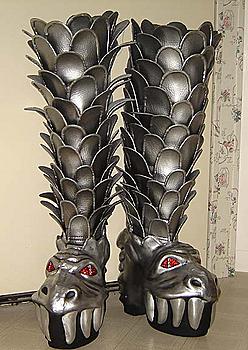
don the Gene Simmons Python boots, batwing garb and makeup, top-knot...
... and show up to a straight-ahead jazz gig (with chops).

Hmm I can get the bass, luthier friend can make it a fretless
Halloween shops have the boots, but I'll likely have to DIY (size 13)
I can get the batwing costume from the Halloween shop though
Make-up from my theatrical friends (hair my own
Jazz gig... need the straight-ahead gazz-jig...
Darn!


Oh, but that's just plain old not true.
I see what you're trying to say, but I think you're missing the same point that many others in this biz miss: He's wearing a costume, and you don't recognize it as such.
He's dressed like a professional jazz musician. In both shots. Why? Cuz that's what he wears to work. And he's working in both cases.
All clothes are costumes. They send a message, intentional or unintentional, about the wearer to anyone that sees them and understands the cultural context of the clothes. Metalheads get caught in this all the time: they think Metalica dresses "normal" without realizing that everyone that isn't "metal" sees the costumes plainly. They dress like teenage boys. Guess who their audience is? ERgo, normal is perceived, not actual.
People who routinely dress publicly in cargo pants and black t shirts with rock band logos see a band on stage dressed just like them, and they think the band is dressed like "normal guys". Put one of the band members in a lime green polo shirt and the audience would jar at the iconoclasm and the player himself would feel like his manhood might have been stolen. This has nothing to do with the quality of the music. Same thing with Manring, he's dressed fashion casual, in muted colors. This is a step more relaxed than business casual, but more "up" than denim and t shirts, true casual. To jazz fans, especially other musicians, this _is_ normal. Not for Metalica. If he showed up in ripped jeans and a black Iron Maiden t shirt, his audience would be disaffected regardless of the quality of the music because his costume would send a message out of context with the expectations of his audience. Take the image further: imagine him in an open gold lamé sport jacket, no shirt, bell bottom doubleknits, and platform shoes. Add medalions on chains around his neck. Different message, huh? But the BeeGees looked exactly how their audience expected: Like more fabulous versions of them. Why isn't Manring wearing sweatpants and a tanktop in those two shots? Because he didn't just get back from the gym - he's working, which involves projecting an image consistent with the occupation. It's just that you equate that image with "normal" as opposed to the other ones I listed.
Pete Townshend didn't want people to associate his music with the conceited rock star image, so he iconoclastically appeared on stage dressed as a plumber. The idea was to invoke that cognitive dissonance described above. Amusingly, English plumbers don't dress like Amercian plumbers, so showing up on stage in the US in a white jumpsuit and Doc Martins became as much an iconic rock look as Townshend had hoped it would not be. Context is everything.

Tell that to Cheap Trick...2. Look like you're all in the same band
To be fair, for many of these groups, their "individual" identity is that of a group that is not-normative, rather than complete extreme individuality. They may not be unique, but biker gangs certainly do have a uniform that sets them apart from "normal" society just the same way that metal heads, goths, punks, etc.Indeed!
Reminds me of how motorcyclists assert their independence from the norms of society and show off their "individuality"... by all dressing alike in black leather, jeans and heavy boots.
Interesting Eilif.
I once read an article about individualism, lonnngg time ago, and it used the biker look as an example, though it (and I myself in my post) weren't specifically referring to biker "gangs" such as the Hell's Angels or Rebels etc. Even the doctors and lawyers who ride on weekends tend to adopt the biker "uniform". I get what you're saying, though.

I think you're absolutely right. I know when I was in a pop-rock group I put alot of care into selecting what t-shirt, jeans wrist-wear, etc that I was going to wear on stage. It was all cheap resale shop stuff, but it definitely wasn't just a matter of throwing on anything that came out of the closet.I would bet many of the big bands who "dress down" on stage with jeans and ripped shirts probably spend a lot of money cultivating that look. Far from going to Walmart and getting a pair of Wranglers and cheap t shirt.
I think you're absolutely right. I know when I was in a pop-rock group I put alot of care into selecting what t-shirt, jeans wrist-wear, etc that I was going to wear on stage. It was all cheap resale shop stuff, but it definitely wasn't just a matter of throwing on anything that came out of the closet.
I don't think it's a bad thing though. Regardless of how much you spend or where you buy it, I think there's a real value in carefully choosing your stage wear. Some will disagree, but I've always seen it as being as vital as a costume for an actor or vaudevillian and an essential part of being a performer.