I see where you're coming from... Interestingly enough, I never went into the VT Bass world wanting any sort of 'Ampeg' character, even though that's apparently what it was intended to do. I learned that after the fact. I bought it because I wanted the supposed 'tube warmth' inherent in it (Ampeg comparisons/simulations aside) and now I can't get away from it. I fell in love with it as a result. I set it as 'flat' as possible (for the 'B-15' vibe I guess) and tweak from there with onboard EQ.
That makes sense. I'm not a fan of the B-15 tone for most things I do, though I do love it on all those old vintage Motown recordings. It is a very warm sound, and the VT does a fairly good job of emulating I would agree.
I do tend to cut a LOT of the highs out of it though. I notice that upper-mid 'clank' at times but I find that through a combo of very small onboard EQ and amp tweaks in conjunction with the VT I can get something that works quite well for me.
I don't want to talk bad about a pedal you love, so I hope you view my comments as just that...comments. I'm not sure if you've followed any of the VT threads around here, but a few people scoped that VT, and there is no "flat" setting on it necessarily. The flattest anyone got it was with the lows and mids just past noon, and highs around 10 o'clock. It still had a curve that favored the upper-mids a bit, and the rig emulation adds a bit of bite in that region as well. That's what provides that grindy snap up top. But hey, that's what an Ampeg does so good job by Tech21 in recreating it! My problem was that I use a lot of passive instruments with no tone controls, so I couldn't really dial that upper mid out any further. The PTC knob worked but it made the total sound too dark. Most of my playing is direct into a PA with no bass head, so I was left with no control over the sound. I didn't want to have to use an EQ pedal so I just gave up on the VT for my needs. Others would love it, so I'm really not dogging it. It was just a personal preference for me.
Every time I try other upper-mid 'massaging' (even with LH-3 onboard tweaks on my 44-02) I lose some of the bite that I love, and I hate adding treble for clarity. Sends me into sizzle territory and I'm not a fan of sizzle.
This part I totally get. Adding more treble doesn't accomplish the same thing. The VT sometimes was perfect for that bite, especially on a grindy J bass with a pick. It was great for those kinds of tunes, but that's such a small part of my needs. Not being able to avoid it for the majority of my playing was a detraction.
I've never tried a Tone Hammer though... sounds like I may have something else to GAS over soon. Does it offer tube character/coloration without the 'Ampeg' vibe?
Yes, it does just that, although calling something tubey seems to mean different things to different folks around here. If you've played a lot of old tube heads, then you know there's lots of room for variation. Traynor vs. Ampeg vs. Hiwatt for example. All extremely different. The Tone Hammer, with the AGS off, is an almost completely transparent active EQ section with cut/boost and sweeping mids. The AGS circuit is an interactive control. As soon as you engage it, it rolls of highs even at the lowest setting, so it sounds vintage right off the bat, but it doesn't change the character of your bass. There is no "emulation" going on. So it warms things up right off the bat. The EQ still works the same, but the frequency points are different with the AGS engaged. Rolling up highs doesn't add sizzle, but upper-mid bite in the 2k-3k area it seems. So you can dial in that kind of grind. The bass knob is also tighter, so you're dialing in lower-mids rather than extended bass so that the result is more like the tone of a sealed 810 cabinet. It's very cool.
Taking it further, as you increase the gain with the AGS engaged, it begins to add more and more warmth, or harmonic content. Eventually it starts to overdrive and get increasingly snarly. The signal is also compressed more as this occurs, just like you'd expect when overdriving a tube amp. Going back to what I said before, the AGS circuit is very interactive with the EQ, so the more you turn it up, the more the low-end tightens up and becomes more focussed to keep the tone from getting muddy. The treble also smooths out so that it doesn't instantly become a buzz saw just because you are pushing the overdrive really hard. Of course, you can boost lows and treble to get that, but it's not automatic which is nice.
Here's the other thing about the AGS. It interacts specifically with the mid control. In other words, that's where it does it's thing. So by setting the gain for a certain amount of overdrive, tweaking the mid control changes the "character" of the effect. But the gotcha is that it also changes the amount of overdrive once you start tweaking the mid, so you might have to back off a bit. It's highly flexible but it can take some noodling just to figure out how it all works together.
A lot of folks around here have nit-picked Aguilar over the Tone Hammer not having two independent level controls so that you can set the output of the AGS tone to match the output of the clean tone, which would essentially make it a two channel pedal. I can understand them because that would make the pedal that much more versatile so that some could also use it as a stomp-box distortion, but because of the way the EQ interacts with the AGS, the chances are that the EQ settings for the clean tone wouldn't really work for the AGS tone for lots of folks. I know they wouldn't for me. I pretty much run my bass flat in the clean mode, and then tweak the EQ for the AGS tone.
One more quick note. The NICE thing about the AGS is that if you set the gain completely counter clockwise and adjust the Level for unity response, then engaging the AGS provides no boost in output. It also doesn't change the EQ functions much at that lower setting. The end result is that engaging the AGS when it is set like this has the effect of simply rolling off all that high end that a lot of vintage players don't like. It sounds almost JUST like turning the tweeter off on a modern cab simply by stepping on the AGS button. Very cool, and that's how I tend to use it, with just a bit of EQ on a passive instrument. Engage the AGS, boost the gain to around 9 o'clock (very slight grit), and then boost the treble to add a touch of upper-mid bite but NO sizzle.
Hope that helps! And sorry for the derail everyone!

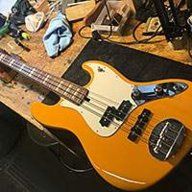
) 16ths and 32ths chops, and every note just stands out, something I've never felt on a passive bass, at least to this extent.





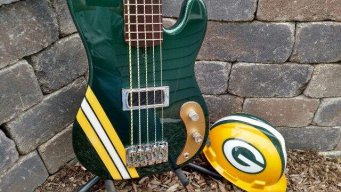

 He he!


