Stick around, we regularly rib each other pretty good around here. We have a few resident jokesters as well and those that just try to be funny like myself
It's all good. No offense taken.

TalkBass has been independent since 1998. Add your voice.
Create a free account to reply to discussions, view embedded media, and browse with fewer display ads.
Join free Log in
Want zero display ads or expanded classifieds tools? Compare plans.
Stick around, we regularly rib each other pretty good around here. We have a few resident jokesters as well and those that just try to be funny like myself
It's all good. No offense taken.
I played a Skyline 44-02 today in a shop. I was very surprised because it's probably 5lbs lighter than my 2009 55-01 Skyline. The shop owner said that Lakland has a new technique for drying the wood that makes it lighter. He also said the reason my bass is heavier is because I wasn't fully dried so the tone won't be as good. Are either of these statements true?

There definitely seems to be better weight consistency in the more recent batches and a lighter average weight.

Stick around, we regularly rib each other pretty good around here. We have a few resident jokesters as well and those that just try to be funny like myself
Has anyone noticed that the weight effects the sound?
You can go back and read this discussion from a couple weeks back, I can't go through it again#1904
And you'll see why I was mentioning 'destinies'
Has anyone noticed that the weight effects the sound?
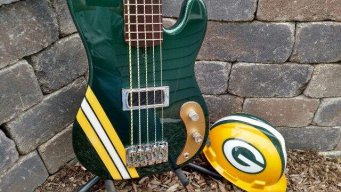
The neck swap was a success. Time consuming to make sure everything was absolutely perfect, but well worth it.
I found that the tone difference was not as much as expected. Here's why:
The '08 maple neck is slightly heavier and a little thicker than the '07 rosewood. Simply more wood. They were also produced at different locations.
I used the same strings and tested both acoustically and plugged in.
My natural finger tone is more on the "warm" side, so nothing will ever sound "bright" to me, but the maple neck is a just a little more "snappy", if that makes sense. I think because the maple neck has more wood, it's closer to the rosewood neck than I expected. Both big, clear, and full sounding.
Bottom line: Both awesome and so well made.
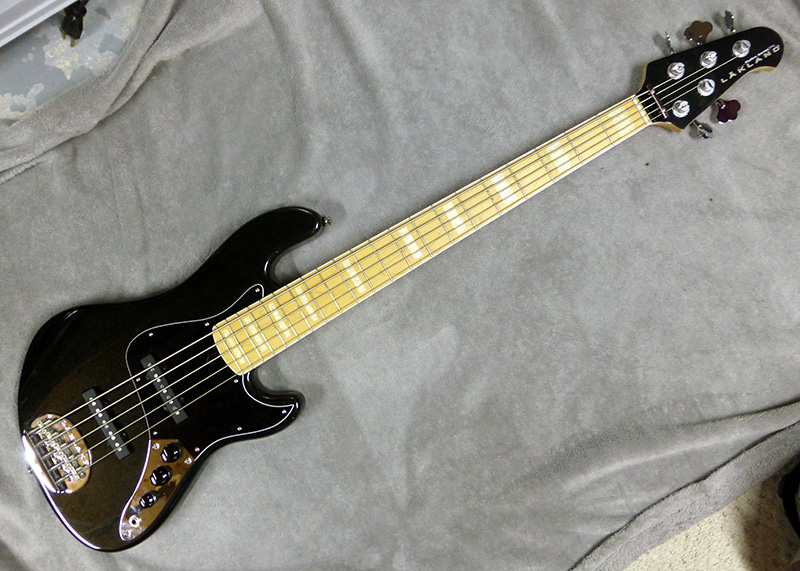


Can someone help me work out the body wood in my fretless 55-02 ?
It's painted black (factory finish, not a refin) so I can't see the grain. The serial is 0805**** and as I said, it's fretless, lined ebony fingerboard.
Anyone know what body wood that might be ?
Real reason for asking is it's my favourite out of my 3 lakies. The others (a fretted '05 55-94D (quilt top, 'burst) and a fretted '10 55-02 natural) both appear to be ash bodied and don't sound as 'right' to me as the fretless 55-02 ... so I'm trying to figure out the differences. Could be that the major difference is the fretlessness
Nice looking BEM, but now I'm hungry for split pea soup
I agree. You can't really expect a fretless to sound the same as a fretted bass. Fretless: flesh and wood are the contact point for the chosen notes.... fretted: metal frets. This makes a huge difference.
If you want to play around with weight, add a fat finger to the headstock. Or for a dramatic, instant demonstration: push the headstock end into a wall, effectively making the wall part of the instrument. You'll hear a difference instantly. You can also push the bass body edge into a counter top.
Halal wood harvesting; I dig it! ! In my family we try whenever possible to eat meat that has not been factory farmed, which often means meat that has been wild and hunted locally......we call it "happy meat"