

Enjoy the benefits of a premium membership!
Upgrade Account
-
TalkBass has been independent since 1998. Add your voice.
Create a free account to reply to discussions, view embedded media, and browse with fewer display ads.
Join free Log in
Want zero display ads or expanded classifieds tools? Compare plans.
You are using an out of date browser. It may not display this or other websites correctly.
You should upgrade or use an alternative browser.
You should upgrade or use an alternative browser.
More options
Who Replied?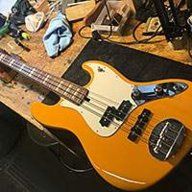
Humbuckers! 500k pots, and 300k tone pot. A friend if mine Peter Boer's recipe. He swears by this combo with these pickups.

The neck swap was a success. Time consuming to make sure everything was absolutely perfect, but well worth it.Let us know what difference in sound you hear...I am curious, as the DJ is a ash body.
I found that the tone difference was not as much as expected. Here's why:
The '08 maple neck is slightly heavier and a little thicker than the '07 rosewood. Simply more wood. They were also produced at different locations.
I used the same strings and tested both acoustically and plugged in.
My natural finger tone is more on the "warm" side, so nothing will ever sound "bright" to me, but the maple neck is a just a little more "snappy", if that makes sense. I think because the maple neck has more wood, it's closer to the rosewood neck than I expected. Both big, clear, and full sounding.
Bottom line: Both awesome and so well made.


Can you or anyone tell me what difference the heavier body would make to the sound. That is, assuming both 55-02s have the same kind of body wood (ash) and the only difference is the weight ?
There is no logical, physical explanation why a heavier bass should sound different from a lighter one (ignoring extreme differences that do not exist in reality, like a 1 lb bass and a 50 lb bass). Resonance is what affects string vibration, and weight is not a predictor of resonance. IME there is no correlation. Some may believe there is, but I have seen neither evidence (beyond anecdotes) nor a logical reason to believe this viewpoint.

The note you hear is dependent on the natural frequency of the string, and that natural frequency is affected by the scale length of the string, the tension the string is under, and the density of the string, as shown in the equation below.
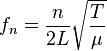
In this equation, n represents the harmonic in question (1 for first natural frequency, 2 would be the first harmonic of the natural frequency, etc), L is the scale length, T is the tension, and mu is the density of the string.
If you keep all the parameters of this equation the same except for density, you can arrive at different natural frequencies. I have a suspicion that its possible to derive an equation that takes into account the contribution of wood density to the equivalent system density (string, wood, damping, friction, etc.). After all, we know there's a difference between using ash and mahogany, or rosewood vs maple. Changing the density of the wood would likely alter the tone being produced.
Ash has a rated density varying from 30 lb/ft^3 to 56 lb/ft^3 according to Engineering Toolbox.
With all this in mind, It would likely make sense that denser wood produces darker, tones while less dense wood would sound brighter, so a heavier bass will produce a different tone than a lighter bass if all the parameters between the two instruments is the same (or near-enough as makes no difference). Is it all clearly discernible by the human ear? ::shrug:: Most of the differences are likely between string type, tension, frets, fretless, fret height, fret-board density, bone type, bridge type, electronics, ad naseum. Still, the math is there.
In this equation, n represents the harmonic in question (1 for first natural frequency, 2 would be the first harmonic of the natural frequency, etc), L is the scale length, T is the tension, and mu is the density of the string.
If you keep all the parameters of this equation the same except for density, you can arrive at different natural frequencies. I have a suspicion that its possible to derive an equation that takes into account the contribution of wood density to the equivalent system density (string, wood, damping, friction, etc.). After all, we know there's a difference between using ash and mahogany, or rosewood vs maple. Changing the density of the wood would likely alter the tone being produced.
Ash has a rated density varying from 30 lb/ft^3 to 56 lb/ft^3 according to Engineering Toolbox.
With all this in mind, It would likely make sense that denser wood produces darker, tones while less dense wood would sound brighter, so a heavier bass will produce a different tone than a lighter bass if all the parameters between the two instruments is the same (or near-enough as makes no difference). Is it all clearly discernible by the human ear? ::shrug:: Most of the differences are likely between string type, tension, frets, fretless, fret height, fret-board density, bone type, bridge type, electronics, ad naseum. Still, the math is there.
Weight and density are independent variables, and density alone does not determine resonance. Obviously there are many factors underlying tone, but I see no reason why weight alone should predict much.
Weight and density are not independent. A denser object will weigh more than an object of a lesser density for the same volume. Cut a piece of foam into the exact dimensions of a brick, the brick weighs more.
F = m*a
Density = m/V
F = density*V*a
Denser = heavier
Sorry, I miss-"spoke". They are related but not the same. Density alone will not predict resonance, and that's where the proverbial money is. I have played a 7lb bass made of swamp ash that resonates dramatically, and a 9lb bass of the same wood by the same maker that feels and sounds dead. Resonance cannot be predicted empirically by weight or species.
Then again, I do not believe you can choose a wood species in advance and know how it will sound once the bass is assembled, so I am very skeptical. IMHO wood influence on bass tone is minimal ......but I don't wanna derail the glory of the Lakie thread so I'll leave my piece at that
Then again, I do not believe you can choose a wood species in advance and know how it will sound once the bass is assembled, so I am very skeptical. IMHO wood influence on bass tone is minimal ......but I don't wanna derail the glory of the Lakie thread so I'll leave my piece at that
I wasn't advocating heavier is better or more resonant, just that heavier is likely denser and therefore different.
So to answer the question, is the weight of each 55-02 contributing to the tone difference. Probably. Is that difference in tone from weight discernible? Only if you can rule out every other possible difference (strings, neck seating, bridge attachment, electronics, etc.) would I say that it probably is the weight impacting the perceived difference. Ultimately, I suspect it's manufacturer variability across all components.
So to answer the question, is the weight of each 55-02 contributing to the tone difference. Probably. Is that difference in tone from weight discernible? Only if you can rule out every other possible difference (strings, neck seating, bridge attachment, electronics, etc.) would I say that it probably is the weight impacting the perceived difference. Ultimately, I suspect it's manufacturer variability across all components.
Classic!
Sorry, I miss-"spoke". They are related but not the same. Density alone will not predict resonance, and that's where the proverbial money is.
I wasn't advocating heavier is better or more resonant, just that heavier is likely denser and therefore different.
For a second I thought you guys were talking about flatulence...

I am sucker for blk/maple. Beeeooooteeeefull!
Agreed, that one really turned out nicely.

I wasn't advocating heavier is better or more resonant, just that heavier is likely denser and therefore different.
So to answer the question, is the weight of each 55-02 contributing to the tone difference. Probably. Is that difference in tone from weight discernible? Only if you can rule out every other possible difference (strings, neck seating, bridge attachment, electronics, etc.) would I say that it probably is the weight impacting the perceived difference. Ultimately, I suspect it's manufacturer variability across all components.
None of these. If the wood was harvested from a tree that was humanely felled, halal if you will, the tone of the bass will be sweeter. If the tree was is not halal, the tone will suck.

There are so many variables in the tone of a bass, it's nearly impossible to nail down a proper method. You could x-ray every piece for voids and test the overall density of the wood, use a CMM to check the neck and neck pocket dims, and hand pick the components in electronics in every pre to be +/-.05% and get a different sounding bass every time. Why? Because all of our senses play into the overall perception of an instrument. The way it feels, the way it looks, the weight, a chic flashed you the first night you played it...all of this plays in subconsciously. Plus, there are tonal variations.
None of these. If the wood was harvested from a tree that was humanely felled, halal if you will, the tone of the bass will be sweeter. If the tree was is not halal, the tone will suck.
ROFL!!
I am sucker for blk/maple. Beeeooooteeeefull!
Agreed, that one really turned out nicely.
Thank you very much. I am very happy with it, but both necks are awesome.