The note you hear is dependent on the natural frequency of the string, and that natural frequency is affected by the scale length of the string, the tension the string is under, and the density of the string, as shown in the equation below.
View attachment 478361
In this equation, n represents the harmonic in question (1 for first natural frequency, 2 would be the first harmonic of the natural frequency, etc), L is the scale length, T is the tension, and mu is the density of the string.
If you keep all the parameters of this equation the same except for density, you can arrive at different natural frequencies. I have a suspicion that its possible to derive an equation that takes into account the contribution of wood density to the equivalent system density (string, wood, damping, friction, etc.). After all, we know there's a difference between using ash and mahogany, or rosewood vs maple. Changing the density of the wood would likely alter the tone being produced.
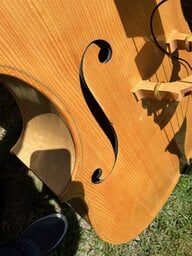
Ash has a rated density varying from 30 lb/ft^3 to 56 lb/ft^3 according to Engineering Toolbox.
With all this in mind, It would likely make sense that denser wood produces darker, tones while less dense wood would sound brighter, so a heavier bass will produce a different tone than a lighter bass if all the parameters between the two instruments is the same (or near-enough as makes no difference). Is it all clearly discernible by the human ear? ::shrug:: Most of the differences are likely between string type, tension, frets, fretless, fret height, fret-board density, bone type, bridge type, electronics, ad naseum. Still, the math is there.
Last edited: