Aside from you and your father's personal experience, anecdotal and empirical evidence, many others' have proven just the opposite. Your anecdotes are duly noted, but I wouldn't use those as expert opinions on this subject, but rather simply just what they are, personal experiences.
Left handed people are often able to adapt to opposite handed activities easier than the converse because their handedness is generally less predominant than right handed people. This is why it appears that the transition is so easy.
Django Reinhardt is a good example to refute your own argument. He was an accomplished banjo, guitar and violin player by the age of 18, when he suffered his injuries. His handedness was so predominant that he chose not to overcome this obstacle by changing hands. He could have easily held his pick in the gypsy style with his intact left thumb, index and middle fingers, but he didn't. Why? Probably because his musical mind/body language was so established at his young age that overriding that might have proven too large an obstacle to overcome.
I could relate many anecdotes from lefthanders who were taught and have played their instruments righthanded, but switched over to lefthanded play as adults, not because of injury, but because it felt better even after many years of playing righthanded. Nearly all of these anecdotes end with the players advancing their technique and creativity to a plateau far beyond their previous play, and in a short period of time.
Ray, I always read your posts carefully and have a lot of respect for your opinions because I think they carry a lot of weight. You have your opinions, but they are just that. When you put them up as the last word on the issue, they tend to lose their gravity. When you berate someone who is presenting cogent arguments to the contrary as delusional, your argument and opinion floats away.
IOW, chill dude.
Ditto on all the above. As far as the scientific studies go, they really show what is related by the posts in this thread, if you read them all. I have a degree in psychology and the following is a synopsis of what is known through scientific enquiry. It is probably true that more is known now than when I got my degree, but these were well established facts at the time and while more may be known now, it is highly unlikely that any of these conclusions have been reversed.
The brain is really two brains. There is a genetic disposition for one of them to be dominant. It could be either way, but for unknown evolutionary reasons, it is usually but not always the left brain that is dominant. As a way of insurance, evolution favoring redundant and highly adaptive creatures;- the left brain controls the right side of the body and the right side of the brain controls the left side of the body. So a right handed person is left brain dominant and vice versa or vers vica, whichever it happens to be. When we are young, neither side is good at anything physical. Over time, the dominant brain trains both sides to do specialized tasks. This conserves energy for the creature because something that one limb can do doesn't have to be learned by both sides. On the adaptive survival side, the possibility exists for the other side to learn the task if the primary limb is lost. It becomes more complex when tasks that require both the right and left limbs to co-operate are learned. So while handwriting exhibits "handedness" in nearly every case, piano playing or guitar playing and such do so to a lesser degree.
Another complication in making generalities is that the right brain and left brain are assymetrical in some important aspects, though not as far as physical control of the limbs is concerned. Specifically the right brain is more capable of abstract creative thought and the left brain is more reasonable in nature. There is some speculation as to whether the strumming plucking and timing action of the "right" hand is favored by left (logical) brain control and the melodic left hand function is favored by right (creative) brain control, but it is impossible to quantify and study these qualities scientifically, so much superstition is possible here.
As a person develops, and the most important thing to remember is that we are not static creatures, many things become possible once learning has started. It is possible for the logical side of the brain to tell the other side to take over the lost functions of a damaged limb. It is possible for the creative side of the brain to assume the dominant reasonable functions if the left side of the brain is damaged. To complicate matters even more, handedness and brain dominance is not always decisive. There are people who have no "dominant" brain. Between the extremes there are every shade of difference. Also, when considering motor skills specialization, it is certainly mostly a matter of experience. Consider pedal steel guitar;- the feet have to do as much as the hand. Is anyone who plays pedal steel right-footed? And what about bicycling? Could the feet learn to steer and shift and the hands to pedal? In a car the clutch is operated by the left foot. This definitely requires more finesse than braking. On a motorcycle the clutch is operated by the left hand. But once you learn to clutch, it doesn't much matter whether it is hand or foot that does it. Then try to switch it to the right side limbs. Oops. So you see it is not just which limb on which side does what, but also whether it is a hand or a foot on either side. While the anecdotal cannot be taken as applying to all cases, it does serve to show what is possible. For instance there are case studies of children who entered school with temporary disability in the right hand, such as a broken arm in a cast, who learned to write with their left hand, and remained left handed with respect to hand writing the rest of their lives. There are also countless example of those left handed individuals who forced themselves or were forced by teachers to learn to do things right handed and continued that way the rest of their lives. Will power is a very strong tool, and the human brain and body are highly adaptive by design.
My advice would be that if you are young and have never learned a stringed musical instrument, try it both ways and pick the way that seems easiest at first. If you have already developed some facility playing left-handed guitar or other instrument that involves stopping and plucking, then seek out a lefty DB. If you really want to play DB and are predisposed to do so left-handed, you can get a good instrument. It will always be rarer than right-handed ones, but tough stuff. It would be worse to subject yourself to something that impedes your progress and after all, no one can hear which hand is doing what and if you stick to the instrument, getting rid of it shouldn't be an issue.
As far as the instruments you mention, I have a DB from Gollihur (Kremona Bulgaria) and it is a fine instrument if it were twice the price he charges for it. I've seen one of those from Jim Laabs and I wouldn't trade my DB for ten of those. When you look at custom makers and professional luthierie, anything is possible. Or you can get a lefty Englehardt;- not so great a bass but dependable and not such a hefty investment. I think the Kremona is going to be a better value in any case, right or left.
Also, and this goes for Timo as well;- if you develop Edgar Meyer level chops no one is going to keep you out of an orchestra. Being left handed never slowed a determined and talented player down. If there is anything to be learned from Jimi Hendrix about handedness, that is it. There are guitarists who can play either instrument either way, orientation of the strings notwithstanding. But that doesn't make them a Jimi Hendrix. It just shows that with practice and perserverence handedness is just not a decisive element.

 to the traditionalists

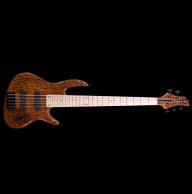
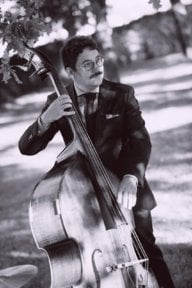
 To be honest, I don't think about my left-handedness very often, and nobody notices it.