• TalkBass has been independent since 1998. Add your voice.
    Create a free account to reply to discussions, view embedded media, and browse with fewer display ads.
    Join freeLog in
    Want zero display ads or expanded classifieds tools? Compare plans.

Lefty Fretless Jazz Bass

Third coat of paint...

E816FEA2-9DCD-4931-A82F-8298FC870D57_zpsjmpppuly.jpg


0286C06E-996F-4E89-BA31-D265B77552B9_zpsj02on9q5.jpg


D0D4C31F-C127-4249-A58B-C762E3D9F374_zpsx08l04iu.jpg


3560C456-1F91-4779-B210-2B5F2B486073_zpsagsmx32q.jpg


376C3FB1-7EC3-4AFD-8680-1A95312951CC_zpscp8owtab.jpg


I am now out of paint, so I'll have to purchase some more. Bummer that I'll have to put this on hold. There's some killer momentum with it right now. Oh well. That will just give me some to mess around with ideas for the headstock (logos, decals, etc.) and maybe actually play a little bass as well.
 
  • Like
Reactions: AGH and JIO
Is that supposed to be a textured finish? If not it looks like you have some pretty extreme orange peel. Its not a big deal as it should sand out easily, and being nitro, witness lines are no problem. But ill give you some free advice anyway. I am assuming it is pretty hot in your shop that you are spraying, so paint, especially nitro, has a tendency to flash off before it has a chance to flow out. Spraying with a gun, you can control this by adding lacquer retarder into the nitro. Since you are using rattle cans from reranch this isn't really an option. What I would do to get the finish to lay out better would be to spray a little closer to the body, and keeping your same hand speed, and fan overlap. The thinner the coat the more prone it will be to flash off. There is a fine line between not laying down enough finish, and getting runs in your paint job. Experience is the only teacher here.
 
  • Like
Reactions: JIO
Is that supposed to be a textured finish? If not it looks like you have some pretty extreme orange peel. Its not a big deal as it should sand out easily, and being nitro, witness lines are no problem. But ill give you some free advice anyway. I am assuming it is pretty hot in your shop that you are spraying, so paint, especially nitro, has a tendency to flash off before it has a chance to flow out. Spraying with a gun, you can control this by adding lacquer retarder into the nitro. Since you are using rattle cans from reranch this isn't really an option. What I would do to get the finish to lay out better would be to spray a little closer to the body, and keeping your same hand speed, and fan overlap. The thinner the coat the more prone it will be to flash off. There is a fine line between not laying down enough finish, and getting runs in your paint job. Experience is the only teacher here.
Thanks for the advice. This is definitely not supposed to be a textured finish, and as I paint this I keep thinking that at some point this will start looking smooth. It sounds like maybe this will not be the case if I keep spraying this way. I'm going for smooth as glass, if possible. I really don't know how heavily or lightly to apply the paint, and how much/hard to sand between coats. I figured that the paint would even-out as it is being sprayed on. I would say I probably am too far away from the body when painting, and I was under the impression that I was actually going at it too finely, as I am really trying to avoid paint runs. Do you think these are the causes for this texture so far? My strokes are pretty even, and I am doing overlapping. That said, I'm also a beginner so I don't have the deft spray touch yet.

I've got some time before painting again because I'm out of paint and need to reorder (I'll be doing that tonight); so how should I prepare myself and this body for the next coat? How much do I need to sand back? What level of smoothness am I shooting for here?
 
Thanks for the advice. This is definitely not supposed to be a textured finish, and as I paint this I keep thinking that at some point this will start looking smooth. It sounds like maybe this will not be the case if I keep spraying this way. I'm going for smooth as glass, if possible. I really don't know how heavily or lightly to apply the paint, and how much/hard to sand between coats. I figured that the paint would even-out as it is being sprayed on. I would say I probably am too far away from the body when painting, and I was under the impression that I was actually going at it too finely, as I am really trying to avoid paint runs. Do you think these are the causes for this texture so far? My strokes are pretty even, and I am doing overlapping. That said, I'm also a beginner so I don't have the deft spray touch yet.

I've got some time before painting again because I'm out of paint and need to reorder (I'll be doing that tonight); so how should I prepare myself and this body for the next coat? How much do I need to sand back? What level of smoothness am I shooting for here?


How many coats do you have on it now? You can probably sand it level with block and 400 grit, just be careful not to cut past your color coat. I would say you would benefit from a slightly heavier coat, personally I would rather sand out a random run or sag than an entire body worth of orange peel.
 
  • Like
Reactions: JIO
How many coats do you have on it now? You can probably sand it level with block and 400 grit, just be careful not to cut past your color coat. I would say you would benefit from a slightly heavier coat, personally I would rather sand out a random run or sag than an entire body worth of orange peel.
It's got "three coats" on it; and I say that with quotation marks because they're pretty wimpy coats. I think I am painting from too far away for fear of runs and applying too heavily, so little paint is settling. I'll buy another couple cans of this stuff, then go at it a little more aggressively.

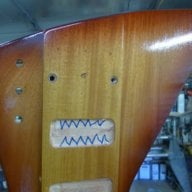
I sanded back a small area on the front of the body around the pot holes, and I think I got it to the smoothness required before applying the next coat. It was hard to capture in an image because of the available lighting.

Do I understand correctly that you want to sand the surface this smooth between each coat? If this is the case then I certainly need to apply thicker coats because if I sand smooth, then I see earlier layers — instead of just smoothing out the topmost layer that I just sprayed. Do I use 400 dry or wet? I used a dry sand here and it worked, but it seemed a little too aggressive.
 
It's got "three coats" on it; and I say that with quotation marks because they're pretty wimpy coats. I think I am painting from too far away for fear of runs and applying too heavily, so little paint is settling. I'll buy another couple cans of this stuff, then go at it a little more aggressively.

I sanded back a small area on the front of the body around the pot holes, and I think I got it to the smoothness required before applying the next coat. It was hard to capture in an image because of the available lighting.

Do I understand correctly that you want to sand the surface this smooth between each coat? If this is the case then I certainly need to apply thicker coats because if I sand smooth, then I see earlier layers — instead of just smoothing out the topmost layer that I just sprayed. Do I use 400 dry or wet? I used a dry sand here and it worked, but it seemed a little too aggressive.

At this stage I would use 400 dry on a block. You don't need to get it totally smooth yet, you just want to knock the highest spots down. Using nitro in a rattle can, I would put at least 5 color coats and another 8-10 clear coats on top of that. With nitro each layer burns into the next so sanding into a previous layer isn't a problem. It wont leave witness lines like a poly finish.
 
  • Like
Reactions: Brett Zeppelin
At this stage I would use 400 dry on a block. You don't need to get it totally smooth yet, you just want to knock the highest spots down. Using nitro in a rattle can, I would put at least 5 color coats and another 8-10 clear coats on top of that. With nitro each layer burns into the next so sanding into a previous layer isn't a problem. It wont leave witness lines like a poly finish.
Thanks for the advice. Now when you say "highest spots" I think this is where I am likely not interpreting correctly. The overall "feel" of the coat of paint is even and smooth; it's just that it's not totally smooth because it has all the speckle all over it and not an even sheen of paint. I don't really have any spots that are higher than others per se, except for the tiny spots between the speckles.

I am more than happy to sand and work on this thing as much as I need to in order to get it right. I just won't have it any other way. I'm certainly not one to take shortcuts and I don't plan to do it here, so if that means I need to sand to a specific finish before spraying the next coat, I'm totally willing.
 
The best lacquer coat is the one that stops just short of running...and knowing where that is requires overdoing it at least once.
Thank you for your input as well. I have a feeling this statement is more profound than most people realize! I have been going at this thing so conservatively that I think that has been my problem thus far. It sounds like I need to just grow a pair and shoot this thing like I mean it.
 
On a better monitor I see the orange peel Hopkins mentioned. Still doesn't look all that bad.

I say he's got the right advice re-sanding and additional coats.
It's all good. I hope that with the advice of these pros, I will get to an end result that will make me happy with the final bass. I am confident that I will get this thing right, because I simply do not have a "well, I guess that's good enough" mentality.

There's been another member of this forum who I've been e-mailing outside of the forum and he's been super-helpful as well. You know who you are so feel free to reveal yourself and claim your props! (I don't want to put you on the spot, though!)
 
Thanks for the advice. Now when you say "highest spots" I think this is where I am likely not interpreting correctly. The overall "feel" of the coat of paint is even and smooth; it's just that it's not totally smooth because it has all the speckle all over it and not an even sheen of paint. I don't really have any spots that are higher than others per se, except for the tiny spots between the speckles.

I am more than happy to sand and work on this thing as much as I need to in order to get it right. I just won't have it any other way. I'm certainly not one to take shortcuts and I don't plan to do it here, so if that means I need to sand to a specific finish before spraying the next coat, I'm totally willing.

An orange peeled finish will have small ripples in the finish, by sanding your are slowly removing the tops of those ripples. Lightly sanding and respraying knocks the highest points of the orange peel down, so you fill in the low spots while removing the high spots. In the end it results in an even finish. Once you get enough coats applied, you can start sanding more finish off to get it dead flat. Then you start working your way up through the grits, wet sanding until you get to 2000 grit then you can buff it out to a mirror finish. The main thing you don't want to do is to sand down to bare wood.
 
  • Like
Reactions: JIO
Thank you for your input as well. I have a feeling this statement is more profound than most people realize! I have been going at this thing so conservatively that I think that has been my problem thus far. It sounds like I need to just grow a pair and shoot this thing like I mean it.

Thanks! Yeah, I'd block sand dry with 320 white Aluminum Oxide paper to the point of going thru what's on there already to get it dead flat before shooting any more paint. That's better than shooting and sanding, shooting and sanding IMO.

With nitro lacquer once I get an absolutely flat surface with no wood coming through I don't sand any more. I just build paint since each coat melts into the previous ones. If absolutely necessary scuff sand with 400 between coats

The proof is in the pudding...
0042frontback.jpg
 
  • Like
Reactions: JIO
An orange peeled finish will have small ripples in the finish, by sanding your are slowly removing the tops of those ripples. Lightly sanding and respraying knocks the highest points of the orange peel down, so you fill in the low spots while removing the high spots. In the end it results in an even finish. Once you get enough coats applied, you can start sanding more finish off to get it dead flat. Then you start working your way up through the grits, wet sanding until you get to 2000 grit then you can buff it out to a mirror finish. The main thing you don't want to do is to sand down to bare wood.
Thanks! Yeah, I'd block sand dry with 320 white Aluminum Oxide paper to the point of going thru what's on there already to get it dead flat before shooting any more paint. That's better than shooting and sanding, shooting and sanding IMO.

With nitro lacquer once I get an absolutely flat surface with no wood coming through I don't sand any more. I just build paint since each coat melts into the previous ones. If absolutely necessary scuff sand with 400 between coats

The proof is in the pudding...
0042frontback.jpg
Hopkins: thanks. I will start knocking this stuff back a little, and then proceed. I'll sand and see if I can capture an image later this evening.

Dadagoboi: that is the pudding that I want. Yum!

Both (and/or others who want to chime-in): should I start thinking about buying an actual paint sprayer instead of doing the rattlecan thing? There are some sprayers for sale right now on my local Craigslist, and I'm thinking that I might be at a little bit of a crossroads here where I could either go buy something like that, or continue with rattlecans. Can one get by with the airless paint sprayers or are those not good enough? There is one ad up right now and the seller is asking $150 for it. I figure if the system is proper for guitar painting, it would be worth trying to get it for maybe $100ish.

One of the ones on Craigslist is the Wagner Paint Crew 770, like this. I was thinking, though, that I might be better off with one that has either a smaller hopper or no hopper at all, and has a glass container directly attached to the gun/nozzle assembly, like this one. I am probably using terrible terminology, so I apologize for that.

Please also keep in mind that these questions come from a total novice, so I'm just doing my best to attain all of the knowledge that I can during this process.
 
As an Amazon Associate, TalkBass may receive commissions from qualifying purchases made via links on this site.
Those airless sprayers aren't really made for fine finishing. They are more designed to spray heavier paint like exterior latex for painting housed or fences. I use a HVLP gravity feed cup gun, but I also have a decent compressor that flows 7cfm at 90 psi, which I would say is bare minimum. I plan on a larger compressor in the future.

Something that my be a good investment is one of the turbine powered HVLP spray stations.
http://www.woodcraft.com/Product/2083184/33566/Earlex-Spray-Station-HV5500-HVLP.aspx
 
Those airless sprayers aren't really made for fine finishing. They are more designed to spray heavier paint like exterior latex for painting housed or fences. I use a HVLP gravity feed cup gun, but I also have a decent compressor that flows 7cfm at 90 psi, which I would say is bare minimum. I plan on a larger compressor in the future.

Something that my be a good investment is one of the turbine powered HVLP spray stations.
http://www.woodcraft.com/Product/2083184/33566/Earlex-Spray-Station-HV5500-HVLP.aspx
Cool. Thanks. That looks kind of like a standalone kit that doesn't require an air compressor, which is kind of nice.

What makes the ones I linked inferior as far as how they apply the paint? Are they used more to just cover large areas and not have fine control?

Are there any slightly more budget options that I could consider? It looks like Earlex has quite a few products in this vein, but I don't know what I'm looking for in terms of specifications.
 
Cool. Thanks. That looks kind of like a standalone kit that doesn't require an air compressor, which is kind of nice.

What makes the ones I linked inferior as far as how they apply the paint? Are they used more to just cover large areas and not have fine control?

Are there any slightly more budget options that I could consider? It looks like Earlex has quite a few products in this vein, but I don't know what I'm looking for in terms of specifications.


Yeah, an airless sprays a lot of paint with a large fan pattern, they are designed for finishes with a much thicker consistency. Earlex does make a less expensive product, but to be completely honest I have never used one of those HVLP systems. I just presented it as a less expensive option than a compressor/spray gun set up.
 
I have a lot of experience using large compressors, pro spray booths, and $400 USA made spray guns. But I know how to get by with a lot less.

For me the minimum is a decent quality 220V single phase 5HP compressor with 20 gallon tank. It will supply plenty of CFM at 40 PSI at the gun. Any higher PSI and you're spraying lacquer all over your shop. I found a used one for $125 on CL.

For guns I use Harbor Freight siphon feed cup guns with 1.6mm nozzles, currently on sale for $22, usually around $30.
Invalid Link Removed

Perfectly adequate for spraying lacquer, both nitro and acrylic. They also shoot polyester catalyzed primer surfacer. I'll never use grain filler/spackle again.

Add another $100 for hoses, connectors and a filter/regulator and you're in business.
 
@Hopkins, @Dadagoboi — thank you both for your awesome input and insight for this project. It is really appreciated. It looks like in order to get something adequate for painting a guitar body, I'm looking at $400 pretty easily to get started. That sounds pretty reasonable, and I can probably make my money back on that fairly quickly when you factor in the time I'll be saving.

For me the minimum is a decent quality 220V single phase 5HP compressor with 20 gallon tank. It will supply plenty of CFM at 40 PSI at the gun. Any higher PSI and you're spraying lacquer all over your shop. I found a used one for $125 on CL.
Would a lower-HP compressor work well? There are a few options on my local CL, but nothing in a 5HP flavor; most are 2HP/3HP. I found one that is a 2HP with a 4-gallon tank.