
The danger is over thinking this and forgetting to play. Marcus Miller made thousands of recordings with a glaring dead spot on his Jazz... says he just worked around it as the bass overall was too good to change just because it had a dead spot.

Enjoy the benefits of a premium membership!
Upgrade Account
-
TalkBass has been independent since 1998. Add your voice.
Create a free account to reply to discussions, view embedded media, and browse with fewer display ads.
Join free Log in
Want zero display ads or expanded classifieds tools? Compare plans.
You are using an out of date browser. It may not display this or other websites correctly.
You should upgrade or use an alternative browser.
You should upgrade or use an alternative browser.
Lets all try to find a criteria for perfect bass neck without any dead spots (4-String only) !!!
- Thread starter Kinetic Bass
- Start date
More options
Who Replied?

We live in a weird age where social media amplifies obsession with minor discomforts and inconveniences.
I’m glad I came up in a world where these things were just tiny hurdles you figured out and moved on to the actual activity:
Playing, composing for, performing and recording bass instruments.
Clouds yelled at, checklist complete.
I’m glad I came up in a world where these things were just tiny hurdles you figured out and moved on to the actual activity:
Playing, composing for, performing and recording bass instruments.
Clouds yelled at, checklist complete.

Might as well try to find the criteria for a perfect world. There’s no such thing.

We live in a world of perfection, its just most of us don’t notice it. Your breaks in your car work 100% of the time, not 90%, there is no ”I can work around that”, we already had that approach a century ago with high fatality rates on the roads.
Your bass electronics are also 100% perfect; each time you pluck a string, an amplified sound comes out 100% of the time not 90% of the time.
Everything around us today from technology point of view represents perfection and we strive for perfection, that’s how we got here, if not we would not be here, we would live like animals without electricity, shelter or food or music or bass guitars.
Leo produced the perfect looking instruments, not perfect playing but perfect looking.
Even a 12 year old can tell what is a dead spot or half dead spot, since we are not comparing one neck against the the other, you are comparing a good note on your neck vs. a bad note or weak note on the same neck, which is easy to tell.
There are plenty of Fender bases out there with perfect necks and no dead spots, people simply hold on to them and never sell them, will they post pictures of them, well you guys never gave it a chance, and dismissed everything from the start.
It’s time to close this thread.
Cheers.
Your bass electronics are also 100% perfect; each time you pluck a string, an amplified sound comes out 100% of the time not 90% of the time.
Everything around us today from technology point of view represents perfection and we strive for perfection, that’s how we got here, if not we would not be here, we would live like animals without electricity, shelter or food or music or bass guitars.
Leo produced the perfect looking instruments, not perfect playing but perfect looking.
Even a 12 year old can tell what is a dead spot or half dead spot, since we are not comparing one neck against the the other, you are comparing a good note on your neck vs. a bad note or weak note on the same neck, which is easy to tell.
There are plenty of Fender bases out there with perfect necks and no dead spots, people simply hold on to them and never sell them, will they post pictures of them, well you guys never gave it a chance, and dismissed everything from the start.
It’s time to close this thread.
Cheers.
Few things are perfect. Brakes grab when cold, fade when hot.
Mic drop your perfection all ya want, peace be with you.
Mic drop your perfection all ya want, peace be with you.

- Jun 30, 2010
- 49,582
- 221,920
- Disclosures
- musician/artist/owner - Gildaxe
Apparently uprights also have 'dead spots'...Interesting. So what about uprights? I have never heared of this brought up in that context. Nor experienced it myself. Sorry for the, er, deadspost.

I have five Fender shaped necks. From 1962 Jazz that the neck at the nut is as small as a two year old girl’s wrist, to My MIM 50s Classic P 1.75” nut chunky monkey, and a couple of Squiers. All have dead spots and guess what? They’re all on The D and all around the 7th fret. Some sixth some seventh. One is at both seventh and eighth slightly.
My Gibson ‘75 G3, 2+2 head, has a restrained note in the same place. My Jack Casady also has a a weak note in the same area.
Explain that.
When playing whole notes held for full bars or longer on the seventh fret of my D strings, it’s a real issue….. almost never. Nay, never. YMMV. Good luck with your quest.
My Gibson ‘75 G3, 2+2 head, has a restrained note in the same place. My Jack Casady also has a a weak note in the same area.
Explain that.
When playing whole notes held for full bars or longer on the seventh fret of my D strings, it’s a real issue….. almost never. Nay, never. YMMV. Good luck with your quest.
Last edited:
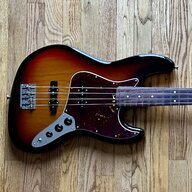
If someone thinks their wood neck doesn't have any "dead spots," they aren't paying attention.
Regardless, starting with photos of grain patterns is as useful as starting with color of the finish. There's a reason people that understand physics (like many posters in this thread) aren't confused by dead spots.
Regardless, starting with photos of grain patterns is as useful as starting with color of the finish. There's a reason people that understand physics (like many posters in this thread) aren't confused by dead spots.
Dead spots are a function of shape structure. All bass necks with a standard shape have a dead spot, and always will, no matter the material, the kind of trusrod, strip reinforcements, etc. A different neck shape, like a conical and twisted shape, eliminates dead spots. My bass is like that and doesn't have any..Can we try an experiment to see if a clear and defined pattern will develop or not and we wasted time here.
For those of us shopping online or looking for that perfect sounding J or P or PJ bass with a neck without any dead spots on it and balanced sustain. The only thing to look for is the wood grain of the neck if we can't play it, maybe there is a specific grain pattern that is bullet proof on neck without any dead spots and balanced sustain.
Lets narrow down the criteria to these only:
1) Fender 34” 4-string, must be one-piece neck only, maple neck only, could be quarter or flat sewn, head stock shape must be Fender or Fenderish with inline tuning matching Fender dimensions only.
2) 4-Bolt square classic heel pattern only.
3) Carbon fiber or metal rods are optional, since vintage stuff never had any.
4) Anything painted where we can’t see the grain even the head stock does not apply we need to see pictures of grain head to toe on all 4 sides.
5) Fat finger does not apply, lets leave it out.
6) Tuning pegs do apply, if you found a specific grain pattern that has dead spots but each time you change to heavier or lighter ones or different alloy tuners adn no more dead spots then it’s an optional component to look for that grain, but not a deal breaker, we are still focusing on grain orientation as primary pattern.
7) Truss rod in the heel or head stock does apply for sure 100%.
8) Fingerboard: Ebony, Maple, some version of Rosewood all apply, no exotics, and no flames or curly woods.
9) Thickness of fingerboard does apply as secondary component, so lets make the standard at 5mm, if it’s thicker, lets see if a pattern will develop with thicker fingerboards vs. neck grain.
10) Neck shape, thickness or radius does not apply, even though it does have a huge effect, we’ll focus on neck shape later and only if we arrive at any specific grain as bullet proof.
11) Neck dive does not apply.
12) No boutique basses either except Fender Custom Shop, must be mass-produced where they don't sit on perfect wood blanks for 10 - 20 years,
13) Lawsuit years do apply, kits under license from Warmoth…etc.. Do apply as well if they match all criteria.
No scientific discussions please, it will steer us into wrong direction in arguing too much what does effect dead spots, lets only focus on people posting their perfect necks with at least 4 pictures of each side with enough close ups on all 4 sides from head to toe, mounted or un-mounted necks, so we can breeze thru many pages of pictures to see if we can narrow it down to some type of grain pattern or not.
Please post pictures only if your neck is well balanced tonally and not even a single sign of dead spots, or even half dead spot, lets keep the threshold very high on this exercise.
As a side bet, I would start with two possible soft targets that we might find useful as reference point, one with straight line grain, very hard to find those unless it’s Fender Custom shop, and second soft target is one with zig-zag tree pattern in the middle, much easier to find especially with vintage stuff. Both examples are attached.
Lets also focus a bit more on grain orientation around D & G string portion of the neck since it’s the most common area for dead spots.
Attachments
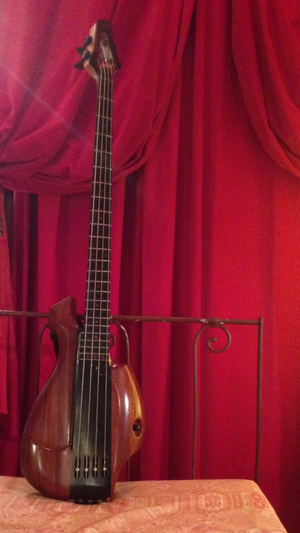
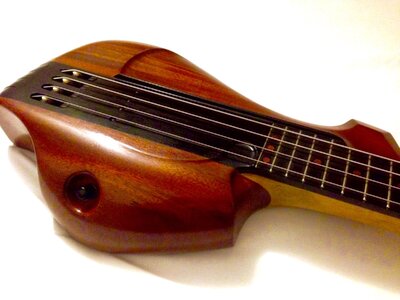
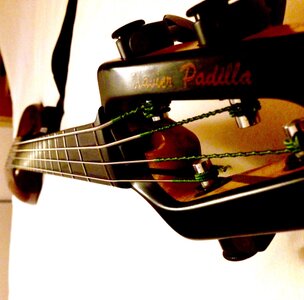
I took a bass to what everybody said was a good repairman working at a local music store. He was mainly a guitar player. He said he couldn't hear any dead spots. He was playing through a solid state guitar practice amp with a 6 inch speaker.
I think we need to define how to identify a dead spot. To me it's an area on the neck where the fundamental frequency of a note is absorbed by some resonance in the neck or body of the bass. Notes played it that position have very little sustain compared to the same note played on a different string. There might be dead spots where higher harmonics die away quickly, but I've never found one that wasn't a worn fret problem.
I think we need to define how to identify a dead spot. To me it's an area on the neck where the fundamental frequency of a note is absorbed by some resonance in the neck or body of the bass. Notes played it that position have very little sustain compared to the same note played on a different string. There might be dead spots where higher harmonics die away quickly, but I've never found one that wasn't a worn fret problem.

Didn't a certain Mr Kubicki get rid of the dead spots on the fender headstock, by removing it?


Scientific measures and arguments must come after we collect data points, I’m not ignoring science, 99% of participants have no background on this subject matter nor they should have, all we need is to find matches, if 5-10 people post images with good necks and we see some close resembles on grain pattern it's already enough to get the ball rolling and shift to second phase looking at neck shape and thickness of these matches. The key is not to get scientific too early in the process., because people are impatient and no one wants to read thru 10 pages of scientific arguments before hand, leave them to the later stages.
This is an experiment nothing more then that, so treat it with simplicity that’s why I narrowed it down to more simple data points.
It sounds like you just want folks to post pictures of necks (that have little or no dead spots) with different 'grain patterns'.

(and ignore other factors that contribute to dead spots).
Maybe I'm way off. It's early and just started my coffee.

T$


I stopped reading here.No scientific discussions please,
Scientific discussions are what you SHOULD be talking about exclusively regarding this topic.



I must be a bit too sensitive to dead spots: I almost feel a bass is defective with them / it. Of course there are varying degrees of deadness.
From this thread and others it seems there are criteria for reducing such problems. Disregarding a fingerboard for a moment, the neck wood requires to have increased stiffness. This can be achieved by,
1) Using quarter sawn timber.
2) Laminating timbers as part of the neck.
3) Using graphite / carbon fibre rods set into the neck timber (rather than metal rods, to keep weight down).
4) Using a neck profile that adds timber. Eg. Using a, U shape or D shape might be preferable to a C shape.
I’m sure 1) through 3) would add cost, whilst 4 might reduce playing speed (for those who like that sort of thing).In summary, would those points not make an excellent start in building a good neck - for use on the best, most expensive models?
Thought I now play Hofners - due to weight considerations - I still feel best playing Fenders. With that in mind, I can’t understand why my 2017 American Elite Precision has a fairly naughty dead spot in the usual place. If it’s elite, it ought to be the best Fender can make. But, no. I can’t help thinking they took no more trouble with timber selection and neck construction than any other Precision. I may be wrong of course!
Fender doesn’t do laminated necks as far as I know, but they could try it!
John. UK
From this thread and others it seems there are criteria for reducing such problems. Disregarding a fingerboard for a moment, the neck wood requires to have increased stiffness. This can be achieved by,
1) Using quarter sawn timber.
2) Laminating timbers as part of the neck.
3) Using graphite / carbon fibre rods set into the neck timber (rather than metal rods, to keep weight down).
4) Using a neck profile that adds timber. Eg. Using a, U shape or D shape might be preferable to a C shape.
I’m sure 1) through 3) would add cost, whilst 4 might reduce playing speed (for those who like that sort of thing).In summary, would those points not make an excellent start in building a good neck - for use on the best, most expensive models?
Thought I now play Hofners - due to weight considerations - I still feel best playing Fenders. With that in mind, I can’t understand why my 2017 American Elite Precision has a fairly naughty dead spot in the usual place. If it’s elite, it ought to be the best Fender can make. But, no. I can’t help thinking they took no more trouble with timber selection and neck construction than any other Precision. I may be wrong of course!
Fender doesn’t do laminated necks as far as I know, but they could try it!
John. UK

Uprights have fairly short, thick necks, and the other end of the string is attached to a huge, flexible structure - in an electric solid body instrument, the body is essentially solid, and contributes only negligible effects in the area of dead spots - the neck is the source of dead spots. In an upright, the neck is not the issue - the body is.Interesting. So what about uprights? I have never heared of this brought up in that context. Nor experienced it myself. Sorry for the, er, deadspost.
Laminating wood strips make a neck less prone to warping and twisting over time. It does not affect the stiffness in a significant way, unless there is significant runout in the wood, and then it reduces stiffness. With straight grain, laminating does nothing for you stiff ness wise. The extra glue adds some damping, but not a lot.I must be a bit too sensitive to dead spots: I almost feel a bass is defective with them / it. Of course there are varying degrees of deadness.
From this thread and others it seems there are criteria for reducing such problems. Disregarding a fingerboard for a moment, the neck wood requires to have increased stiffness. This can be achieved by,
1) Using quarter sawn timber.
2) Laminating timbers as part of the neck.
3) Using graphite / carbon fibre rods set into the neck timber (rather than metal rods, to keep weight down).
4) Using a neck profile that adds timber. Eg. Using a, U shape or D shape might be preferable to a C shape.
I’m sure 1) through 3) would add cost, whilst 4 might reduce playing speed (for those who like that sort of thing).In summary, would those points not make an excellent start in building a good neck - for use on the best, most expensive models?
Thought I now play Hofners - due to weight considerations - I still feel best playing Fenders. With that in mind, I can’t understand why my 2017 American Elite Precision has a fairly naughty dead spot in the usual place. If it’s elite, it ought to be the best Fender can make. But, no. I can’t help thinking they took no more trouble with timber selection and neck construction than any other Precision. I may be wrong of course!
Fender doesn’t do laminated necks as far as I know, but they could try it!
John. UK
Graphite rods do add stiffness, but they also add mass. Carbon fiber, while much lighter than steel, is 3x the density of maple.
Quarter sawn timber and flat sawn do not vary in stiffness from each other to any significant degree. Wood is more isotropic, at least along the grain direction, than people think it is. Across the grain, it's far different, but again if you have straight grain (necks have to be made from straight grain to work well at all) , the sawing direction doesn't affect the stiffness. They do warp differently. A flat sawn neck is likely to "cup", which means it will change radius (by a negligible amount) in a bass neck - with the right measuring gear, you might be able to measure a change, but you'd never notice it playing a bass neck. Quarter sawn lumber is very useful in places where you want a wide, flat piece of lumber that will stay flat - a big table, for example. Bass guitar necks are not really a place where there's a real performance advantage to having quarter sawn lumber - the fact that quarter sawn is more expensive (making is is more wasteful than plain sawn) kinda carries over into making is desired, but that's not really a rational desire. Fender made many early basses which today have a very high perceived amount of "mojo", using flat sawn lumber for their necks.
The one thing not covered here that helps quite a lot is reducing the length of the neck. I have a short scale that has a conversion neck - the amount of cantilever is much shorter than a standard 34 inch scale, 20 or 22 fret neck. It's 1 3/4 inch wide at the nut (big for a 4 string neck), but it's plain maple, no graphite reinforcement, not roasted. Compared with my 34 inch scale 5 string necks, which are roasted, and have graphite rods, it's even more free of reduced sustain areas - my 5's are very good at managing that, but the short scale is remarkably free of noticeable sustain differences - it is objectively my "best neck" in terms of evenness of response.
Last edited:
Not 100% on topic, but the more basses I try, the more I'm convinced that:
- you CAN have a bass free of DEAD spots (as in, completely dead spots), but never, no matter the material and construction, you will have a neck where each and every note is completely consistent. To picky people (like me), these weaker spots can be quite evident and annoying, while others (most people, I'm sure) will declare that their bass has no dead spots whatsoever
- Corollary to the previous statement: everything has a trade-off, there's no free lunch. Maybe you can find a bass that is extremely consistent in the infamous C-D# area on the G string (frets 5-8), but this could mean that, if you are really willing to look for them, there could be weaker spots in potentially more troublesome areas, like on the first positions on the E, A or D strings. This, in my experience, has been the case in many short scale basses, where the G string is perfect, but the trade-off is a weaker spot maybe on the 5th fret of the E string. Many years ago I had a Stingray that had a completely dead G (3rd fret) on the E string
- With that being said, I'm becoming less and less worried about weaker spots on frets 6-8 on the G string, if this means that every note has a consistent decay on more useful parts of the neck
Anyway, here's another trick to potentially eliminate dead spots on a traditional 4 string Fender style neck: tune BEAD
- you CAN have a bass free of DEAD spots (as in, completely dead spots), but never, no matter the material and construction, you will have a neck where each and every note is completely consistent. To picky people (like me), these weaker spots can be quite evident and annoying, while others (most people, I'm sure) will declare that their bass has no dead spots whatsoever
- Corollary to the previous statement: everything has a trade-off, there's no free lunch. Maybe you can find a bass that is extremely consistent in the infamous C-D# area on the G string (frets 5-8), but this could mean that, if you are really willing to look for them, there could be weaker spots in potentially more troublesome areas, like on the first positions on the E, A or D strings. This, in my experience, has been the case in many short scale basses, where the G string is perfect, but the trade-off is a weaker spot maybe on the 5th fret of the E string. Many years ago I had a Stingray that had a completely dead G (3rd fret) on the E string
- With that being said, I'm becoming less and less worried about weaker spots on frets 6-8 on the G string, if this means that every note has a consistent decay on more useful parts of the neck
Anyway, here's another trick to potentially eliminate dead spots on a traditional 4 string Fender style neck: tune BEAD
Thanks for your comments, micguy. Maybe my little list of good things to do for a bass neck is not all that good after all!Laminating wood strips make a neck less prone to warping and twisting over time. It does not affect the stiffness in a significant way, unless there is significant runout in the wood, and then it reduces stiffness. With straight grain, laminating does nothing for you stiff ness wise. The extra glue adds some damping, but not a lot.
Graphite rods do add stiffness, but they also add mass. Carbon fiber, while much lighter than steel, is 3x the density of maple.
Quarter sawn timber and flat sawn do not vary in stiffness from each other to any significant degree. Wood is more isotropic, at least along the grain direction, than people think it is. Across the grain, it's far different, but again if you have straight grain (necks have to be made from straight grain to work well at all) , the sawing direction doesn't affect the stiffness. They do warp differently. A flat sawn neck is likely to "cup", which means it will change radius (by a negligible amount) in a bass neck - with the right measuring gear, you might be able to measure a change, but you'd never notice it playing a bass neck. Quarter sawn lumber is very useful in places where you want a wide, flat piece of lumber that will stay flat - a big table, for example. Bass guitar necks are not really a place where there's a real performance advantage to having quarter sawn lumber - the fact that quarter sawn is more expensive (making is is more wasteful than plain sawn) kinda carries over into making is desired, but that's not really a rational desire. Fender made many early basses which today have a very high perceived amount of "mojo", using flat sawn lumber for their necks.
The one thing not covered here that helps quite a lot is reducing the length of the neck. I have a short scale that has a conversion neck - the amount of cantilever is much shorter than a standard 34 inch scale, 20 or 22 fret neck. It's 1 3/4 inch wide at the nut (big for a 4 string neck), but it's plain maple, no graphite reinforcement, not roasted. Compared with my 34 inch scale 5 string necks, which are roasted, and have graphite rods, it's even more free of reduced sustain areas - my 5's are very good at managing that, but the short scale is remarkably free of noticeable sustain differences - it is objectively my "best neck" in terms of evenness of response.
I’ve a Takamine TB10 which has a really thick neck (34” scale). That bass seems remarkably free of note-sustain issues. Likewise, my Am Dlx Jazz 5 (2004) is pretty free, and I put that down to the extra timber in the wider neck.
As to short scale basses, I have six Hofners. The four, 500/1 - two German, two HTC - have quite chunky necks and are largely free of issues. The two Verithin basses (HTC) have slight problems but their necks are thinner than the ‘Beatle’ basses.
Due to neck, back, hand issues I much prefer the Hofners even though I’m not a huge fan of the violin body shape. For all other reasons they are lovely to play and the Verithin especially fits me like a glove.
John


