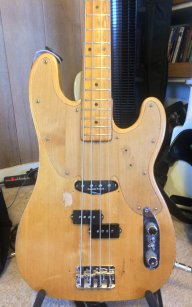
I bought a Gibson Grabber in 1975, the one with the sliding pickup. It was a decent bass (I really wanted the Ripper but couldn't afford it) but I chuckled when Gibson reissued them recently for big $$. They were never that great!

TalkBass has been independent since 1998. Add your voice.
Create a free account to reply to discussions, view embedded media, and browse with fewer display ads.
Join free Log in
Want zero display ads or expanded classifieds tools? Compare plans.
It was, but it was also posed in a way of saying "Why would you buy a vintage bass, it's not worth it." At least that's what I got from it.

It wasn't. The question I asked was in the spirit of " putting aside collectability,mojo, value, price -- if vintage was inherently better than modern."
If one reads the entire thread, there have been plenty of satisfactory answers, if, of course, we can take out the countless references once again to collectability, price and mojo (although a couple of folks explained mojo is a legitimate and applicable quality).
In 1957 a P-Bass would set you back $220 (over $1800 inflation-adjusted). According to US Census data, average household income was $3600 in 1957 (about $31,000 inflation-adjusted). Make no mistake: these were very much luxury items.Here is the problem I have with vintage instruments. They were once working-class-accessible music tools bought by young rockers who used them to craft the rebellious youth movement known as rock'n'roll.
Sorry, but that just sounds like sour grapes.Now these same instruments are being bought by rich old dudes as music room trophies and financial status symbols.
I'm not sure how this is relevant since we were talking about real vintage instruments...not modern relics. But since you've brought it up, the first relic guitar made by the Fender Custom Shop was done at the special request of Keith Richards. Is he "so un-rock'n'roll it hurts" in your book?Guitars are faked as relics to give them a false sense of authenticity. That is so un-rock'n'roll it hurts, and the whole scenario is a cultural travesty.
Now that's just sillySo keep your romanticized, mythologized, price-inflated vintage basses and guitars, old wealthy dudes. Those cool old guitars are all tainted by your money and lies now. They're dead to me.

So you're upset that what was once cheap is now expensive? I'm not sure I understand your point. The once cheap instruments are obviously worth more to other people than they are to you... But you still want them to be cheap because they are the same instruments they were back when they were cheap? I honestly can't figure out what you mean.
On the other hand, music stores are in business to make money, if you want top dollar for your used gear, never sell it to a music store, the market pays what it will bear and the only way to make prices come down is if people stop buying, nobody owes it to you to price what they have for sale to your liking when they have other buyers interested, and if you don't like the prices, you are free to move on and buy something else.
BAM! Salvo that

14 pages in less than 48 hours... Nothing resolved...
To quote the Beatles. " You say you want a resolution " This is Talkbass nothing ever get resolved here.
It wasn't. The question I asked was in the spirit of " putting aside collectability,mojo, value, price -- if vintage was inherently better than modern."
If one reads the entire thread, there have been plenty of satisfactory answers, if, of course, we can take out the countless references once again to collectability, price and mojo (although a couple of folks explained mojo is a legitimate and applicable quality).
Yeah, I hear you. I think it's impossible to have clear, absolute guidelines when dealing with objects that people put emotions into. The opposite effect can be seen in 70s Fenders, where people's hatred of Fender in that era have caused many to overlook very fine instruments on their belief that all 70s Fenders are crap. Since we're not dealing with commodities but with instruments that people love/hate/fantasize about, there is no rational way to quantify actual value or worthiness of musical instruments.I'm talking about the lack of absolutes and the Humpty-Dumpty world we seem to have fallen into where a word (or instrument quality/value) when used means what Humpty
(or some demographic) wants it to mean. It's like, "This bass is worth this much because *I* say it is," and most of the "I's" in question have a profit-based conflict of interest. It's not a question of cheap vs. expensive; it's more like a questioning of the "evaluating" process whereby formerly marginal product now is desirable/collectible . . . based on what? Anybody know of a checklist whereby vintage value of an instrument is assessed? Not referencing condition of a specific instrument, but what makes
that make and model collectible (especially now, if it was not before.
To try to parse out your last sentence: it is of no concern to me whether they are cheap now, or expensive, since I am not in the market for any of them. I'm out of buying mode. I want to know the underlying rationale for the elevation of status in instruments which for long were not even blips on the radar screen. (Whether the long-term
labeled "vintage" instruments are worth the prices being asked for them now is another question I'm not addressing here.)
If we're discussing vintage basses, doesn't that automatically 'limit' the samples?Then you might want to limit your sample to certain brands. Given the number of really bad entry-level instruments in the sixties as compared to the entry instruments today, I don't think any case can be made that vintage is inherently better. It certainly is not more consistent.
Yeah, I hear you. I think it's impossible to have clear, absolute guidelines when dealing with objects that people put emotions into. The opposite effect can be seen in 70s Fenders, where people's hatred of Fender in that era have caused many to overlook very fine instruments on their belief that all 70s Fenders are crap. Since we're not dealing with commodities but with instruments that people love/hate/fantasize about, there is no rational way to quantify actual value or worthiness of musical instruments.
If we're discussing vintage basses, doesn't that automatically 'limit' the samples?



To Bass Northwest's credit, they described every bass they had, regardless of age, price, or condition as having a "real sleek, fast, feel". Wasn't quite as annoying as The Boutique Bass Guitar Retailer That Capitalizes Every Single Word In a Sentence That Shall Remain Unnamed.

The Warwick Corvette $$ that I bought from Bass NW was described as having that "sleek fast feel". It actually does have it! (wenge neck)

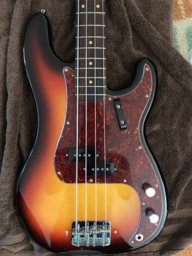
In 1957 a P-Bass would set you back $220 (over $1800 inflation-adjusted). According to US Census data, average household income was $3600 in 1957 (about $31,000 inflation-adjusted). Make no mistake: these were very much luxury items.
The cost of an American Standard P-Bass today is $1350 with average household income of $53,600. So, in both absolute terms and relative to income, the cost of an American-made P-Bass is quite a bit lower today. If that's too much for you, there's the Road Worn '50s for $1000, Classic Series '50s for $900, Standard Series for $600, or a variety of Squiers for just $300.
Today they are working-class-accessible tools...not back then!
Sorry, but that just sounds like sour grapes.
Besides, there are plenty of vintage instruments that can be had for reasonable prices. I bought my '56 Les Paul Junior for $2000 a couple of years ago. It had been refinished and refretted, but still played and sounded great. I fell in love with the '63 SG Junior I played in Seattle on Tuesday. It had a professionally repaired headstock crack. They're asking $2200. Both of these guitars are within reach to the average "young rocker" if they want them.
I'm not sure how this is relevant since we were talking about real vintage instruments...not modern relics. But since you've brought it up, the first relic guitar made by the Fender Custom Shop was done at the special request of Keith Richards. Is he "so un-rock'n'roll it hurts" in your book?
Now that's just silly