• TalkBass has been independent since 1998. Add your voice.
    Create a free account to reply to discussions, view embedded media, and browse with fewer display ads.
    Join freeLog in
    Want zero display ads or expanded classifieds tools? Compare plans.

Let's be completely honest here about vintage basses...

The first musicians to use those instruments were jazz and country players. But you keep raging against the machine...it's good for circulation.

Well, I did say they used the then-new-fangled electric instruments to craft rock'n'roll, which would imply that rock didn't exist yet. So, good point, but i think mine still stands.

Regardless, the first thing I think when I see a vintage (or reliced) guitar or bass is "vanity dad band". To me vintage instruments have the same stigma as coffee-table boutique basses: luxury items intended for collectors and wannabes concerned with projecting an image of wealth and prestige, and not really intended for working musicians.
 
  • Like
Reactions: Muddslide
Interesting thread ...

I own about 30 basses, some new, some vintage, some boutique, some not. They are all four strings (a fiver or sixer literally makes my wrist hurt due to the neck width). One is a fretless, the rest fretted.

I bought these basses for a number of reasons. Some were ones I wanted as a kid. Others are some that were recommended to me, here at TB and elsewhere. And still others are ones that I played, liked, and just had to have it (my Epi Jack Casady is one of those - a very underrated bass if you ask me).

But back to the original poster's question: are vintage better than new?

I would say that in terms of quality, new today is certainly better from a quality control standpoint. I've got a '73 Jazz Bass whose neck pocket has about a quarter inch of body past the neck. My '73 Gibson EB-3 has a front that cherry colored, and a back that's mahogany colored (that's why it's a factory second). And so on.

The technology we have today allows builders to build instruments far more precisely on a consistent basis than was possible in the past. Computers have aided greatly in that effort. My Sadowsky Vintage 4 for example is absolutely flawless, as are my Laklands and Alembics. Fit and finish is perfect. My Peaveys are great too.

Hardware is also greatly improved in my view. Babicz is making great bridges for Gibsons, as is Hipshot. Gotoh, Schaller and Hipshot make great replacement parts too. And pickups - Barts, EMGs, Seymour Duncans, Lindy Fralin, et. al. make pickups as good or better than the originals. Active electronics - in the 70s, only Alembic and Musicman were doing them for the most part (Gibson brought out the RD Artist and Victory Artist late in the decade). Now we have Bartolini, John East, Aguilar, et. al. This is all a good thing in my opinion.

Playability, ergonomics, and tone is very subjective. To me, those parameters are up to the individual, whether vintage or new.

Are vintage worth the money? I dunno. I guess it depends on the individual and what they like. Are they better than new? I don't think so, not in my experience anyway. They're just different from what one can get today. Some are willing and able to pay for that "different," and that's fine. But I think purchasing a new instrument is as equally rewarding in many respects as buying that vintage instrument. At the end of the day, it's all about individual preferences. My two cents.
 
The painting "Portrait of a Peasant" by Vincent van Gogh is housed at a museum near me in Pasadena, CA, so I've had opportunity to see it repeatedly
with the naked eye and it is indeed more powerful as an original than as a reproduction, as plates, no matter how good the photograph, simply cannot
convey the aggressive texturing. So in the case of Vincent, I'm gonna go all Neil Young and say this painting needs PONO to be fully appreciated!

View attachment 708362 View attachment 708364

I obviously flunked art appreciation. :-)
 
  • Like
Reactions: Jah Wobble Fan
I obviously flunked art appreciation. :)

In retrospect, I was thinking that I am probably being short-sighted about technological advances. Perhaps the classic canvases simply need to be re-photographed in high def. For that matter, give it a couple of years and you'll probably be able to produce a 3D print from your home laser printer that you can wave in my face as refutation.


mcluhan.jpg
 
Last edited by a moderator:
  • Like
Reactions: TMARK
My art comparison probably was not very good, partly since I know nothing about art. How about comparing to a 60's era Corvette vs a new one (or pick any collectable car still made
In retrospect, I was thinking that I am probably being short-sighted about technological advances. Perhaps the classic canvases simply need to be re-photographed in high def. For that matter, give it a couple of years and you'll probably be able to produce a 3D print of your home laser printer that you can wave in my face as refutation.

View attachment 708490

I guess the essence of my point is that the difference in value is completely/mostly related to collectability in the case of a guitar or bass - maybe more like certain baseball cards. I could probably never be convinced that a 60's or 70's Fender is better from a tone or playability standpoint vs what can be done today.
 
Some people (myself) find the history behind older things to be the attraction. The whole reason I started collecting cast iron was because I was using something that was a part of history. Yesterday, I cooked my eggs in something that could have been used to clobber a drunken settler during a lonely night on the prarie. I'm not a weapons collector but I once saw a Samurai sword from the early 1400's and I still want that thing just because of the things that it was a part of before Columbus set sail.

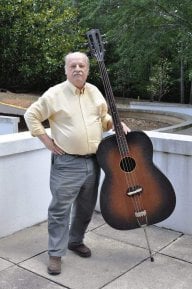
Uprights are also a good example. I'm jonesing for an S9 from the 50's just because it was more than likely used to play some of the earliest rock. There are older and nicer Kays out there but they are not historically important to me and when I'm paying that's the only opinion that matters.
 
Some people like them, some don't. I happen to be one who doesn't. I certainly can understand the value of them for collecting and showing purposes, but I remember when there was a movement among musicians to take back vintage instruments from the evil profiteering collectors and play them. Often the conversation included things like "in spite of their deficiencies" or "warts and all." I think many felt vindicated when they saw a guy like Stevie Ray Vaughn or Eric Johnson playing an old Strat, in spite of the fact that a team of specialists were hired to make sure the old guitars weren't falling apart every night.

There's nothing inherently wrong with liking or not liking old instruments, but there really isn't all that much magic in them. To take the electric bass guitar specifically, it's not like Leo Fender employed the highest level of craftsman to build his instruments, they were built on an assembly line and by most accounts using whatever was cheap. To add to that, it's not like Leo was so overwhelmed by his creations that he folded his arms and retired. He went on to make improvements and re-imagined versions of them.

And that's really where I check out... OK, there's something to the value of pre CBS instruments, I get it, but when you go beyond that and say that the 1970s stuff is "vintage" it becomes a hard pill to swallow. Equating quality with advancing age is a misstep and one that costs an ever increasing wad of cash... And let me finish with this question... what comes next? If a 1975 Fender is a very valuable vintage piece, you have to be prepared to accept all those pointy headstock neon things into the fold sooner than later. Or perhaps even more mind numbing, the vintage 1987 1957 Fender Stratocaster American Vintage Reissue...
 
Steve's got a good point - as the years go by, there are fewer and fewer vintage pieces available, making them more expensive. If you're a collector, that's one thing. If you're more of a player, however, maybe that vintage instrument isn't worth the price given what one can get today for the same price. I could spend $12K on a 1960 Jazz
bass, or buy three Sadowskys for that price, with equal or better quality, playability, hardware and tone (tone is subjective). Again, all personal preference.
 
Why do people care? If you want to spend big $$$ and get a vintage bass, go for it. If you want to play an expensive modern bass, go for it. If you want to play a cheap beater, go for it. What's the difference?
The original question was about whether the old stuff is better quality than the new stuff. It’s a valid question for someone considering a purchase because there are many modern vintage-style instruments available that cost less $$$.
 
  • Like
Reactions: FlatwoundFunk
Well, I did say they used the then-new-fangled electric instruments to craft rock'n'roll, which would imply that rock didn't exist yet. So, good point, but i think mine still stands.

Regardless, the first thing I think when I see a vintage (or reliced) guitar or bass is "vanity dad band". To me vintage instruments have the same stigma as coffee-table boutique basses: luxury items intended for collectors and wannabes concerned with projecting an image of wealth and prestige, and not really intended for working musicians.

A vintage instrument is also a survivor instrument; it's lasted long enough to accumulate its various mojos. A well-worn old instrument also likely is a good instrument that was loved and played enough to show its age. The old instruments that appear neglected or abused may be the bad apples in the bunch. Electronics in old instruments will decay, as they will in new instruments if given long enough. Warped necks on old basses? Not really their fault, once you consider the string choices electric bassists had in the first two decades of the instruments' existence.

And vintage basses were never "intended" to be anything except tools to play music. A lot of predator dealers have manipulated them into some sort of Grail, with apparently no shortage of acolytes. Most of my basses are old and used -- partly due to economic reasons, but also because they are the instruments I grew up with and we have a shared history.
 
  • Like
Reactions: Doctor J
The mantra I keep hearing everywhere is 'tone is in your hands'. As my playing continues to improve and my personal misconceptions about the instrument continue to be defeated, I'm finding this to be true.

But then, your assertion here begs the question: why does 'stock' matter so much if electronic components like pots, pickups, wiring age to different specification then? To me, it would make more sense to improve an old instrument with appropriate components that help it play, sound or even look better for the person playing it.

The main source of my bemusement is this: to me, a bass is meant to be played. It's why most of them were built in the first place. To render a bass as being a mere collector's item just because it's old and a 'all original' is to basically render it useless, like a bowl of plastic fruit occasionally dusted off as to look relevant in someone's dining room.

@nerkoids i am in agreement with you. I own a vintage bass, but i play it and gig it regularly (it is my only bass). as far as the component drift, well i believe that is just preference like everything else. one may prefer a high tolerance new bass up to spec, another may like old vintage bass that has drifted and sounds "unique". different strokes for different folks, there is no right or wrong, as you aptly say it is an instrument to be played.

i do agree the tone is in your hands, but that's just one part of the equation. the instrument another, amp/mic/micpreamp/console/tape/digital/mastering/recorded format/stereo/your ears all matter as well. the whole signal path matters.
 
The original question was about whether the old stuff is better quality than the new stuff. It’s a valid question for someone considering a purchase because there are many modern vintage-style instruments available that cost less $$$.
The mere fact that many seasoned pros do just fine without having any vintage basses in their arsenal answers that question.
 
Or perhaps even more mind numbing, the vintage 1987 1957 Fender Stratocaster American Vintage Reissue...

You made me LOL because the fact is, the best-playing Precision I've encountered of late was an '82 AVRI belonging to a cat from whom I was buying a Craigslist MIM P bass. Said guy was dumping the MIM because he had decided he needed no backup. I asked if I could play his #1 an he obliged. Great player, and it also had a sweet patina with lots of checking and all that -- really gorgeous piece. So -- yes, early AVRIs are apt to (continue) to gain in reputation, and to appreciate in value.
 
  • Like
Reactions: FlatwoundFunk
A vintage instrument is also a survivor instrument; it's lasted long enough to accumulate its various mojos. A well-worn old instrument also likely is a good instrument that was loved and played enough to show its age. The old instruments that appear neglected or abused may be the bad apples in the bunch. Electronics in old instruments will decay, as they will in new instruments if given long enough. Warped necks on old basses? Not really their fault, once you consider the string choices electric bassists had in the first two decades of the instruments' existence.

And vintage basses were never "intended" to be anything except tools to play music. A lot of predator dealers have manipulated them into some sort of Grail, with apparently no shortage of acolytes. Most of my basses are old and used -- partly due to economic reasons, but also because they are the instruments I grew up with and we have a shared history.

Don't blame it on the dealers. It takes two to tango, and if someone's willing to pay the price, why shouldn't the dealer sell it to them for that price? Would YOU sell a 62 Jazz for $600? Doubt it. Some stuff is priced out of our league. Not everyone is selling to us common folks, and that's how it's always going to be. Time to accept it.
 
And that's really where I check out... OK, there's something to the value of pre CBS instruments, I get it, but when you go beyond that and say that the 1970s stuff is "vintage" it becomes a hard pill to swallow. Equating quality with advancing age is a misstep and one that costs an ever increasing wad of cash... And let me finish with this question... what comes next? If a 1975 Fender is a very valuable vintage piece, you have to be prepared to accept all those pointy headstock neon things into the fold sooner than later. Or perhaps even more mind numbing, the vintage 1987 1957 Fender Stratocaster American Vintage Reissue...

This made me think of discovering a few days ago that the band Green Day is now considered "classic rock." At least according to the radio station I happened to flip on.
 
  • Like
Reactions: FlatwoundFunk