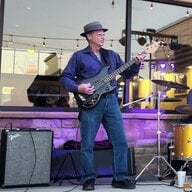
As we all know lengthy cable runs can diminish the presence of the upper portion of the audible frequency spectrum. As this is ESPECIALLY detrimental to bass I have been experimenting with ways to reduce the effect. I started by slowly eliminating different pedals, my effects loop, and my pedal board entirely then experimenting with different cables. I have now progressed to 1 low loss component between my bass and my amp. I have had to adjust my playing somewhat to work around the new setup, and my stage presence is somewhat diminished. But every single Hz of my playing is now accurately reproduced with no coloring or loss. I can really tell it's made a huge difference because now when I play the audience can't stop looking at me. And BONUS, it turns out that buying one of these is considerably cheaper than all of the gear I used previously.
I'm now considering modding my bass and amp to use 1/8" input/output jacks to shorten the cable run from tip to tip.
--------------
Fun Facts
Prior to the advent of tape and digital delays musicians used to run a line from the unused 1/4" "to speaker" output of their amp into the effects loop return. This cable routing would create a cascading delay style effect. The delay interval was controlled using varying lengths of cable. Usually only professional musicians could afford to do this as a 5ms delay required approximately 7,000 feet of cable to achieve. That's why all older style amps use 1/4" outputs instead of speak-on, it was considered a design feature and was a big selling point.
Similarly before the advent of the high wattage amps we know and love today top level musicians would chain together amps to achieve the wattage necessary to power their rigs. By routing the 1/4" "to speaker" output into the input of a second identical amp you could add the wattage just like resistors in series. In order to achieve 1,000 watts a performer would require 5 200 watt amplifiers wired in series.
The standard tuning we all know and love became standard once rock and roll was developed. Musicians soon learned that using EADG tuning they could play ANY song using only open strings. It wasn't until the rise of hip hop music that the B string and associated tuning was added to accommodate for the lower bass notes the artists preferred.
The vintage style coiled instrument cables were actually a huge part of why many famous musicians had such phenomenal playing. The tight coils of the cable extended over a long distance made them into a highly sensitive receiving device not unlike an antenna. In fact these cables became such sensitive receivers that they could actually pick up the subtle changes in electrical output within the players brain. If you look closely artists like Hendrix were only actually playing about 1/3 of the notes heard on their recordings, the rest of the sound is being transmitted from his brain into the cable. That's why their licks were so amazing, we were actually hearing what they THOUGHT it should sound like. Unfortunately due to the proliferation of television, radio, cell phones, and the internet the density of radio interference is now too great and any signal put out by the human brain is drowned out. That's why many modern players just can't measure up to the rock and roll gods of old.