Action is a combination of relief and bridge saddle height. Both have to be correct for the action to be right.Relief is not really the same as action.
There are many other ideas about how setup your bass. This one is a good starting point.

TalkBass has been independent since 1998. Add your voice.
Create a free account to reply to discussions, view embedded media, and browse with fewer display ads.
Join free Log in
Want zero display ads or expanded classifieds tools? Compare plans.
Action is a combination of relief and bridge saddle height. Both have to be correct for the action to be right.Relief is not really the same as action.
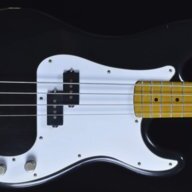

Higher action?Know what I mean? The clacking of strings against the frets.
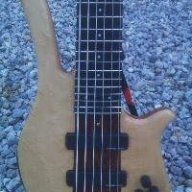
My strandberg has stainless steel frets, and I seem to get a ton more clack than my Bongo with brass frets. I've tried a few different strings on it so far: NYXL (stock), My go to DR's, High Beams, Fat Beams, and Black Beauties.
I wasn't a huge fan of the tone of the NYXL's, but there was slightly less clack than all the DR's.
My tone is on the aggressive side, so I don't want to go with tapes or flats. I'm just wondering if anyone has had any success lessening clack with a different string choice while still retaining that zing.
Thanks


Not necessarily. From my own own experience, out of two basses with identical strings and set up numbers, one can be ruthlessly revealing, and the other extremely forgiving, of the same technical flaws.

Action is a combination of relief and bridge saddle height. Both have to be correct for the action to be right.
There are many other ideas about how setup your bass. This one is a good starting point.
The answer you don’t want to hear is clean up your technique. Sorry. Perhaps you need to turn your volume knob up and pluck lighter as well. Or raise your action. Those might also help.
Fair enough. Without seeing it, there could be several issues and several solutions, treble knob down, technique adjustments in the right and/or left hands, different strings, truss rod/setup adjustments. There are usually several ways to skin the cat. There seems to be a natural bias on talkbass to throw money at the issue and buy more or different gear, I just have a knee jerk reaction to advise people to learn more, practice more, and become better musicians and not spend money. Which is why I made the technique suggestion. It may not be the answer. The solution in your case and/or the OP’s case may be gear based and require different strings or a different setup, I don’t know. For some reason I always feel the need to be one of the few voices shouting “the solution is in your brain and hands not in your wallet” I may not always be right, but I feel that viewpoint needs to be represented as well.Not entirely accurate. I have pretty clean technique and when I put a set of Chromes on one of my basses, the clacking was overwhelming. I’m not sure why, but the clacking was so pronounced that I had to take them off immediately. Never heard anything like it.


I've been doing some string experimentation with my P-bass (Warmoth, with standard nickel frets). Prior to this, I had some TIJFs on it and didn't notice unusual amounts of string-on-fret clack. I then tried some Chromes and EB Group IV flats, and both gave me more-or-less unbearable amounts of clack. Next was GHS P-flats and then back to the TI's, and the clack was back to "normal". So there's no doubt, given this experience, that different strings produce different amounts of clack. Hex vs. round core doesn't necessarily seem to matter, as my results varied in that regard, but the sample size is small. Similarly for stainless vs. nickel.Thanks for all the replies. Some are very helpful. Some not so much, because, as I said, I don't get it on my Bongo at all. I don't get it on other basses I've played either. But I don't think I've ever used stainless steel frets before.
I still appreciate the suggestions though.
I've played with action, playing touch, right hand position, eq........that was the reason I posted this here regarding string types.
I guess first order of business is to try out some higher tension hex cores (nickel lo-riders probably) to start.
I've been doing some string experimentation with my P-bass (Warmoth, with standard nickel frets). Prior to this, I had some TIJFs on it and didn't notice unusual amounts of string-on-fret clack. I then tried some Chromes and EB Group IV flats, and both gave me more-or-less unbearable amounts of clack. Next was GHS P-flats and then back to the TI's, and the clack was back to "normal". So there's no doubt, given this experience, that different strings produce different amounts of clack. Hex vs. round core doesn't necessarily seem to matter, as my results varied in that regard, but the sample size is small. Similarly for stainless vs. nickel.
Having said all that, there's no doubt that my technique could be better, and when I really try to focus on clack-free fretting, I can do it most of the time, but to the detriment of my playing in other respects. So I have some work to do here. Bottom line is that I think your issue is a combination of clack-y strings and technique. Good luck in identifying and resolving the problem.

@Grinderman ,
In that song, I’m not hearing the type of string clack that the OP is referring to.
OP has clearly stated its clack when fretting a string. Right when the string makes contact with the fret.