And increasing dead spots? Doesn't headstock overall mass has a great influence on how notes ring?

Enjoy the benefits of a premium membership!
Upgrade Account
-
TalkBass has been independent since 1998. Add your voice.
Create a free account to reply to discussions, view embedded media, and browse with fewer display ads.
Join free Log in
Want zero display ads or expanded classifieds tools? Compare plans.
You are using an out of date browser. It may not display this or other websites correctly.
You should upgrade or use an alternative browser.
You should upgrade or use an alternative browser.
Light tuners affecting tone?
- Thread starter allexcosta
- Start date
More options
Who Replied?
Possible. People use a FatFinger to reduce dead spots so it seems logical that tuner mass or lack of it could affect tone also. I have Hipshot Ultralights on all my basses except one and I have no complaints about tone. Fodera, I believe, won't use ultralights because they prefer the tone of the added mass from the Gotohs they use. (I think they use Gotohs.)

My prediction: you will get more than one response saying that it makes no difference whatsoever. You will also get more than one response saying that it does, or might, make a difference. Whether anyone will assert that any difference is actually audible is a third question.
Personally, Scarlett, I don't give a........................I believe there are many things that make so much more difference so the question is moot on a practical basis. Weight is a consideration, tone...meh.
Personally, Scarlett, I don't give a........................I believe there are many things that make so much more difference so the question is moot on a practical basis. Weight is a consideration, tone...meh.
Changing to light weight tuners will suck the tone right out of a good sounding bass. UNLESS.............you have a neck with metal reinforcement rods. 


Prolly has some effect in certain cases.
Go 180* the other direction, to the bridge. Do you think a high mass bridge vs. a flimsy bent steel bridge will make any difference?
You decide, but there's a whole industry devoted to exactly that assertion.
Go 180* the other direction, to the bridge. Do you think a high mass bridge vs. a flimsy bent steel bridge will make any difference?
You decide, but there's a whole industry devoted to exactly that assertion.
I believe there are many things that make so much more difference so the question is moot on a practical basis. Weight is a consideration, tone...meh.
We recently had some interesting discussions on deadspots related to headstock mass and it didn't really seem like a moot point for many...

Fodera, I believe, won't use ultralights because they prefer the tone of the added mass from the Gotohs they use. (I think they use Gotohs.)
I do wonder sometimes why the same tuners (Gotoh GB-7 and their ilk) are found on $200 basses (say, Yamaha) and also on $20,000 basses (for example, Alembic). IMHO, I don't think it is necessarily because the Gotohs are better, but they do cost less, I imagine a lot less, in large quantities, than something like Hipshot Ultralite tuners.


I have used ultralites for years and prefer them for their weight and ability to hold a bass in tune. I recently replaced the tuners on my Roadworn Jazz with the ultralites and noticed that I had several dead spots. Put the originals back on and the deadspots went away. The roadworn has a very thin neck and the headstock is definitely thinner than my MIA Jazz so yes, it made a difference. Got a set of the Hipshot reverse tuners which were lighter than the Fenders and they worked great. Hipshot have a lot of great tuners and if deadspots are a consideration I'd try a fatfinger or something to see if mass helps the problem. Heavier tuners could move the problem up the neck and away from where you play most of the time if you're lucky. Would it make a difference on every bass? No. I've used the ultralites many times with great results, but it definitely made a difference this time. I hate neck dive so I always look for ways to reduce the weight, but sometimes its possible to choke the tone. BTW, I like some of the Gotoh tuners too. Some folks hold the headstock next to a wooden doorway and play to see if it goes away. Increasing mass can move or even solve a deadspot, but lots of expensive basses have those issues sometimes too. Good luck.

Nearly everything has the potential to effect tone but whether it does or not has to be taken on a case-by-case basis. There are no hard and fast rules for predicting how any particular bass will respond to a mod prior to trying it and seeing what happens, if anything.
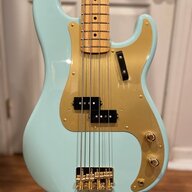
funny I just bought a new bass a hwy one precision , with the stock tuners it had a barley noticable dead spot High C on the g string ,O changed out the stock tuners with gotoh GB9's (heavier tuners) it had a worse than average deadspot C# g string, with gotoh GB340 res-o-lites(very light tuners )the dead spot must have moved between notes because its disappeared , just played it and its gone
 ....if you believe it does, it does.
 That only works for country music.
I'm working on a theory that how tight the truss rod is affects tone, sustain, and possibly dead spots.
As usual, there seems to be no one size fits all answer.
After all these are just hunks of wood with bits of metal and plastic stuck on; not exactly designed as consistent, mill spec parts.
As usual, there seems to be no one size fits all answer.
After all these are just hunks of wood with bits of metal and plastic stuck on; not exactly designed as consistent, mill spec parts.
Jim C said:I'm working on a theory that how tight the truss rod is affects tone, sustain, and possibly dead spots.
As usual, there seems to be no one size fits all answer.
After all these are just hunks of wood with bits of metal and plastic stuck on; not exactly designed as consistent, mill spec parts.
I think I agree with your theory.
Jeff Scott said:I do wonder sometimes why the same tuners (Gotoh GB-7 and their ilk) are found on $200 basses (say, Yamaha) and also on $20,000 basses (for example, Alembic). IMHO, I don't think it is necessarily because the Gotohs are better, but they do cost less, I imagine a lot less, in large quantities, than something like Hipshot Ultralite tuners.
I've wondered the same but didn't dare say it out loud. But if it works, it works.

IMO the lack of neck dive is worth any change in tone that might occur.
It's not going to make the difference between a good sounding bass and a bad one. I can guarantee that.
It's not going to make the difference between a good sounding bass and a bad one. I can guarantee that.
I do wonder sometimes why the same tuners (Gotoh GB-7 and their ilk) are found on $200 basses (say, Yamaha) and also on $20,000 basses (for example, Alembic). IMHO, I don't think it is necessarily because the Gotohs are better, but they do cost less, I imagine a lot less, in large quantities, than something like Hipshot Ultralite tuners.
Gotoh could care less if Fodera started using some other tuners...
Fodera has made about 3000 basses in almost 30 years working non-stop. Samick and Cort make 300 guitars and basses EVERY DAY each...
Engraving the little butterfly on the back of their tuners probably costs a lot more than what they pay for the tuners themselves.
I mean, Fodera pays Hipshot to make 10 custom bridges per month. Do you really think they can't pay for Ultralights, which are 3 or 4 bucks more expensive than the ones they use?
I recently replaced the tuners on my Roadworn Jazz with the ultralites and noticed that I had several dead spots. Put the originals back on and the deadspots went away.
funny I just bought a new bass a hwy one precision , with the stock tuners it had a barley noticable dead spot High C on the g string ,O changed out the stock tuners with gotoh GB9's (heavier tuners) it had a worse than average deadspot C# g string, with gotoh GB340 res-o-lites(very light tuners )the dead spot must have moved between notes because its disappeared , just played it and its gone
This is the kind of experience I was looking for...


