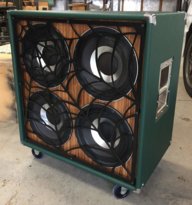
The magnitude function? Here's the one for two 4" round ports.You might want to verify that you input the TS parameters correctly, this doesn't look correct, especially at 125 watts.
Can you post the amplitude transfer function?

TalkBass has been independent since 1998. Add your voice.
Create a free account to reply to discussions, view embedded media, and browse with fewer display ads.
Join free Log in
Want zero display ads or expanded classifieds tools? Compare plans.
The magnitude function? Here's the one for two 4" round ports.You might want to verify that you input the TS parameters correctly, this doesn't look correct, especially at 125 watts.
Can you post the amplitude transfer function?

You are correct, I got two threads mixed up.HO (non LF)? That sounds like Detlalite, I thought he was dealing with a K-140 with an E-140 recone?
Here's what I have to TS parameters. Set LE to 0 and resistance to 0. I'm wondering about the BL, as the frame is a K-140 and the spec sheet has 22.3, but the E-140 has 24.1. E-140 has a more powerful motor at 1.35 T vs 1.2 T.You are correct, I got two threads mixed up.
With the K/E-140, this may in fact be the case, though I would set ale to zero to establish a reference and set the series resistance to 0 as well.
I was just looking around the forum and saw a thread where this subject came up. JBL E140 cab build (starting post #25) It looks like the T/S parameters as measured for that driver varied from the published specs from JBL, perhaps through age and use. There was some modeling with the measured T/S parameters in a 3.5 cubic foot box that looked pretty flat to 55hz or so (post #34). I'm wondering if I need to get a DATS and measure my driver. It would take a week or so to get the unit. Sorry to put everyone through this again. At least, I don't feel alone anymore!Regardless, not sure if we're dealing with proper T/S parameters or what...I'm just watching.
Ok, part of this is the quirky nature of WinISD and part of this due to your tuning selection. If you tune this driver too low, its system response behavior changes (but not the the amount that WinISD predicts).
Using a 3.5CF box and 2 x 4" diameter ports 1.5" deep yields a much more real world friendly tuning and the low mid dip is only 0.7dB (not over 3dB):
View attachment 7399868
The second harmonic would have to be the foundation of any lows out of this driver, at least for the lower register. I'm guessing this is where the voicing comes from. I'm actually more interested in building now than when I started. Regardless of result, I doubt I'll look at bass cabinets the same ever again.Correct, it's not great w/deep, extended bass.
There are other models that are, but the mid voicing isn't very good for bass guitar. For example, the E-145 (which hold up better at low frequencies and higher power w/an Xmax about twice the E-140.
Correct, plus the mid voicing.The second harmonic would have to be the foundation of any lows out of this driver, at least for the lower register. I'm guessing this is where the voicing comes from. I'm actually more interested in building now than when I started. Regardless of result, I doubt I'll look at bass cabinets the same ever again.
Happy New Year!

I had a pair of E145s back in the day, when bi- or tri-amping was fairly common (mid 80s-ish). They suited me much better than 140s when used that way, but yeah, not the greatest as a standalone thing.Correct, it's not great w/deep, extended bass.
There are other models that are, but the mid voicing isn't very good for bass guitar. For example, the E-145 (which hold up better at low frequencies and higher power w/an Xmax about twice the E-140.
Totally, great in a biamped setup w/ E-130's on the top crossed over around 150HzI had a pair of E145s back in the day, when bi- or tri-amping was fairly common (mis 80s-ish). They suited me much better than 140s when used that way, but yeah, not the greatest as a standalone thing.
I had an E120 in a Cabaret wedge cab with a ring radiator, or alternatively a pair of E110s. Fun for a while, but I really don't miss hauling around those old school multiamped rigs. Just the BGW active crossover probably weighed as much as a Subway 800 head.Totally, great in a biamped setup w/ E-130's on the top crossed over around 150Hz


Never thought of using an E/K-130 in a bass amp, but yeah . . that would have some interesting upper harmonic presence.Totally, great in a biamped setup w/ E-130's on the top crossed over around 150Hz
Yes! Not much of a change on my graphs. I'm going to reinstall WinISD to see if that changes things. I briefly thought about writing a program for this too, as I can code C/C++. However, the time and issue of coming up with a validation process pushed me away from that idea. Still, it would be nice to know what is going on under the hood.Looking at posts 66 and 67, the curves should be dramatically different if Re is set to zero. Something's going wrong. There may be two things happening.
First, how WinISD calculates the parameters for modeling. It takes some of your parameters, and computes others from them. One thing is that hitting the tab key after entering a parameter will cause it to recalculate, if it can. Last time I looked, which was many years ago, details on what it was doing were murky.
Second, all of the T/S parameters are interrelated. Changing Re requires changing Qes too. They are proportional to one another.
I didn't analyze your design concept any further than that, but it illustrates why one needs to proceed with caution when working with any software tool. WinISD gets a lot of flak, but it also gets the most scrutiny. Wanting to really understand what the model is doing, is one of the things that motivated me to write my own modeling program, which I've used in its various states of evolution for three projects now.