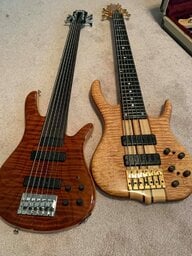
To me the age-old debate is misleading, as fretlines offer minimal help in my experience. Finger-placement intonation, according to visual fretline-finger relationships, changes across the fretboard. For example, according to one bass intonation method (Willis), intonation occurs after the fretline near the nut; moving up the neck, intonation occurs on the fretline; moving further up the neck, intonation occurs centered between fretlines. Given this, if one chooses to believe that intonation always occurs on or before the fretline, they will be playing out of tune often, unless they limit play to one area of the neck, say a within a 4-whole step range.
Next, visual observation of intonation of this phenomenon adds a layer of brain processing that could detract from music flow. Fretlines or not, ear recognition of intonation should occur first and last. How it works for me? I hear that my intonation is off, say while playing a perfect fifth dyad that is moving up and down the neck. Is it easier to adjust visually, or adjust according to ear?
To adjust visually: 1) I hear that intonation is off. 2) I look at the fingerboard to determine why, based on relationship of finger placement to fretline. 3) I adjust finger relation to fretline, hoping to achieve intonation. 4) My ear judges whether intonation is achieved. 5) If intonation is not achieved, go back to step 2. By the time this activity occurs, a lot of music has probably passed by.
To adjust by ear: 1) I hear that intonation is off. 2) I adjust fingers to achieve intonation.
In the intonation debate, which do you prefer? 4 or more steps, or 1 or 2 steps (1 step if your intonation is right from the start). Which is more efficient and practical?
Assuming that one is a proponent of lines, what happens on a dark stage when lines are not visible? In a sight-reading situation, what happens when the music is so fast, that you cannot move your eyes from the chart to look at fretlines? In a performance situation, how does it look when the performer is staring at fretlines, instead of interacting with audience and fellow musicians? What happens if instrument standard tuning changes during a song/performance (one string becomes slightly flat, one slightly sharp)? How do you reconcile this based on visual fretline reference?
I am not against fretlines. I have basses with and without them. However, fretlines don't make my playing or intonation better. For me, intonation is always in the ear of the beholder/player, fretlines or not.