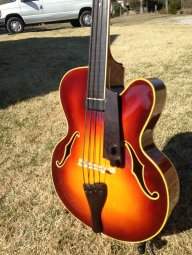
How about this? "You play fretless? Dude, you're awesome!" I am most sincere about that sentiment,btw.

TalkBass has been independent since 1998. Add your voice.
Create a free account to reply to discussions, view embedded media, and browse with fewer display ads.
Join free Log in
Want zero display ads or expanded classifieds tools? Compare plans.
A lot of people tend to compare upright bass to electric bass in regards to having lines. The upright bass is fretless and doesn't have lines so does it stand to reason an electric bass also shouldn't have lines? NOPE! Here's why:
1) The upright bass is built with 'anchor points' in mind. Half and first positions are easy enough. With your index finger anchored on first position A on the G string your pinky will naturally fall on B. Shift up so your index is on C and you're naturally spanning C to D. On basses with a D neck the D on the G string will naturally occur at the point where the neck meets the body. It is very very natural to shift to the D by 'feel.' The electric bass has no such system. It is just a long plank of wood. There are no tactile reference points on an electric bass.
2) Plenty of people use markings, dots, etc. on upright bass. "Probably just kids or people learning!" you say? Nope!
See the pencil mark around the high D? This is one of the best bassists in the world.
What's this? DOTS on Edgar Meyer's fingerboard!

To adjust visually: 1) I hear that intonation is off. 2) I look at the fingerboard to determine why, based on relationship of finger placement to fretline. 3) I adjust finger relation to fretline, hoping to achieve intonation. 4) My ear judges whether intonation is achieved. 5) If intonation is not achieved, go back to step 2. By the time this activity occurs, a lot of music has probably passed by.
To adjust by ear: 1) I hear that intonation is off. 2) I adjust fingers to achieve intonation.
In the intonation debate, which do you prefer? 4 or more steps, or 1 or 2 steps (1 step if your intonation is right from the start). Which is more efficient and practical?
Assuming that one is a proponent of lines, what happens on a dark stage when lines are not visible? In a sight-reading situation, what happens when the music is so fast, that you cannot move your eyes from the chart to look at fretlines? In a performance situation, how does it look when the performer is staring at fretlines, instead of interacting with audience and fellow musicians? What happens if instrument standard tuning changes during a song/performance (one string becomes slightly flat, one slightly sharp)? How do you reconcile this based on visual fretline reference?
To me the age-old debate is misleading, as fretlines offer minimal help in my experience. Finger-placement intonation, according to visual fretline-finger relationships, changes across the fretboard. For example, according to one bass intonation method (Willis), intonation occurs after the fretline near the nut; moving up the neck, intonation occurs on the fretline; moving further up the neck, intonation occurs centered between fretlines. Given this, if one chooses to believe that intonation always occurs on or before the fretline, they will be playing out of tune often, unless they limit play to one area of the neck, say a within a 4-whole step range.
Next, visual observation of intonation of this phenomenon adds a layer of brain processing that could detract from music flow. Fretlines or not, ear recognition of intonation should occur first and last. How it works for me? I hear that my intonation is off, say while playing a perfect fifth dyad that is moving up and down the neck. Is it easier to adjust visually, or adjust according to ear?
To adjust visually: 1) I hear that intonation is off. 2) I look at the fingerboard to determine why, based on relationship of finger placement to fretline. 3) I adjust finger relation to fretline, hoping to achieve intonation. 4) My ear judges whether intonation is achieved. 5) If intonation is not achieved, go back to step 2. By the time this activity occurs, a lot of music has probably passed by.
To adjust by ear: 1) I hear that intonation is off. 2) I adjust fingers to achieve intonation.
In the intonation debate, which do you prefer? 4 or more steps, or 1 or 2 steps (1 step if your intonation is right from the start). Which is more efficient and practical?
Assuming that one is a proponent of lines, what happens on a dark stage when lines are not visible? In a sight-reading situation, what happens when the music is so fast, that you cannot move your eyes from the chart to look at fretlines? In a performance situation, how does it look when the performer is staring at fretlines, instead of interacting with audience and fellow musicians? What happens if instrument standard tuning changes during a song/performance (one string becomes slightly flat, one slightly sharp)? How do you reconcile this based on visual fretline reference?
I am not against fretlines. I have basses with and without them. However, fretlines don't make my playing or intonation better. For me, intonation is always in the ear of the beholder/player, fretlines or not.

How true is this? My fretless bass is converted from fretted, so don't know if the lines are as accurate as a bass that is specifically made to be fretless. I've intonated it to be in tune open and at the 12 fret line, but when I play and actually look and play at the lines, sometimes it doesn't sound right. When I play and trust my ears and then look, my fingers are always a little off the line.Unlined fretless = approximate intonation
Lined fretless = accurate intonation
Feel good

You mean this isn't true?There will always be "those" people out there that think you cant play bass without a Fretless unlined Fodera and Hand built boutique Amp and cab from a Craftsman who made his own tubes and electronics by hand and was then killed so the amp could never be replicated.
,




Many of us have a much different experience. The biggest difference I see is that no one is telling people who play an unlined fretless that they are wrong. It's always the other way around.To me the age-old debate is misleading, as fretlines offer minimal help in my experience.

That's because you need to intonate it with the 1st harmonic (12th 'fret') and the 12th 'fret'. Using the open string will typically make it a little off.How true is this? My fretless bass is converted from fretted, so don't know if the lines are as accurate as a bass that is specifically made to be fretless. I've intonated it to be in tune open and at the 12 fret line, but when I play and actually look and play at the lines, sometimes it doesn't sound right. When I play and trust my ears and then look, my fingers are always a little off the line.

Many of us have a much different experience. The biggest difference I see is that no one is telling people who play an unlined fretless that they are wrong. It's always the other way around.
Imagine how cool it would be if every manufacturer offered every one of their basses in both fretless and left handed as well? No one is likely to wake up tomorrow and decide to try playing lefty, but for those who try fretless isn't it in all out best interests if they decide to stick with it? We can't really do much of anything for the lefties unfortunately (sorry southpaws!) but we should encourage players to try fretless as often as we can, and support whatever makes that transition easier.
Not very.How true is this?
Yes, you need to compare the 12th fret harmonic with the 12th stop note....I've intonated it to be in tune open and at the 12 fret line, but when I play and actually look and play at the lines, sometimes it doesn't sound right. When I play and trust my ears and then look, my fingers are always a little off the line.

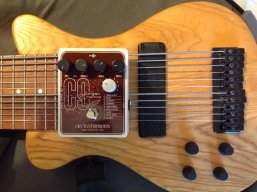
Nothing oozes quality like a nice ebony fretboard with maple lines. Or maybe abalone! Naw, let's go with 18 karet gold! Blank fretboard? Screams luthier laziness!