• TalkBass has been independent since 1998. Add your voice.
    Create a free account to reply to discussions, view embedded media, and browse with fewer display ads.
    Join freeLog in
    Want zero display ads or expanded classifieds tools? Compare plans.

Machine Shop Practice: Making Custom Metal Hardware For Basses

IMG_3024.jpeg
I'm going to write a quick summary post about metal lathes, coming up soon. Quick answer: Yes, those little mini-lathes can be used to make small round parts like Fender-style bridge saddles and strap buttons. Not high precision or high powered, but they are useable. And they are compact and fairly cheap. Yes, in most industrial cities, you can find a decent "real" metal lathe in that price range or less.

Hang on, I've got a few more Overview Of Tools posts to go before we get into the real meat of this thread.

I have an 1950's unimat db sl micro lathe with milling accessories. I have maanaged to make some pretty cool stuff on it but half the time is figuring how to physically manage with such a small machine. String trees and knobs are easy but anything elses gets tricky. Mostly I use it for custom competition airgun parts.Here's a few airstrippers and a competition field target stock that I designed and made had a lot of machine time into them..
FullSizeRender-1.jpeg
FullSizeRender-2.jpeg
FullSizeRender.jpeg
IMG_2963.JPG
 
Last edited:
View attachment 5059903

I have an 1950's unimat db sl micro lathe with milling accessories. I have maanaged to make some pretty cool stuff on it but half the time is figuring how to physically manage with such a small machine. String trees and knobs are easy but anything elses gets tricky. Mostly I use it for custom competition airgun parts.Here's a few airstrippers and a competition field target stock that I designed and made had a lot of machine time into them..
View attachment 5059897 View attachment 5059898 View attachment 5059899 View attachment 5059901

Very nice machine work! Gunsmithing is another direction in metalworking skills.

Those Unimat lathes are very nice, high quality and good precision. The limitation is that they are small and very low powered. They are made for small hobby work. Where you have plenty of patience. The import mini-lathes have more power, but are not as precision.
 
  • Like
Reactions: MovinTarget
Very nice machine work! Gunsmithing is another direction in metalworking skills.

Those Unimat lathes are very nice, high quality and good precision. The limitation is that they are small and very low powered. They are made for small hobby work. Where you have plenty of patience. The import mini-lathes have more power, but are not as precision.

Thanks, I love machining as hobby and ya my tiny machine is pia for sure since it so small but I manage.. I think I'd get a compact mill /drill before another lathe , maybe..
 
Last edited:
  • Like
Reactions: MovinTarget
Okay, Bandsaws:

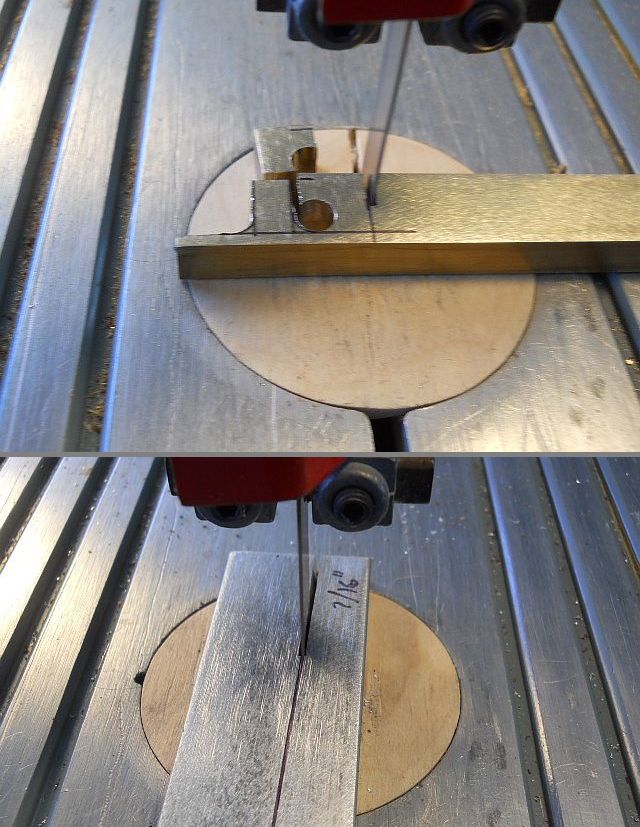
A bandsaw is a very useful machine to have for metalworking, like we do on basses. Using a bandsaw is the quickest way to saw out rough shapely contours on plates and relatively thin bars and blocks. A standard 14" woodworking bandsaw will saw aluminum plate up to 1/2" thick with no problem. Brass to 3/8" thick. A normal 14" bandsaw will usually have a 3/4 HP motor. Those plate thicknesses are about where a 3/4 HP saw will start to bog down, running out of power. Smaller bandsaws with smaller motors can cut aluminum and brass, but not as thick.

Standard woodworking blades work fine for cutting aluminum and brass on a bandsaw. They make special bandsaw blades for aluminum, but they aren't really necessary.

Here's my aluminum/brass bandsaw:

View attachment 5058780

It's a low-priced import Enco 14" woodworking bandsaw that I bought new around 1990. I use it almost daily, as you can see from the mess of scraps on the table. It's been a trooper.

This bandsaw is dedicated to cutting only aluminum, brass and pickguard material. There's a reason for that. As soon as you cut aluminum on a bandsaw, the whole insides of the saw gets coated with aluminum dust. Sparkly particles everywhere, including embedded in the rubber tires. If you then use the saw to cut your beautiful flame maple neck blank, it will become Metalflake Flame Maple. Which is probably is an exotic tonewood.

So, if you want to use your only bandsaw to cut a few aluminum parts, you need to allow time to thoroughly clean out the saw afterward.

You may have noticed that I didn't mention Steel and Stainless above. Do Not try to cut steel or stainless on your regular woodworking-type bandsaw! You'll get a shower of sparks and destroy the blade in a few seconds. Don't do it. Don't even think about doing it. The blade speed of a woodworking bandsaw is 10 Times the speed needed for steel. Really.

To bandsaw steel and stainless, you need a special bandsaw with an internal gear transmission to shift it down into the Low-Low range. If you are used to normal bandsaws, it's amazing to see how slowly the blade moves on a steel-cutting bandsaw. You can almost count the teeth going by. But that's what it takes to cut steel, stainless steel, and also titanium.

I have a dedicated Steel/Stainless bandsaw, a 14" Grizzly special model that has the extra geared transmission. I couldn't find a picture of it at the moment. I don't use it very often, but it does the job when I need it. I've cut 1/2" thick stainless plate with it.

This is a good reason why you may not want to mess around with custom stainless hardware for your basses. Sawing, drilling and shaping stainless requires more special machines that have more horsepower, slower speeds, frame strength, and definitely higher cost.

Cutoff Bandsaws:

If you start making batches of custom metal parts, a cutoff bandsaw is a big timesaver. A Cutoff bandsaw is a specialty bandsaw that pivots down to horizontal, sawing chunks of metal from bar stock. They generally come in two sizes, Small and Large. I have one of each, and I use them both. The Small one every day; the large one maybe once a month.

View attachment 5058857

Here's the Small one, in the foreground. I bought it new in 1982 for about $175. Made in Taiwan. It's been a workhorse all these years. Almost every metal part I make starts out as a slug sawn from bar stock, on this saw. It's theoretically capable of sawing 4" diameter round stock, but it doesn't really have the poop for that. I use it for 1" and smaller solid stock, although it will cut larger thin wall tubing.

If you are getting into some serious bass metalworking, I recommend that you get one of these small cutoff saws. New, today, they are $370 at Harbor Freight. I've seen used ones around here on CraigsList for $100-$150.

View attachment 5058858

Here's the Big one. The same design machine, scaled up 3X. About 4' long, 1 1/2 HP. It will actually saw through 4" diameter round steel. I've done it. I generally use the Big saw for larger size aluminum bar stock, over an inch. You'll see me use it cutting the blanks for those bridges.

Both of these cutoff bandsaws will saw both aluminum/brass and steel/stainless. They have three speeds; I have both of them set on their medium speeds. That speed is somewhat slow for aluminum, but not too fast for stainless, if I'm gentle with the feed rate. A little while ago, I was sawing some 1/2" dia stainless round stock on the Small saw. Making up some spoke wheel truss rod parts.
On you aluminum only cutting band saw, how many TPI for blades and blade speed?
 
On you aluminum only cutting band saw, how many TPI for blades and blade speed?

I use 1/4" x 10 TPI wood cutting blades, the same blades I use on my 14" woodworking bandsaw. The exact same blades. When the blade on the wood saw starts getting somewhat dull, I put on a new sharp one. The half-dull blade goes on the aluminum saw. Works fine, gets some more life out of it.

If I were doing a lot of aluminum cutting, I'd get a bandsaw blade that's actually made for cutting aluminum. In the 10-12 TPI range.

I don't remember what the blade speed is, but I have it on the slowest of the three V-belt pulleys. That works fine for 6061 aluminum and 360 brass, up to 1/2" thick. I realize that this blade and speed aren't optimal by the Machinery Handbook tables, but the blade cuts well and doesn't clog up.
 
If you’re gonna make your own parts, even with just a hacksaw and vise, one thing you can’t live without is a tap n die set.

One thing I'll add about taps and dies; those cheap metric and imperial sets are handy for having lots of sizes on hand, but the taps and dies are not great quality, and this becomes a problem especially in the smaller sizes we would use on instruments. That said, I have one of those sets and it gets used regularly.

For making instrument hardware you will likely only use a few sizes, like 10-32 for truss rods, and 4-40 or M3 x 0.5mm for saddle height screws, maybe 6-32 or M4 x 0.7mm for intonation. Small taps like M3 (or worse, 4-40) can break really easily, and it is worth paying for good name-brand high-speed steel (HSS) taps such as SKF, Dormer, Greenfield etc. for those sixes that you will use. They will cut much better threads and last longer. Also essential is to have the proper tap drill sizes; when you get down that small the tolerances become smaller and fractional drills are too far apart from one size to the next, and 'close enough' doesn't apply. Again it's probably better to buy quality drills in the sizes you need rather than investing in a whole set of 'number drills' (1-60) or small metric drills.

The talk about drill presses reminded me of something; for years all I had was one of those benchtop models. When I got into making instruments, the only thing it couldn't do was drill for the posts of a tune-o-matic bridge, or the string-through ferrules on a Telecaster, as the reach just wasn't enough. If you only ever built basses, where the bridge is usually much nearer the edge of the body, you could get by with just one of those small ones. Bigger drill presses are certainly very useful, and more powerful, but for most luthiery uses the benchtop drill-presses will do the job.
 
One thing I'll add about taps and dies; those cheap metric and imperial sets are handy for having lots of sizes on hand, but the taps and dies are not great quality, and this becomes a problem especially in the smaller sizes we would use on instruments. That said, I have one of those sets and it gets used regularly.

For making instrument hardware you will likely only use a few sizes, like 10-32 for truss rods, and 4-40 or M3 x 0.5mm for saddle height screws, maybe 6-32 or M4 x 0.7mm for intonation. Small taps like M3 (or worse, 4-40) can break really easily, and it is worth paying for good name-brand high-speed steel (HSS) taps such as SKF, Dormer, Greenfield etc. for those sixes that you will use. They will cut much better threads and last longer. Also essential is to have the proper tap drill sizes; when you get down that small the tolerances become smaller and fractional drills are too far apart from one size to the next, and 'close enough' doesn't apply. Again it's probably better to buy quality drills in the sizes you need rather than investing in a whole set of 'number drills' (1-60) or small metric drills.

The talk about drill presses reminded me of something; for years all I had was one of those benchtop models. When I got into making instruments, the only thing it couldn't do was drill for the posts of a tune-o-matic bridge, or the string-through ferrules on a Telecaster, as the reach just wasn't enough. If you only ever built basses, where the bridge is usually much nearer the edge of the body, you could get by with just one of those small ones. Bigger drill presses are certainly very useful, and more powerful, but for most luthiery uses the benchtop drill-presses will do the job.

Yes, I agree. I plan to do one segment on this thread about tapping holes; procedure, choice of taps, etc. And yes, I don't recommend those tap/die sets for machine shop use. They are made for repairing threads, not cutting threads in new parts. I buy individual taps of the sizes I need. High quality, mostly 2-flute spiral point style, which are often called Gun Taps.
 
This Invalid Link Removed is probably a joke compared to the saws you are talking about, but I wonder if it could help me cut 3/8" aluminum bar. I now use a hacksaw. I don't mind the sawing, but the filing to get the cut sides true takes me forever. @Bruce Johnson what do you think?

I purchased one of those, took it home, unpacked it, packed it back up and took it back.

Everything is plastic, not a chance of cutting anything cleanly or accurate. Plu, I can't imagine it lasting.

I purchase the next bigger model, not super quality but it does the job.

I want to step up to one of the smaller horizontal saws that @Bruce Johnson is describing.
 
Everything is plastic, not a chance of cutting anything cleanly or accurate

My thought is that the cut would not be perfect and still require cleanup but it would be way better than my hacksaw cuts and therefore would save me a bunch of cleanup time.

I saw a video for the next bigger model and it looked like it had even more slop in it.
 
  • Like
Reactions: MovinTarget
I am probably getting ahead of things but when cutting threads, for our purposes I would assume it would almost always be a fine thread as opposed to coarse?

That depends on the needs of the part. The thread sizes you'll see most commonly in electric bass hardware are 4-40, 6-32, 10-32, 1/4-20, M3, M4 and M5. 4-40, 6-32 and 1/4-20 are in the Coarse series; 10-32 is Fine.
 
Sanding Machines:

In metalworking of parts for electric basses, we often use sanding machines to quickly shape the outsides of metal parts. Mostly stationary belt sanders. You don't have to have a belt sander. You can shape metal parts with files. But a belt sander is so much faster for flattening sides, rounding off corners, taking out tooling marks, etc.

There are many different sizes and types of belt sanders. It's important to consider the length of the belt. When sanding/grinding soft metal like aluminum, if the abrasive belt heats up too much, aluminum particles will fuse to the belt and clog it up. Sometimes they can be cleaned off, but often the belt is ruined. The way to keep the belt cool is to use a long length belt. The extra length flying around through the back of the machine is what keeps it cool. If you plan to sand aluminum, it will be much more productive on a machine with a long belt.

My favorite sanding machine for metalworking is called a Knife Belt Sander. Folks who make knives love these things.

IMG_9387B.jpg


The Knife Belt Sander uses a 2" x 72" sanding belt; 2" wide x 72" long. The belts are available in a wide range of grits, from 60 up to 2000. You can even get Scotchbrite belts. You can see I have a whole collection of belts in the rack behind it. I most often use 80 and 180 grit belts. The belts aren't very expensive, like $8 each. And they last a surprisingly long time.

One of the coolest features of a Knife Belt Sander is that it only takes a few seconds to change belts. When knife makers are shaping and polishing up a blade, they'll go up through a whole series of grades to bring it up to a near-polish. Also note that there's a straight vertical platen behind the belt, partway up. Then there's an unsupported slack section of belt above it. And the exposed roller at the top. You can sand on any of those three areas, based on what shape of metal part you are sanding.

This machine is a Grizzly, which I bought new around 1993. Man, what a workhorse and a good investment. I typically use it around 8 times a day. It's starting to make noises like it may need some new bearings eventually. But it has never failed.

IMG_9025B.jpg


To the right of the Knife Belt Sander is another Grizzly sander, a vertical 6" x 48" belt with a 12" disk on the other end. It's a nice solid machine, but I don't use it very much. The belts overheat and clog and tear too easily sanding aluminum. Trouble keeping them tracking. And those belts are $15-$25 each. Same thing with the disk on the other end. It's too easy to clog them up on aluminum.

This machine does work well on steel and stainless. Or Wood.

IMG_9388B.jpg


You'll notice this wheel on the left end spindle of the Knife Belt Sander. This is a Finishing Wheel. It looks like a stone grinding wheel, but it's actually soft and porous. A strip of ScotchBrite wrapped up into a roll. This one was 8" diameter when new. Now it's worn down to about 6". I use it constantly for deburring edges and polishing out file marks on metal parts. Regular deburring between machining steps.

These Finishing Wheels aren't cheap, about $40, but they are well worth it if you do metalworking. You can get sizes to mount on most grinders, buffers, spinning shafts.
 
Last edited:
Random stuff:
Hammer faces, dollies, and fixtures should be polished, or they'll print into softer metal.
Sharpies (black) burn off at aluminum (and copper, silver) annealing temperature.
Quenching -non-ferrous- metals in water locks the anneal/softening process. The opposite of what it does to steel/iron.
Also, casting and file finishing is often a good (cheap) option. Though, I think this thread is aimed at the "machine work" aspect of metal work.

Rick
 
Moving into the Machine Shop machines:

A quick overview of Milling Machines. So you know what machines I'm talking about.

Milling machines have a spindle with a cutter, a table that can be moved precisely in two or three axes, and a heavy strong frame that can take a lot of side load. Mills are made primarily to cut metal moving sideways, flat accurate surfaces. They can also drill holes in accurate locations, a process we call Machine Drilling. More detail on that coming up.

Most mills used in machine shops are thousands of pounds and thousands of $. They need to be big and heavy to cut away metal at an efficient rate.

There are some miniature tabletop hobby milling machines available, but they are very limited in power and strength. They can only take very shallow cuts. You can make bass hardware on one, very slowly.

There is an in-between class of milling machines called Mill/Drills. They are a cross between a heavy duty drill press and a light duty milling machine. These Mill/Drills are nice size and cost for a small home shop. They aren't too big and heavy, around 800 lbs, and run on single phase 120/240 power. You can buy them new in different sizes from places like Grizzly and Harbor Freight for $900 to $4000. I see older used ones on the LA CraigsList regularly for $500-$1000.

My "Green Mill" is an older model Mill/Drill made in Taiwan in the early '80's. I bought it used in 1989 for $400. It was my only milling machine up until about 10 years ago. It's been a faithful workhorse all these years. I still use it almost every day. All the metal hardware on my basses was made on this machine.

IMG_9034B.jpg


The previous owner fitted it with an oversize 2 HP motor and American thread leadscrews. I've added a strong 6" vise and digital readouts on the X and Y axes. I've built up many years worth of tooling and accessories for it. It will do almost all of my milling and machine drilling operations that I need to build bass hardware. It did for many years.

But, of course, I've added other machines now. I currently have 7 milling machines; 4 are operational, 3 are awaiting restoration/repair.

This is my big mill. It's a Kondia, made in Spain in the '80's. This type of milling machine is officially called a Turret Mill, but is usually referred to as a Bridgeport. Because the Bridgeport company was the largest manufacturer of them back in the '50's to '90's. Most "Bridgeport" mills that you see are the Series I model. My Kondia is a Spanish copy of a Bridgeport Series II, which is a little larger. The Kondia weighs about 3400 lbs and has 3 HP. More than you need in a small shop.

IMG_9041B.jpg


Besides being powerful, a Turret Mill like this is very adjustable to do odd jobs. The table has a real long crosswise X-axis, about 24". The Y-axis is about 10", and the Z-axis of the huge knee is about 12". The spindle head also adjusts in 4 axes; turret ram, turret rotation, head tilt and head nod. Plus it can do drilling like a drill press. I've fitted the Kondia with a big 8" vise (which weighs 200 lbs!), power feed on the X-axis, and an import 3-axis digital readout.

The Kondia can mill aluminum off of blocks at about three times the rate of the Green Mill. Horsepower and cast iron. So that's what I use it for. These days, I do most of my precision drilling in the Green Mill, and most of the heavy milling in the Kondia. You'll see that I used both machines making those aluminum bridges. I could have done it all in the Green Mill, but the Kondia is faster.

Two other milling machines that I use often, making bass hardware:

IMG_9042B.jpg


This is a small Horizontal Milling Machine, made by the Diamond Company in the '50's. Horizontal milling machines were popular from the 1890's through the 1940's, then went extinct. As you can see, the spindle is horizontal, supported by an overarm. It uses cutters like wheels and sawblades. Or cutters ground to shapes. A very handy machine for milling the sides and edges of blocks, or cutting rabbits or grooves. I use it a fair amount for squaring up blocks for bass hardware.

IMG_9035B.jpg


This is the Barker, which I quickly showed earlier. It's a small benchtop 3-axis horizontal milling machine, made for factory use. It's modular, and can be set up in many different ways. You set it up with a cutter and a fixture, and it does that same operation every day for decades. When I worked at Lockheed in the '80s, I remember seeing a long bench with at least a dozen of these Barkers lined up. Each one set up to do one specific small milling job on a part.

I have mine set up to act as a small Cold Saw. I have a 0.030" wide slotting saw blade in the spindle, and a little vise set up with a depth stop. I use it to slice off small slugs of brass and aluminum to an accurate length. Blanks for truss rods and other bass parts.

That's a quick look at the milling machines that I use here.
 
Hi Bruce, a very nice overview of machines!

When I was in high school I took a full year of "metals shop" and it was a tremendous introduction to all of these machines. Students were required to set up tooling and perform operations on all the machines, including cutting threads on a back geared lathe. Stick and oxyacetylene welding got thrown in, too.

One of the machines we were required to use was a horizontal shaper. I don't see them mentioned very often, and wondered if you have one in your shop. I still remember how mesmerizing it was to see it make passes across the work, producing a very nice flat surface.
 
Sanding Machines:
...
It's kinda funny, you never really think about how handy these machines are until you use one once. :cool:
I'm lucky that my ShopSmith has a 12" disk sander, and I have 2 sander spindles so I can keep one spindle loaded with coarse paper and the other with a medium paper and just swap the spindle. I also have the 6" belt sander, which is currently down because the belt broke at the seam and I need to order more belts. It was a really old belt so the seam was weak from years of sitting in a somewhat damp garage before I got it, it's part of the territory of belt sanders that Bruce mentioned, belts will break.

I really would love to get one of those strip sanders. ShopSmith makes a little strip sander attachment that can run either a 1" or 1/2" sanding strip -
strip_sander_on_mark7_l.jpg
It's kind of hard to see in that photo, but it has a backing "platen" behind the sanding strip and they have flat and curved platens as well. Table tilts as well. For my ShopSmith-centric shop it makes more sense for me to try and find one of these. But the theory is the same.

Yeah, sanders, who knew they were so cool? :cool: