I just purchased an Ampeg SVT-3pro. I’ve only had combo amps before now and I’m wondering if I should match the wattage of the head to the cab or get a cab that can take slightly more power? It’s a 450w head, so should I go around 500w cab? Would it power a 600 watt cab? I know not to get one that is rated less than the head, but I’m just looking for advice.

Enjoy the benefits of a premium membership!
Upgrade Account
-
TalkBass has been independent since 1998. Add your voice.
Create a free account to reply to discussions, view embedded media, and browse with fewer display ads.
Join free Log in
Want zero display ads or expanded classifieds tools? Compare plans.
You are using an out of date browser. It may not display this or other websites correctly.
You should upgrade or use an alternative browser.
You should upgrade or use an alternative browser.
Matching a cab to a head
- Thread starter matt82
- Start date
More options
Who Replied?

- Feb 12, 2006
- 60,978
- 5
- 220,736
- Disclosures
- Development Engineer-Mesa Boogie, Development Engineer-Genzler (pedals), Product Support-Genz Benz
Cabinet ratings are maximum safe power and should be rated in RMS units.
Be sure to understand that the amp’s rated power varies with impedance. If you choose an 8 ohm cabinet, look at the amp’s rated power into 8 ohms.
Be sure to understand that the amp’s rated power varies with impedance. If you choose an 8 ohm cabinet, look at the amp’s rated power into 8 ohms.

It'll certainly power any 500 or 600Watt cab.
It puts out 275Watts RMS into an 8Ohm cab, so I'd advise a cab with at least 300Watts RMS power handling at 8Ohms.
If you're going to use a 4Ohm Cab then the amp will provide 450Watts RMS and that's when it'd be best to have a cab that can handle 500 or 600Watts RMS.
You can also divide the 4Ohm power into two 8Ohm cabs, which is when you'll start being asked to turn down lol.
Speaker size is a bit of a personal preference but generally the more speakers you have the louder it'll be, eg 210<410<610<810.
Hope that helps, or makes sense!
It puts out 275Watts RMS into an 8Ohm cab, so I'd advise a cab with at least 300Watts RMS power handling at 8Ohms.
If you're going to use a 4Ohm Cab then the amp will provide 450Watts RMS and that's when it'd be best to have a cab that can handle 500 or 600Watts RMS.
You can also divide the 4Ohm power into two 8Ohm cabs, which is when you'll start being asked to turn down lol.
Speaker size is a bit of a personal preference but generally the more speakers you have the louder it'll be, eg 210<410<610<810.
Hope that helps, or makes sense!

what type of music are you playing?I just purchased an Ampeg SVT-3pro. I’ve only had combo amps before now and I’m wondering if I should match the wattage of the head to the cab or get a cab that can take slightly more power? It’s a 450w head, so should I go around 500w cab? Would it power a 600 watt cab? I know not to get one that is rated less than the head, but I’m just looking for advice.
Usually more classic rock stuff, but lately more modern stuff e.g. Deftones, etc. No slap, no pick, all finger style. Decent lows with some growlwhat type of music are you playing?

Didn't they debut in the nineties?more modern stuff e.g. Deftones

The only thing to add is that there is no need to match amp and cabinet power ratings. The only downsides to having a great excess of cabinet capacity are more to pay and more to carry.
Yeah lol, I just meant more modern than what I’m usually playing, like Pink Floyd, etc.Didn't they debut in the nineties?

The cab rating is not a power requirement, it’s a “do not exceed” value. You can power a cab rated 600 watts with a 5 watt amp.
You need to know your amp output power into different load / impedance values, and then look at speaker impedance values & power limits while shopping.
By the way; if you have an amp capable of producing 500 watts into a 4 ohm load, it’s not always putting out 500 watts. If you connect that amp to a 4 ohm speaker cab & play your bass into the amp with the volume fully “off” the amp is putting out zero watts. If you crack the volume just enough to barely hear your bass, the amp might be putting out 1/2 watt or so. If you keep cranking the volume knob, you can get to max power the amp can produce.
Most people playing a 500 watt amp are likely using something less than the amp’s full 500 watt capability. That’s how you can run a 300 watt rated cab with a 500 watt amp, but you have to be careful and know when you are stressing the cab. Sometimes that’s a sharp learning curve, so getting a cab capable of handling at least the max output of the amp is a good idea. It’s not likely you will need to use the max output of the amp often or at all, but if you do, you probably need a higher powered amp (and good hearing protection ).
You need to know your amp output power into different load / impedance values, and then look at speaker impedance values & power limits while shopping.
By the way; if you have an amp capable of producing 500 watts into a 4 ohm load, it’s not always putting out 500 watts. If you connect that amp to a 4 ohm speaker cab & play your bass into the amp with the volume fully “off” the amp is putting out zero watts. If you crack the volume just enough to barely hear your bass, the amp might be putting out 1/2 watt or so. If you keep cranking the volume knob, you can get to max power the amp can produce.
Most people playing a 500 watt amp are likely using something less than the amp’s full 500 watt capability. That’s how you can run a 300 watt rated cab with a 500 watt amp, but you have to be careful and know when you are stressing the cab. Sometimes that’s a sharp learning curve, so getting a cab capable of handling at least the max output of the amp is a good idea. It’s not likely you will need to use the max output of the amp often or at all, but if you do, you probably need a higher powered amp (and good hearing protection ).

Regarding the 5 watt comment, years ago my favorite high fi dealer had a problem with the power amp driving his Klipsch horns. Temporarily, he demoed them with the 5 watt headphone circuit of the amp. Those horns still blew my socks off.

For some of us, the 90s still counts as more modern.Didn't they debut in the nineties?


I have a saying that what was pro quality then is pro quality now. However, the trade-off is likely to be convenience of some sort, but it is still a capable product for its intended purpose.Didn't they debut in the nineties?

The first priority should be safe operation of both the amp an cab.
Check the specs.
For a tube amp you need to know the expected impedance and power ratings. The amp will make the same power as long as you show it the expected load. Don't assume the amp is safe with an impedance mismatch...Impedance mismatch is when the load presented by the cabs is not what the amp expects.
The Ampeg V4B has 8 ohm, 4 ohm, and 2 ohm outputs and it is rated for 100W

For a solid state amp you need to know the minimum impedance the amp is rated for. You also need to know how much power the amp is rated for at the load presented by speakers.
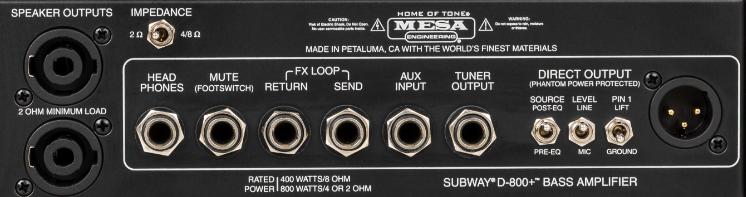
Mesa Subway 800 amps are rated 400W at 8 ohms, 800W at 4 ohms, and 800W at 2 ohms. Minimum impedance is 2 ohms.
For speakers, ideally you need the impedance, the RMS power rating, and the mechanical power rating. The combined impedance all speakers is compared to how much power the amp can produce.
A speaker's RMS power rating is often based on how much power the voice coil can safely dissipate. The Mechanical power rating can be more important for bass than the RMS power rating. Why? At low frequencies the speaker cones tend to move more. If you feed them too much power the cone will exceed it's max linear displacement capabilities, which can cause damage to the speaker's cone and suspension.
Unfortunately most cab makers do not publish any data on their designs mechanical power handling. Also how much the cones move is a function of both the driver and the way the cab is tuned. So if you put the same driver in a different cab, the drivers mechanical power handling capabilities will change. The main point is speaker's mechanical power ratings are not necessarily correlated with their RMS power ratings.
It's usually best if the amp's RMS power rating is equal to or lower than the combined RMS power rating of your cabs. However, the bottom line with speakers is you need to use a bit of discretion and restraint because it is possible to destroy the drivers with less than a cab's RMS power rating if you go nuts and crank the lows while pushing the amp to clipping.
You also need to know what happens when you add an extension cab. Ideally you use matching cabs.
Most of the time multiple speakers are connected in parallel, but there are rare examples where speakers are connected in series. If the impedance of both cabs is the same, for parallel you simply divide the impedance by the number of cabs. For example two 8 ohm cabs results in 8/2 = 4 ohms. Four 8 ohm cabs in parallel results in 8/4 = 2 ohms. If the impedance matches, the cabs share available power equally, power handling doubles, and sensitivity goes up +3dB.
If you connect two cabs with different impedances in parallel, use this formula where Z is impedance:
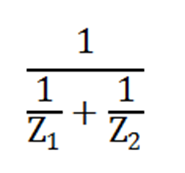
For example if you have an 8 ohm cabinet and a 4 ohm cabinet:
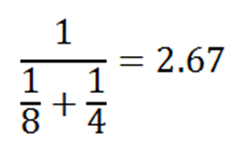
Power is not shared equally when the impedance is different. For 8 ohms and 4 ohms, divide the available power by 3. The 4 ohm cab gets two shares and the 8 ohm cab gets one share. For examples if the amp can produce 300W: 300/3 = 100W per share. The 4 ohm cab gets 100 x 2 = 200W and the 8 ohm cab gets 100 x 1 = 100W
In the rare instance the cabs are connected in series, the impedance simply adds. 8 + 8 = 16 ohms. 8 + 4 = 12 ohms. If the impedances match, the available power is shared equally. If impedances are different, the higher impedance cab dissipates more power.
Check the specs.
For a tube amp you need to know the expected impedance and power ratings. The amp will make the same power as long as you show it the expected load. Don't assume the amp is safe with an impedance mismatch...Impedance mismatch is when the load presented by the cabs is not what the amp expects.
The Ampeg V4B has 8 ohm, 4 ohm, and 2 ohm outputs and it is rated for 100W
For a solid state amp you need to know the minimum impedance the amp is rated for. You also need to know how much power the amp is rated for at the load presented by speakers.
Mesa Subway 800 amps are rated 400W at 8 ohms, 800W at 4 ohms, and 800W at 2 ohms. Minimum impedance is 2 ohms.
For speakers, ideally you need the impedance, the RMS power rating, and the mechanical power rating. The combined impedance all speakers is compared to how much power the amp can produce.
A speaker's RMS power rating is often based on how much power the voice coil can safely dissipate. The Mechanical power rating can be more important for bass than the RMS power rating. Why? At low frequencies the speaker cones tend to move more. If you feed them too much power the cone will exceed it's max linear displacement capabilities, which can cause damage to the speaker's cone and suspension.
Unfortunately most cab makers do not publish any data on their designs mechanical power handling. Also how much the cones move is a function of both the driver and the way the cab is tuned. So if you put the same driver in a different cab, the drivers mechanical power handling capabilities will change. The main point is speaker's mechanical power ratings are not necessarily correlated with their RMS power ratings.
It's usually best if the amp's RMS power rating is equal to or lower than the combined RMS power rating of your cabs. However, the bottom line with speakers is you need to use a bit of discretion and restraint because it is possible to destroy the drivers with less than a cab's RMS power rating if you go nuts and crank the lows while pushing the amp to clipping.
You also need to know what happens when you add an extension cab. Ideally you use matching cabs.
Most of the time multiple speakers are connected in parallel, but there are rare examples where speakers are connected in series. If the impedance of both cabs is the same, for parallel you simply divide the impedance by the number of cabs. For example two 8 ohm cabs results in 8/2 = 4 ohms. Four 8 ohm cabs in parallel results in 8/4 = 2 ohms. If the impedance matches, the cabs share available power equally, power handling doubles, and sensitivity goes up +3dB.
If you connect two cabs with different impedances in parallel, use this formula where Z is impedance:
For example if you have an 8 ohm cabinet and a 4 ohm cabinet:
Power is not shared equally when the impedance is different. For 8 ohms and 4 ohms, divide the available power by 3. The 4 ohm cab gets two shares and the 8 ohm cab gets one share. For examples if the amp can produce 300W: 300/3 = 100W per share. The 4 ohm cab gets 100 x 2 = 200W and the 8 ohm cab gets 100 x 1 = 100W
In the rare instance the cabs are connected in series, the impedance simply adds. 8 + 8 = 16 ohms. 8 + 4 = 12 ohms. If the impedances match, the available power is shared equally. If impedances are different, the higher impedance cab dissipates more power.
I was wrong, Deftones did not debut in the nineties, my apologies
According to Wikipedia Deftones debuted in the eighties
According to Wikipedia Deftones debuted in the eighties
I often run more amp than cab but you need to be sensible.
If your set 8s heavy and loud, that is potentially not good because it is easy to just turn a just a bit more...because the amp has it... but the cab might not.
Modern speakers are pretty resilant as opposed to some of the rubbish i grew up with..plus unless new..you never know what sort of life they've had.
I had 50w 15's in a Marshall cab, Ampeg 10's were 80w etc.
Now you have some very high wattage quoted..and some might be creative, but 300w 10" are not that hard to find in many cabs.
So I'd say 350w amp.and a single 10 for bass is not something you want run loud with pedals etc
but for a sensible gig and volumes, then should not be a issue.
But a rule of thumb would be 500w at 4ohms, you'd match 600w plus in cabs..
If your set 8s heavy and loud, that is potentially not good because it is easy to just turn a just a bit more...because the amp has it... but the cab might not.
Modern speakers are pretty resilant as opposed to some of the rubbish i grew up with..plus unless new..you never know what sort of life they've had.
I had 50w 15's in a Marshall cab, Ampeg 10's were 80w etc.
Now you have some very high wattage quoted..and some might be creative, but 300w 10" are not that hard to find in many cabs.
So I'd say 350w amp.and a single 10 for bass is not something you want run loud with pedals etc
but for a sensible gig and volumes, then should not be a issue.
But a rule of thumb would be 500w at 4ohms, you'd match 600w plus in cabs..


