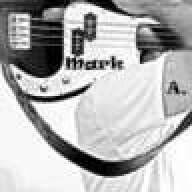
Thanks! It's a '57 Kay pro. Sounds great through the WA.Cool bass wow! (And amp of course)

TalkBass has been independent since 1998. Add your voice.
Create a free account to reply to discussions, view embedded media, and browse with fewer display ads.
Join free Log in
Want zero display ads or expanded classifieds tools? Compare plans.
Thanks! It's a '57 Kay pro. Sounds great through the WA.Cool bass wow! (And amp of course)

Yeah, I forgot about the two PH's being the same height. I guess I had an svt fridge in mind when I wrote that. I have a newer generation 4x4 Tacoma......I would bet it is not as high as your truck. Now trying to load a 410/15 PH solo is a different story.The PH412 is the same cab as the PH810. The main reason I sold my PH810 was because if I drove my extended cab 4wd Dodge Ram there wasn't a pivot point when loading all by myself, the top of the cab was flush with the tailgate down.
I have another Dodge truck, but its a 2wd and only a single cab, the PH810 was no problem tip and loading into it, but less cargo room I really didn't prefer taking that truck to gigs.
In a medium-sized cab, you might dig the latest iterations of the MAS 112 or Bodai 112 made by Mike Arnopol. Particularly for outdoor use (or when trying to carry a larger room with your rig), Mike's cabs are, in my experience, unequaled in terms of clear monitoring and carrying the house without having to be crushingly loud on stage. They would certainly have a stronger low end response (and better power handling) than the 210AV cabs (which I've played through on a few occasions). Max volume should be on par with a "super" 2x12.This is my experience for sure- those little Ampeg cabs are among my favorite pieces of gear ever, and they sound awesome for recording, vintage tones, and small rooms, but lots of low end at volume is not their strong suit at all, and that’s been the case with every amp I’ve paired them with.
With that in mind, what cabs do you like with your WA when you need lots of volume and a more full low end? I feel like the SPL I get from my 2/210AV stack is enough for most things, but the low end isn’t there with a 5er in a loud band, and it disappears even more outdoors.

In a medium-sized cab, you might dig the latest iterations of the MAS 112 or Bodai 112 made by Mike Arnopol. Particularly for outdoor use (or when trying to carry a larger room with your rig), Mike's cabs are, in my experience, unequaled in terms of clear monitoring and carrying the house without having to be crushingly loud on stage. They would certainly have a stronger low end response (and better power handling) than the 210AV cabs (which I've played through on a few occasions). Max volume should be on par with a "super" 2x12.
Efficiency vs. your two, 210AVs, I can't say for sure -- I found the Walkabout to be insufficient (at least if I wanted to keep it clean and dynamic) for loud gigs through my MAS 112 (though it sounded great), but mine is an 8 Ohm cab and a dB or two less efficient than the current, 4 Ohm cabs.
With the Walkabout and a MAS 112, I don't think you'd need an HPF for speaker protection, but, based on past experience, I think you'd get a small but significant increase in clean volume with the amp -- at least I did, running my fDeck HPF3 in the effects loop -- vs. using the lowest semi-parametric band. Your mileage might vary on that count.
Your reasoning is sound. I simply tried it in both spots and, to me, it sounded a little better (more open, clear, dynamic) in the effects loop. The difference was subtle, but there. Might be an impedance thing (I play passive basses), might be a combination of factors -- I don't know for sure.Interesting idea putting your hpf in the effects loop. I’ve always put mine between the bass and amp input. Logically I would think that you’re wasting preamp resources processing the lower frequencies that, in the end, you’re not sending to the cab. Can you explain you’re thought process?
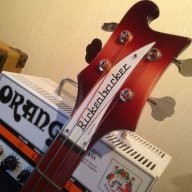

It depends. If the HPF can not handle line level signals, or has a low input impedance (<1M), then it must go before the input of the amp. If it can handle line level, it may still be better before the amp (especially if there's a compressor in the amp, the HPF should go before the compression) but overall it may not make much difference.Yeah - I'll try it in the effects loop on a couple of different amps and see how it sounds.
@agedhorse - any input on putting a HPF in different places in the signal chain?
The FDeck has input impedance of >1MIt depends. If the HPF can not handle line level signals, or has a low input impedance (<1M), then it must go before the input of the amp. If it can handle line level, it may still be better before the amp (especially if there's a compressor in the amp, the HPF should go before the compression) but overall it may not make much difference.

People have tested the FDeck in both places, and the maker, Francis Deck, has mentioned to feel free to use it wherever you wish. Apparently, the input is robust enough to take the hotter signal from the pre section or effects loop without issue.
From the laymans view, putting it in the pedal chain may sound weird, as where would all those really low frequencies come from if you have a string tuned to 41 Hz? But apparently, plenty do get generated as most users use it as the last pedal in the chain.
Again, from the layman’s view, placing it between the pre and power makes more sense as any really low frequencies that got boosted in the heads tone section can be controlled better.
I have not tested it in the effects loop, but now that this has popped up again, I’ll have to give it a test.
YMMV
I use the fdeck HPF-Pre Series 3 and it seems to work well in either position on the heads I've tried it on. My thinking is that if there is something I want to remove from my signal, it's usually better to do it earlier rather than later in the signal path. This is especially true if what I'm removing would trigger an effect in way that's not consistent with shaping the final output I'm trying to produce.
I can load one of my vintage svt fridges easier that I can the WA15!Yeah, I forgot about the two PH's being the same height. I guess I had an svt fridge in mind when I wrote that. I have a newer generation 4x4 Tacoma......I would bet it is not as high as your truck. Now trying to load a 410/15 PH solo is a different story.
 Truck or suv mind you... And not counting the head!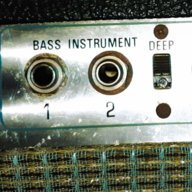
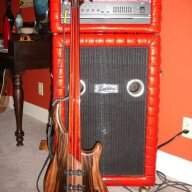
Your red Kustom amp is so cool!I can load one of my vintage svt fridges easier that I can the WA15!

Welcome to the tribe!I'm in on this! I was looking for a powerful, USA-made bass combo and I stumbled on the Walkabout. I found a 12" model on Guitar Center Used online for $850 but I talked them down over the phone to $600. It's an early silver-face model with the date given inside the amp as 2001. It has the active/passive inputs, no player network, no fx loop bypass.
It had some issues and looked like it was gigged hard. I first used wood-glue and a gloss black paint pen to fix the spots where the tolex was coming loose or chipped off. Then I took off all the knobs and scrubbed them with soap to get the dirt off. Every jack and pot got a good deoxit scrub (this very thread had a tip to use a bent pipe cleaner to get the inside of the jacks- genius!). I replaced the handle because the old one was held together with electrical tape. The fan wasn't working so I did the SilenX fan replacement, again from this thread (all I have to say is everyone here must be WAY better solderers than I am because that was not easy in that cramped space!). I must have blown out one pound of dust bunnies inside the amp. The stock tubes were totally dead and one was microphonic so I replaced them with a NOS General Electric 12AX7 in V1 and a JJ 12AX7 gold pin V2.
All I can say is it sounds unbelievable. It's the first amp in years that really hit me with that inspiring feeling. The notes just feel so alive and the low-mids are so thick. I used the EQ tip from here to use the first parametric band to scoop out some of the real lows and boost the Bass knob a bit, which really made it pump.
Have taken it to practice a few times, just the one 1x12 combo has no trouble in my post-rock trio. It handles effects very well. I play a Bass VI (six strings, tuned as a guitar one octave down) and it gives the guitar-sounding strings a very sweet sound.
I must have read almost every page of this mega thread off and on at work while I was waiting to get home and play it more. I had no idea this amp had a cult following until after I bought it and played it awhile. I'm looking forward to the next time someone asks if anyone has ever tried sending its preamp to a bigger power amp and the next time someone asks if you can run it at 2ohms!
No doubt....It almost seems counter intuitive. Trying to lift a heavy combo like a Scout, is like deadlifting a bag of cement, compared to moving a load almost three times the weight with a hand truck.I can load one of my vintage svt fridges easier that I can the WA15!

I'm in on this! I was looking for a powerful, USA-made bass combo and I stumbled on the Walkabout. I found a 12" model on Guitar Center Used online for $850 but I talked them down over the phone to $600. It's an early silver-face model with the date given inside the amp as 2001. It has the active/passive inputs, no player network, no fx loop bypass.
It had some issues and looked like it was gigged hard. I first used wood-glue and a gloss black paint pen to fix the spots where the tolex was coming loose or chipped off. Then I took off all the knobs and scrubbed them with soap to get the dirt off. Every jack and pot got a good deoxit scrub (this very thread had a tip to use a bent pipe cleaner to get the inside of the jacks- genius!). I replaced the handle because the old one was held together with electrical tape. The fan wasn't working so I did the SilenX fan replacement, again from this thread (all I have to say is everyone here must be WAY better solderers than I am because that was not easy in that cramped space!). I must have blown out one pound of dust bunnies inside the amp. The stock tubes were totally dead and one was microphonic so I replaced them with a NOS General Electric 12AX7 in V1 and a JJ 12AX7 gold pin V2.
All I can say is it sounds unbelievable. It's the first amp in years that really hit me with that inspiring feeling. The notes just feel so alive and the low-mids are so thick. I used the EQ tip from here to use the first parametric band to scoop out some of the real lows and boost the Bass knob a bit, which really made it pump.
Have taken it to practice a few times, just the one 1x12 combo has no trouble in my post-rock trio. It handles effects very well. I play a Bass VI (six strings, tuned as a guitar one octave down) and it gives the guitar-sounding strings a very sweet sound.
I must have read almost every page of this mega thread off and on at work while I was waiting to get home and play it more. I had no idea this amp had a cult following until after I bought it and played it awhile. I'm looking forward to the next time someone asks if anyone has ever tried sending its preamp to a bigger power amp and the next time someone asks if you can run it at 2ohms!