
Enjoy the benefits of a premium membership!
Upgrade Account
-
TalkBass has been independent since 1998. Add your voice.
Create a free account to reply to discussions, view embedded media, and browse with fewer display ads.
Join free Log in
Want zero display ads or expanded classifieds tools? Compare plans.
You are using an out of date browser. It may not display this or other websites correctly.
You should upgrade or use an alternative browser.
You should upgrade or use an alternative browser.
Mesa Subway Bass DI-Preamp
- Thread starter bucephylus
- Start date
-
- Tags
- mesa mesa subway subway
More options
Who Replied?

FWIW, I somewhat criticized Andy for the lack of a mute switch when the box was announced. Then, I went ahead and got the box, planning to just plug in and tune separately. What I discovered is that you can just plug the tuner into the through jack and simply zero the input volume to tune, which works just as well as a mute switch. So, that feature, at least, isn't really missing. BTW, the preamp voicing is outstanding with the passive Fender J.Not to stir the pot but does anyone know or think there might be a plus version of the DI pedal? I don't need the plus version of the amp but I wouldn't mind a few extra features on the DI, like a mute switch, etc.

FWIW, I somewhat criticized Andy for the lack of a mute switch when the box was announced. Then, I went ahead and got the box, planning to just plug in and tune separately. What I discovered is that you can just plug the tuner into the through jack and simply zero the input volume to tune, which works just as well as a mute switch. So, that feature, at least, isn't really missing. BTW, the preamp voicing is outstanding with the passive Fender J.
That would work great for regular gigs but it would be nice to have a mute for the wedding and church gigs as both of those types of settings have lots of starts and stops, announcements, etc. I guess I could just get a mute pedal to put in front of it.
It would also be nice to have the bright switch and aux in / headphone out. At private events, people always come up and ask "can you play........", and its nice to download a song on the phone while on break and learn it real quick. The D800 has this feature but when we are ampless it would be nice to just bring the DI pedal.
Not complaining, I love the Mesa tone and the Subway DI already has great and very useful features. I think I will just order it and if Mesa comes out with a new one I'll think about it then.
Last edited:

That would work great for regular gigs but it would be nice to have a mute for the wedding and church gigs as both of those types of settings have lots of starts and stops, announcements, etc. I guess I could just get a mute pedal to put in front of it.
It would also be nice to have the bright switch and aux in / headphone out. At private events, people always come up and ask "can you play........", and its nice to download a song on the phone while on break and learn it real quick. The D800 has this feature but when we are ampless it would be nice to just bring the DI pedal.
Not complaining, I love the Mesa tone and the Subway DI already has great and very useful features. I think I will just order it and if Mesa comes out with a new one I'll think about it then.
Slap it on a nano board with a tuner pedal and a one-spot and you're set.
Last edited:

- Feb 12, 2006
- 61,035
- 5
- 220,956
- Disclosures
- Development Engineer-Mesa Boogie, Development Engineer-Genzler (pedals), Product Support-Genz Benz
Features always come with a tradeoff. Beyond a certain point, in order to operate from batteries and retain high audio quality with low noise (especially driving a pair of balanced outputs), the addition of features becomes a problem due to the added electrical load. Most of the low power op amps struggle with either driving long lines and low impedance loads, can't drive close to the supply rails (thus limiting the ability to drive power amps), or suffer from noise floor challenges. Then there's the whole simplicity versus versatility challenge that we have seen with the D-800 versus the plus model that targets different players needs/wants/desires.
I am listening, and there are possibilities, but we are sensitive to targeting these products to the players that they are most useful to primarily. If the market is large enough, sure, anything is possible.
I am listening, and there are possibilities, but we are sensitive to targeting these products to the players that they are most useful to primarily. If the market is large enough, sure, anything is possible.
Features always come with a tradeoff. Beyond a certain point, in order to operate from batteries and retain high audio quality with low noise (especially driving a pair of balanced outputs), the addition of features becomes a problem due to the added electrical load. Most of the low power op amps struggle with either driving long lines and low impedance loads, can't drive close to the supply rails (thus limiting the ability to drive power amps), or suffer from noise floor challenges. Then there's the whole simplicity versus versatility challenge that we have seen with the D-800 versus the plus model that targets different players needs/wants/desires.
I am listening, and there are possibilities, but we are sensitive to targeting these products to the players that they are most useful to primarily. If the market is large enough, sure, anything is possible.
Thanks for listening

I'm just talking up a wish list. To be honest, between my Titan, D800 and the Subway DI, Life is good.
I am listening, and there are possibilities, but we are sensitive to targeting these products to the players that they are most useful to primarily. If the market is large enough, sure, anything is possible.
I think it is dependent on the use cases. For me, I can see how a mute switch (foot switch) would be useful. If I'm really going ultra-light, I'm taking a powered pa cab, the Subway, a few cables, and my bass (though usually 2 in a double bag). In that case an easy way to mute the setup to switch basses or take a break would be what I'm used to. Since I'm not going into a head I can't mute there - would have to twiddle a knob and I'm a creature of habit. I normally have a tuner pedal so i'm used to stepping on that.
That said, the above nano rig I show solves that problem and is pretty damn portable. Plus you've got extra 9V cables to power some other things if you want.
I know there are guys that run a tuner from a separate output that might want that though you can do that from the thru.
The parametric would be nice - maybe concentric pots to save space? Though that might go above the power requirements for a battery. I don't really run anything from battery power anymore though as good 9V power supplies are easy to find and much more flexible.
- Feb 12, 2006
- 61,035
- 5
- 220,956
- Disclosures
- Development Engineer-Mesa Boogie, Development Engineer-Genzler (pedals), Product Support-Genz Benz
My experience with concentric pots (except on large format mixing consoles) has been horrible... not user friendly, and nowhere near robust enough for a piece of MI gear, especially a pedal.
My experience with concentric pots (except on large format mixing consoles) has been horrible... not user friendly, and nowhere near robust enough for a piece of MI gear, especially a pedal.
yeah, as I was typing that I thought the same thing. I suppose one way to save space would be to have the frequency pots have a smaller knob, but at some point space is space. As it stands the size is a perfect fit for the nano board, and I think that provides a pretty ideal grab-and-go solution.
- Feb 12, 2006
- 61,035
- 5
- 220,956
- Disclosures
- Development Engineer-Mesa Boogie, Development Engineer-Genzler (pedals), Product Support-Genz Benz
Right, and the nano-board format was a consideration when developing this platform. At some point size, control position, feature set and available space dictate the product itself if you want it to be player-friendly.yeah, as I was typing that I thought the same thing. I suppose one way to save space would be to have the frequency pots have a smaller knob, but at some point space is space. As it stands the size is a perfect fit for the nano board, and I think that provides a pretty ideal grab-and-go solution.

To Agedhorse, is this really "the subway D800 preamp in a box" or is it deleting some of the Amplifiers pre? And if so what is NOT in this that is in the full amp package? (Beside the power amp of course)
- Feb 12, 2006
- 61,035
- 5
- 220,956
- Disclosures
- Development Engineer-Mesa Boogie, Development Engineer-Genzler (pedals), Product Support-Genz Benz
This is almost exactly the same minus the power amp output tube emulation circuitry which is tightly integrated with the power amp itself.

I have a question about the DI out before I order one:
In the manual, DIRECT OUT XLR JACK paragraph, it says the DI out XLR ranges from -30 to -10 dBu depending on the MASTER.
The video says it depends on the INPUT.
In the DI OUT SOURCE SWITCH paragraph, it says the signal is source from the Buffer pre gain or before the Master.
Something does not add up here, obviously the signal of the DIRECT OUT XLR can not be controlled by the master. (Or is it?)
Does anybody has an idea of what do we have at the DIRECT OUT XLR in pre or post EQ mode, which controls affect it and what is the signal range? Thanks.
In the manual, DIRECT OUT XLR JACK paragraph, it says the DI out XLR ranges from -30 to -10 dBu depending on the MASTER.
The video says it depends on the INPUT.
In the DI OUT SOURCE SWITCH paragraph, it says the signal is source from the Buffer pre gain or before the Master.
Something does not add up here, obviously the signal of the DIRECT OUT XLR can not be controlled by the master. (Or is it?)
Does anybody has an idea of what do we have at the DIRECT OUT XLR in pre or post EQ mode, which controls affect it and what is the signal range? Thanks.
- Feb 12, 2006
- 61,035
- 5
- 220,956
- Disclosures
- Development Engineer-Mesa Boogie, Development Engineer-Genzler (pedals), Product Support-Genz Benz
The signal routing and level are as the manual says (unless I am misunderstanding your question).
The source switch takes the signal from right after the input buffer (like with any active DI) when in the pre position and right before the master volume (after the eq) in the post position. I believe there is a block diagram in the full-sized downloadable manual on the website which might be helpful.
Regarding the output level, with an average bass and average playing style (average is of course debatable), the level will fall close to the middle of the stated range.
[edit] I think I know see your question... The level in the post position does not depend on the master level.
I will double-check the manual and see if there is a typo. Thanks for bringing this to our attention.
The source switch takes the signal from right after the input buffer (like with any active DI) when in the pre position and right before the master volume (after the eq) in the post position. I believe there is a block diagram in the full-sized downloadable manual on the website which might be helpful.
Regarding the output level, with an average bass and average playing style (average is of course debatable), the level will fall close to the middle of the stated range.
[edit] I think I know see your question... The level in the post position does not depend on the master level.
I will double-check the manual and see if there is a typo. Thanks for bringing this to our attention.

might need one of these for a show in phoenix, not bringing the d180 or orange cabs in the rent a car
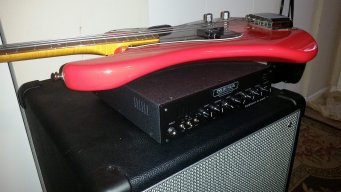
so im thinking of selling off my d800 for a the subway bass di and a crest prolite 2.0/3.0 combo to power my fearfuls. what do you guys think? D800 sound but with alot more power?

so im thinking of selling off my d800 for a the subway bass di and a crest prolite 2.0/3.0 combo to power my fearfuls. what do you guys think? D800 sound but with alot more power?
I have not tried the pedal, but the Vintage Stallion's post, above, states that there's "tube emulation circuitry" in the power amp portion of the head but not the pedal, so there's that.
- Feb 12, 2006
- 61,035
- 5
- 220,956
- Disclosures
- Development Engineer-Mesa Boogie, Development Engineer-Genzler (pedals), Product Support-Genz Benz
You are correct, in the downloadable version of the manual there are a few extra words that make it incorrect. If you remove "at higher MASTER VOLUME settings", the paragraph reads correctly. Sorry for the confusion (and thanks for reading the manual), we will update the manual accordingly.I have a question about the DI out before I order one:
In the manual, DIRECT OUT XLR JACK paragraph, it says the DI out XLR ranges from -30 to -10 dBu depending on the MASTER.
The video says it depends on the INPUT.
In the DI OUT SOURCE SWITCH paragraph, it says the signal is source from the Buffer pre gain or before the Master.
Something does not add up here, obviously the signal of the DIRECT OUT XLR can not be controlled by the master. (Or is it?)
Does anybody has an idea of what do we have at the DIRECT OUT XLR in pre or post EQ mode, which controls affect it and what is the signal range? Thanks.
That circu
That tube emulation circuit is only active when your pushing the power amp part of the d800, correct? Like when the power amp limit/clip/whatever thats called light comes on right. I didn't think it was active at normal volumesI have not tried the pedal, but the Vintage Stallion's post, above, states that there's "tube emulation circuitry" in the power amp portion of the head but not the pedal, so there's that.


