• TalkBass has been independent since 1998. Add your voice.
    Create a free account to reply to discussions, view embedded media, and browse with fewer display ads.
    Join freeLog in
    Want zero display ads or expanded classifieds tools? Compare plans.

Mesa Subway D-350!

I’m familiar with Cake, worked many of their shows around the Fashon Nugget era.

The bass tone was fairly low mid and mid-centric. As usual though, it depends on the cabinet.

With the Subway 115, set the tweeter level no more than 12:00 and roll the bass eq off just a little. Add a little bit of low and high mid to taste and you should be in the ballpark.

Thank you for your response. The hardest part of tweaking my 350 is it always sounds good.
I’m familiar with Cake, worked many of their shows around the Fashon Nugget era.

The bass tone was fairly low mid and mid-centric. As usual though, it depends on the cabinet.

With the Subway 115, set the tweeter level no more than 12:00 and roll the bass eq off just a little. Add a little bit of low and high mid to taste and you should be in the ballpark.
I’m familiar with Cake, worked many of their shows around the Fashon Nugget era.

The bass tone was fairly low mid and mid-centric. As usual though, it depends on the cabinet.

With the Subway 115, set the tweeter level no more than 12:00 and roll the bass eq off just a little. Add a little bit of low and high mid to taste and you should be in the ballpark.

Thank you for your response. My present eq/horn settings already are in your suggested ballpark. Dailed up the input recently and it sounds close. Getting feedback from you and this knowledgeable group is amazing. Thanks again.
I’m familiar with Cake, worked many of their shows around the Fashon Nugget era.

The bass tone was fairly low mid and mid-centric. As usual though, it depends on the cabinet.

With the Subway 115, set the tweeter level no more than 12:00 and roll the bass eq off just a little. Add a little bit of low and high mid to taste and you should be in the ballpark.

.
 
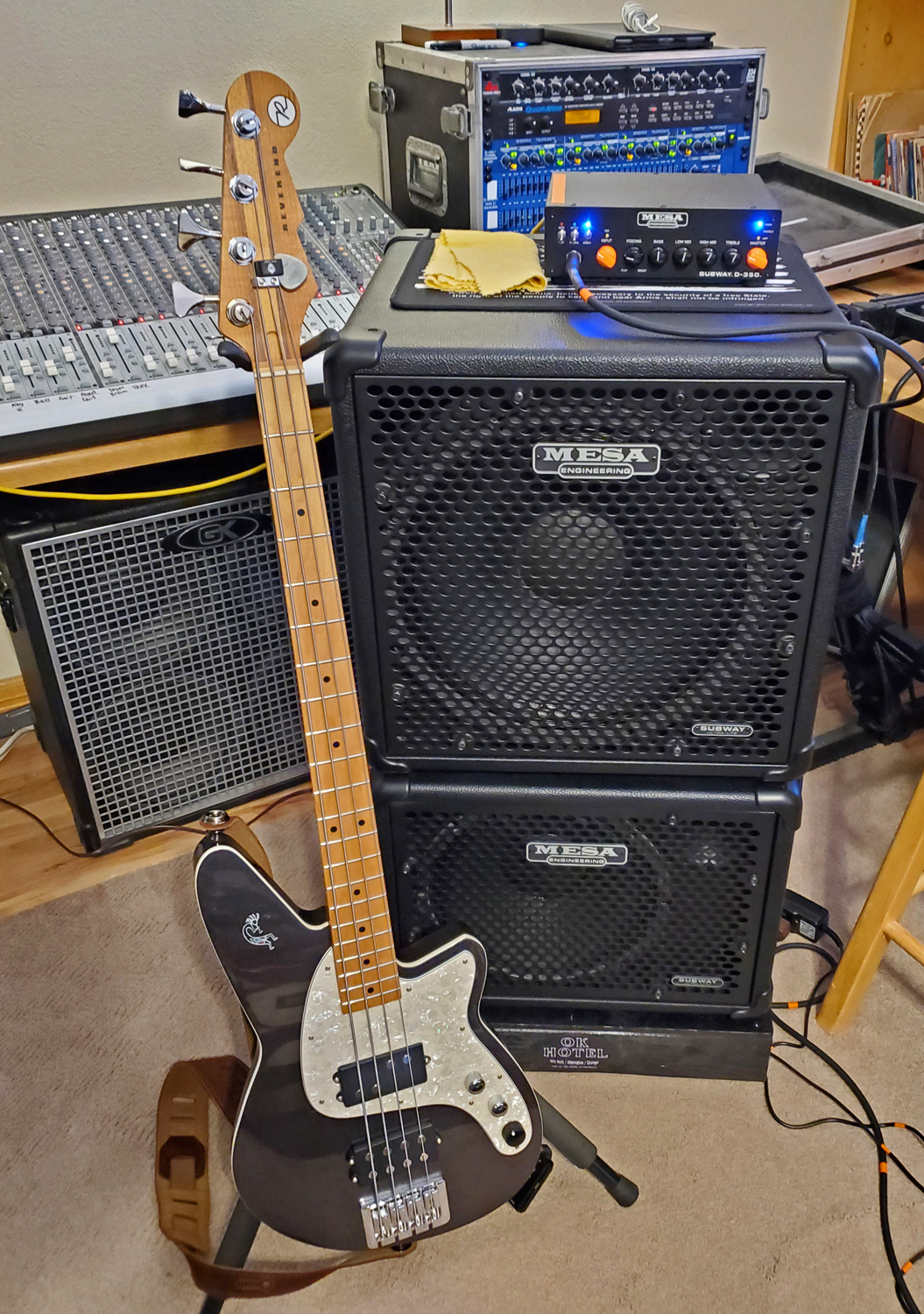
*cross post... Finally got a pic of my current practice / gig rig = SW112 / SW115 / SW D350.
The D350 far exceeded my expectations. Amazing amount of grunt!
I like simple / easy, and like set it & forget it.
Everybody (including me...) LOVES the sound of this rig! (how many times have we heard that here?)

DuMD9ec.jpg
 
Any opinions on how well a Magellan 212T may pair with a Subway cab, D-350 in particular? Under powered or in the zone?
Certainly in the zone, though being a 4 ohm cabinet won’t pair with another cabinet and the D-350.
 
It would be almost too easy to just give in and order a Subway 115. Whenever the day comes I get to finally try one in person I'll see what all the buzz is about. Watching with curiosity for what's coming next too.
I'm thinking, as hairy as it could be for some.

Some sort of FaitalPRO 10PR300 10" Neodymium Professional Woofer 8 Ohm joint saddled with the D350 in a nice cabinet mom would like. You would still have to careful with over use of too much bass but...

:)
 
Certainly in the zone, though being a 4 ohm cabinet won’t pair with another cabinet and the D-350.

Bob Gallien had mentioned in an interview that GK uses a multilayer circuit board with gold-on-gold connectors that never corrode and do not give you connection problems. What does Mesa Boogie use on their Subway series? Tin? Wouldn’t tin corrode eventually have interconnection problems down the road? Thank you, Bill.
 
  • Like
Reactions: MCF and DJ Bebop
Bob Gallien had mentioned in an interview that GK uses a multilayer circuit board with gold-on-gold connectors that never corrode and do not give you connection problems. What does Mesa Boogie use on their Subway series? Tin? Wouldn’t tin corrode eventually have interconnection problems down the road? Thank you, Bill.
While the term "gold" sounds exotic and premium, it turns out that gold on gold isn't much (if any) more reliable than passivated tin in most applications, and in fact tin has the added advantage of being a thicker plating and more forgiving in many connector applications. The thickness of the gold flash on connectors is typically ~5 - 10 micro-inches, which when plated on conductive coated clear Mylar can actually be seen through, it's THAT thin. Gold is not plated directly over copper, there must be a diffusion barrier of nickel to prevent copper ion migration through the gold. Tin plating thickness is typically 200-300 micro-inches, and is generally more forgiving.

Gold is better where there is chemical reactivity present (vapors corrosive to copper or tin), or where the dimensions and spacing are very close (ie. fine pitch), or a hard surface is required (like for a switch contact, but the plating will be much thicker and more expensive). Tin is better for general connector applications because it is more forgiving.

We use both gold and tin where appropriate, it depends on the connector and the application. For most switches, we do use gold (called hard gold over nickel) plated contacts because they are more reliable and last longer. I am wary of using gold as a marketing term because in general 5-10 micro-inches of gold is more marketing than performance IMO. If you look at (real) high reliability connectors that are not used in consumer items, you won't see 5-10 micro-inches but considerably thicker and it may also be a type of plating called hard gold.

The ICEPower modules that GK uses in all of their amps use tin plated connectors exclusively, ICEPower does not use ANY gold connectors, therefore all GK connections can't possibly be gold on gold. It's just simple fact, doesn't make it better or worse just not all gold on gold. In general I have always liked the way GK has laid their amps out, and they haven't seemed to have had any issues with their connectors regardless of the material.

I've used tin on tin for over 40 years, I haven't had any corrosion issues with any of my designs over that 40 year period, I'm sure my results would be about the same if I had used gold.

[edit: thought I would do a quick fact check to be sure I was remembering correctly and here's a couple of GK PCB that clearly shows tin connectors]:
upload_2023-7-10_12-43-6.png

upload_2023-7-10_12-45-5.png
 
While the term "gold" sounds exotic and premium, it turns out that gold on gold isn't much (if any) more reliable than passivated tin in most applications, and in fact tin has the added advantage of being a thicker plating and more forgiving in many connector applications. The thickness of the gold flash on connectors is typically ~5 - 10 micro-inches, which when plated on conductive coated clear Mylar can actually be seen through, it's THAT thin. Gold is not plated directly over copper, there must be a diffusion barrier of nickel to prevent copper ion migration through the gold. Tin plating thickness is typically 200-300 micro-inches, and is generally more forgiving.

Gold is better where there is chemical reactivity present (vapors corrosive to copper or tin), or where the dimensions and spacing are very close (ie. fine pitch), or a hard surface is required (like for a switch contact, but the plating will be much thicker and more expensive). Tin is better for general connector applications because it is more forgiving.

We use both gold and tin where appropriate, it depends on the connector and the application. For most switches, we do use gold (called hard gold over nickel) plated contacts because they are more reliable and last longer. I am wary of using gold as a marketing term because in general 5-10 micro-inches of gold is more marketing than performance IMO. If you look at (real) high reliability connectors that are not used in consumer items, you won't see 5-10 micro-inches but considerably thicker and it may also be a type of plating called hard gold.

The ICEPower modules that GK uses in all of their amps use tin plated connectors exclusively, ICEPower does not use ANY gold connectors, therefore all GK connections can't possibly be gold on gold. It's just simple fact, doesn't make it better or worse just not all gold on gold. In general I have always liked the way GK has laid their amps out, and they haven't seemed to have had any issues with their connectors regardless of the material.

I've used tin on tin for over 40 years, I haven't had any corrosion issues with any of my designs over that 40 year period, I'm sure my results would be about the same if I had used gold.

[edit: thought I would do a quick fact check to be sure I was remembering correctly and here's a couple of GK PCB that clearly shows tin connectors]:
View attachment 5121021
View attachment 5121023
Wow! Thank YOU very much for this excellent information, it is greatly appreciated. -Bill
 
The Rumble 410 is a fairly decent cabinet, just a little large and heavy.
I was surprised to see that the Rumble is 7 1/2 pounds heavier than my Subway 410. They impressed me as being very good for the money when I heard one powered by a MarkBass head some time ago. I suspect it would sound great with a D350 and make a nice affordable gig ready rig for someone on a budget.
 
I’m familiar with Cake, worked many of their shows around the Fashon Nugget era.

The bass tone was fairly low mid and mid-centric. As usual though, it depends on the cabinet.

With the Subway 115, set the tweeter level no more than 12:00 and roll the bass eq off just a little. Add a little bit of low and high mid to taste and you should be in the ballpark.
Sacto’s finest! So cool that you worked with them and could give advice on achieving a similar tone. I am so happy I joined the Mesa family. Thank you.
 
While the term "gold" sounds exotic and premium, it turns out that gold on gold isn't much (if any) more reliable than passivated tin in most applications, and in fact tin has the added advantage of being a thicker plating and more forgiving in many connector applications. The thickness of the gold flash on connectors is typically ~5 - 10 micro-inches, which when plated on conductive coated clear Mylar can actually be seen through, it's THAT thin. Gold is not plated directly over copper, there must be a diffusion barrier of nickel to prevent copper ion migration through the gold. Tin plating thickness is typically 200-300 micro-inches, and is generally more forgiving.

EVjWLOo.jpg