Yes, I know from personal experienceI can think of another pic or two that would work well lol but then I would (rightfully) be in TB jail for violating our no politics rule.

That's why I went where I went until the flat earth police come for me

TalkBass has been independent since 1998. Add your voice.
Create a free account to reply to discussions, view embedded media, and browse with fewer display ads.
Join free Log in
Want zero display ads or expanded classifieds tools? Compare plans.
Yes, I know from personal experienceI can think of another pic or two that would work well lol but then I would (rightfully) be in TB jail for violating our no politics rule.

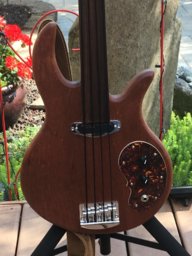
Have to say it's kind of a unique collector's piece
 .
.
For smaller companies, outsourcing is not that cheap. It requires not only contracting with factories but hiring consultants and project managers (preferably unaffiliated with the manufacturers, packagers and shippers) to supervise to enforce your product standards, and those costs have to be amortized over a relatively small volume of merchandise. Boutique electronics can't be priced like commodities, regardless of where they're made. There are a lot of external costs as well. Genzler isn't manufacturing in Taiwan because it's cheapest -- last I heard (admittedly a bunch of years ago) it costs on average around twice as much as one of the industrial centers in mainland China -- but probably because as a startup they determined it was the best option for getting product out the door without having to fund the launch of an entire factory from scratch or outsource to vendors they weren't sufficiently confident in.So they’re charging US-made prices but manufacturing overseas? Not kool! That just confirms my cynicism when it comes to most businesses. Eliminate local jobs but charge the same as if they were still doing the work. Great for profits, sucks for everyone else. If I am wrong about this feel free to correct me. I’m not trying to pick on any one company and I do quite like Genzler’s product line so I’m kind of saying this with some reluctance.
I have negotiated prices on mesa gear twice over the past few years. I would have bought anyway at list price but it never hurts to ask. One dealer told me they could not advertise a lower price on new gear but could certainly sell for whatever they want. Not sure if they are really prohibited from advertising the lower price or not.This simply is not true, though people on the internet can say anything they want, truth or not.
For smaller companies, outsourcing is not that cheap. It requires not only contracting with factories but hiring consultants and project managers (preferably unaffiliated with the manufacturers, packagers and shippers) to supervise to enforce your product standards, and those costs have to be amortized over a relatively small volume of merchandise. Boutique electronics can't be priced like commodities, regardless of where they're made. There are a lot of external costs as well. Genzler isn't manufacturing in Taiwan because it's cheapest -- last I heard (admittedly a bunch of years ago) it costs on average around twice as much as one of the industrial centers in mainland China -- but probably because as a startup they determined it was the best option for getting product out the door without having to fund the launch of an entire factory from scratch or outsource to vendors they weren't sufficiently confident in.
By contrast, Mesa set up its factory decades ago, and they don't have to hire outside consultants to ensure that the factory doesn't work against Mesa's own interests.
I occasionally dip into Bunnie Huang's blog for insights into electronics manufacture and outsourcing. It's very accessible to people outside the trade and occasionally fascinating, such as this piece on why subtle design decisions can cause drastic price changes or this one on why so many products aren't made by robots. He also has an extensive series on his own experiences, step by step, in the process of getting a product of his own from design files through manufacture to shipping. It's pretty brutal but he documents it with an easygoing sense of humor. This isn't a field I'm in, I just find it interesting to read about, and as I have friends who are experimenting with parlaying their electronics skills into side jobs designing and selling products in small volumes, I get to see some of the stresses they go through.


It's more or less a older one-off concept piece that got out into the wild...
So, do you guys have any thoughts or comments?


Thank you for your insights and the links.For smaller companies, outsourcing is not that cheap. It requires not only contracting with factories but hiring consultants and project managers (preferably unaffiliated with the manufacturers, packagers and shippers) to supervise to enforce your product standards, and those costs have to be amortized over a relatively small volume of merchandise. Boutique electronics can't be priced like commodities, regardless of where they're made. There are a lot of external costs as well. Genzler isn't manufacturing in Taiwan because it's cheapest -- last I heard (admittedly a bunch of years ago) it costs on average around twice as much as one of the industrial centers in mainland China -- but probably because as a startup they determined it was the best option for getting product out the door without having to fund the launch of an entire factory from scratch or outsource to vendors they weren't sufficiently confident in.
By contrast, Mesa set up its factory decades ago, and they don't have to hire outside consultants to ensure that the factory doesn't work against Mesa's own interests.
I occasionally dip into Bunnie Huang's blog for insights into electronics manufacture and outsourcing. It's very accessible to people outside the trade and occasionally fascinating, such as this piece on why subtle design decisions can cause drastic price changes or this one on why so many products aren't made by robots. He also has an extensive series on his own experiences, step by step, in the process of getting a product of his own from design files through manufacture to shipping. It's pretty brutal but he documents it with an easygoing sense of humor. This isn't a field I'm in, I just find it interesting to read about, and as I have friends who are experimenting with parlaying their electronics skills into side jobs designing and selling products in small volumes, I get to see some of the stresses they go through.

Me too now that I've had more time to think of it.If a D-350 maintained the DI, Aux In and Headphone Out I would love to have one for studio work and travelin'.

sounds about right, and all of why there's no 350+ or 500+ in the first place.The weight is already light, we want all of he features of the 800, the biggest plus would be a possible reduction in cost. All else being the same, it would be the price difference between the two power modules and then add in andy engineering work and any overhead incurred with a different SKU. Not sure what power modules are used, but there is something like a $30 difference between similar ICE modules of 1000W and 500W. So while 350W is enough for most gigs, would we rather pay a few bucks more and get 800W? Probably. Without knowing the exact modules used, I'm guesstimating, but I doubt the price difference would be more than $100.