• TalkBass has been independent since 1998. Add your voice.
    Create a free account to reply to discussions, view embedded media, and browse with fewer display ads.
    Join freeLog in
    Want zero display ads or expanded classifieds tools? Compare plans.

Mesa Subway D-800+

So i was reading the d800+ manual @agedhorse and i saw it has 2 hpf's in it, a fixed one at 22hz and the variable one. Whats the point of two of them?
Whenever 2 HP filters are cascaded, the net turnover frequency will shift up. Each filter is second order. The base frequency of the two cascaded filters is 28-30Hz. As the control is rotated clockwise, the HP frequency increases.
 
Whenever 2 HP filters are cascaded, the net turnover frequency will shift up. Each filter is second order. The base frequency of the two cascaded filters is 28-30Hz. As the control is rotated clockwise, the HP frequency increases.
How steep is the roll off (dB/octave) Andy and is it variable as well? If you have something proprietary going on with the circuit and would prefer not to share any additional information that's cool. Thanks!
 
Easy to miss. A compound filter like this just sounds better and more musical when used for acoustic roll off. A pure 4th order filter works better for driver protection, the combination is the best of both worlds for this application IMO.
 
So I don't understand those numbers and such about the hpf. Would one be able to achieve a sealed cab vibe with that? My mind is reeling at all the sound possibilities using the hpf, voicing, deep switch and bass knob in conjunction with each other. I'm already discovering so many possibilities on the classic even without the adjustable hpf.

 
So I don't understand those numbers and such about the hpf. Would one be able to achieve a sealed cab vibe with that? My mind is reeling at all the sound possibilities using the hpf, voicing, deep switch and bass knob in conjunction with each other. I'm already discovering so many possibilities on the classic even without the adjustable hpf.
Yes, adjusting the HPF freq can give the impression of various sealed cab tunings.
 
All - I just received the D-800+. It arrived about an hour ago. I only had about 15 minutes to play around with it before meetings started in my home office again .... BTW - I pre-ordered with Sweetwater and they already came in. I don't know how many they have, but I got mine!

Plugged into a Bag End S15X/S15 stack, the amp sounds really wonderful. It has all of the plug and play characteristic as the D-800. You don't have to do much to get a really great tone. The tone circuits and controls will definitely be for tweaking and not major EQing.

So here are the quick hits on the new features (again, only a few minutes spent):

Variable High Pass Filter - I'm really going to like this control. Dialing it up to 9:00 started taking away the rumble without the perceived low end. The Bag End stack starts rolling off at 50 hz, so it will be interesting to see how well it handles other cabinets. But there is really no reason to NOT use this control to kill unuseful low frequency ranges. Lots more to test here.

agedhorse - Does the HPF affect the DI signal? I actually hope that it does, but wanted to check.

Variable frequency low/high mid controls. - I LOVE them. I was able to get a lot of mid range growl by setting the low mid frequency to 10:00 and bumping it up. I boosted just a "nudge", but what a great difference.

I'm not a big fan of boosting high mids, but the frequency range goes from 300 to 5,000 hz, so there is a crazy amount of tweaking that can be done. My normal trick on my ParaEQ is to take 2,000-3,000 hz down a bit to get rid some high mid nasalness. Then I boost a bit of treble around 6K or 7K to get some cut back in. I tried something similar with the Mesa and it was completely unnecessary on this head. When I put the voicing filter at 9:00, the signal is really well balanced and this additional tweaking isn't needed.

Bright Switch - This is probably the only control I won't use UNLESS I am using a 15 inch speaker without a tweeter. It was a bit too bright for my tastes, but then again, I don't go for crazy amounts of treble. This is more of a preference thing.

With all of the EQing available, I also found the Deep switch to not be needed with a full stack. I think I'll save that more for a single cab application, where low end is very thin.

So overall, this is still a very plug and play amp. That doesn't go away. But the additional controls, especially the low and high mid controls, will be worth it for me. I'll write more as I get more time with it.
 
The variable HPF only affects the post DI output. In the pre position, the signal is sourced directly from the input buffer exactly like an active DI.
 
  • Like
Reactions: Low Key
The variable HPF only affects the post DI output. In the pre position, the signal is sourced directly from the input buffer exactly like an active DI.

Which makes sense, since low end in the house necessarily has to be handled by the sound tech. One hopes they have similarly good technology & skills. Too bad that's often not the case. In some cases I'd be afraid to send the board a high-passed signal for fear of what they might do to compensate.
 
Which makes sense, since low end in the house necessarily has to be handled by the sound tech. One hopes they have similarly good technology & skills. Too bad that's often not the case. In some cases I'd be afraid to send the board a high-passed signal for fear of what they might do to compensate.

Yeah, I thought about this more and it probably makes sense to have the house take the entire signal and deal with it. My only only thought was that a high-passed signal would eliminate some low end rumble and thump to the board, thus requiring less compression and squashing of the bass signal. But then again, PA's tend to have subs that can handle lower lows. Plus, PA power amps tend to have HPFs anyway. Regardless, it's a great feature even if only used for bass speakers. I was coincidentally searching for a HPF pedal before I decided on the Mesa.
 
  • Like
Reactions: /\/\3phist0
I hear you about the FOH techs. In the world I travel, it's rarely an issue but if it is, you can always switch to post and then take a listen out in the house and work with the audio tech to the best of your ability to come up with something acceptable. If fact, the Subway platform is based somewhat on the "voiced" channel strip concept, not just electronically but mechanically as well.
 
Well I got mine today as well, got to plug it in and make sure everything works, which it does. Sadly, I won't get to put it through its paces until next week...
IMG_2734.JPG
 
Well I got mine today as well, got to plug it in and make sure everything works, which it does. Sadly, I won't get to put it through its paces until next week...

Cool! Good luck with yours as well! I won't have much of a chance to use it live until a week from Sunday, at a 1,000 seat church auditorium. I'll bring only one of my Bag End 15s, mostly as a monitor. I'm dying to try it with a full band though.
 
Cool! Good luck with yours as well! I won't have much of a chance to use it live until a week from Sunday, at a 1,000 seat church auditorium. I'll bring only one of my Bag End 15s, mostly as a monitor. I'm dying to try it with a full band though.

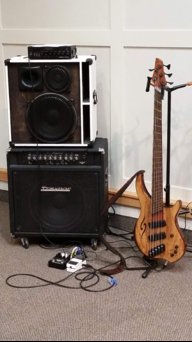
Ooh, ooh!!! Let me know how it sounds with the Bag Ends! My D-800+ is on the way, and I'm planning on using it in larger rooms / outdoors with a pair of S15-D. Smaller rooms will get a pair of Mark Bass NY 121 cabinets. The Bag Ends are awesome with the M6 Carbine...I'm hoping the will be a slightly different flavor of awesome with the D-800+.
 
  • Like
Reactions: wave rider