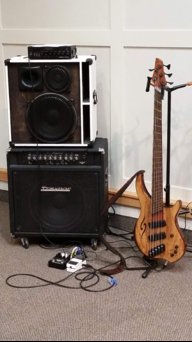
A variable HPF on a bass amp head is the coolest thing ever 

TalkBass has been independent since 1998. Add your voice.
Create a free account to reply to discussions, view embedded media, and browse with fewer display ads.
Join free Log in
Want zero display ads or expanded classifieds tools? Compare plans.

In non-technical terms it's for sounding great in spite of even the most challenging venue acoustics or just tightening up the low end as an additional voicing control.you guys are something. one of these days I'll figure what that things for.

I can't recall who first mentioned it in this thread, but I really dig what happens tonewise on the 800+ when I flip the deep switch on and then rein it in by raising the variable HPF frequency. That's a really nice way to get a bit more punch without becoming boomy. (And on the non-plus 800 head, I don't use the deep switch.)
On the 800 (no +), it can be useful to flip the deep switch, then cut the low end using the bass and low mid control.
While I don't use padded inputs either, I don't understand how using one affects tone, per se. Doesn't it simply lower the gain. Shouldn't it sound the same if you were to turn your gain knob up enough to compensate for the db difference? ...just wondering @agedhorseIn regards to active/passive inputs, I have never heard a single active one that sounded as good as the passive input. So I never ever use them. I too agree that they rob the tone of soul somehow. I've told a few guys about not using the active input over the years and they've been surprised at the improvement in tone.
Also thanks for the EQ tips, I'm going to try the bass boost button with low end roll off and see if that's something that will work for me.

Yep. This is how mine has been set for a little while now too.both switches on and the HPF and Voicing the same @ about 10:00. point the rest of the EQ at the ceiling
Been there for the last dozen gigs or so. It works for everything

Yes this is correct for the Subways. There is no change of input impedance and zero difference in tone. It's just re-scales the gain control.While I don't use padded inputs either, I don't understand how using one affects tone, per se. Doesn't it simply lower the gain. Shouldn't it sound the same if you were to turn your gain knob up enough to compensate for the db difference? ...just wondering @agedhorse
Yes, it's something I have been doing for many, many years.Wellllll I do hear voices and occasionally a ghost or two, but, umm I thought it sounded different. I'm already going to meetings for it.
I'm not talking about the Subways cause I don't have one.
Agedhorse, do the GB SM amps have the same/similar active passive input design?

Yes, it's something I have been doing for many, many years.
I have also tried to design ghost free amps, though they may not be the first choice for death metal where ghosts in the machine seem to be desirable.

It is the bass amp choice of Marilyn's Ghost.I think you should add this to the back of the amp: do not expose to moisture, thieves, or ghosts
Realize this is an old post, but just wanted to clarify something about the native high mid control. The manual for the d800 says the high mid is center around 480hz I think. On my d800+ the high mid sweep goes from 300hz clear up to 5000hz. If the knob is close to 3:00 and thats 480hz, does it mean that the sweep is very non-linear? Or should it be 3:00 on the high mid? Or am I thinking of it like a clock and I should not be? Or is the d800 manual incorrect?So, earlier I promised that I would locate the LM and HM frequency control positions on the D-800+ that mapped to the native mid eq points on the D-800 but I had some things come across my bench that needed attention and like many engineers I was easily distracted... hey look, squirrel...
Anyway the D800+ eq is the same as the D-800 with the Low Mid freq a tiny bit higher than the 9:00 position and the High Mid control a tiny bit lower than the 3:00 position.
The amps won't sound EXACTLY the same because there is some additional circuitry supporting the variable high pass filter, and other internal functions, but it should be very, very close.
Both are correct.
The points chosen on the D800 do not correspond to the 12:00 positions on the D800+ frequency sweep controls. They were chosen based on listening tests by our advisory board players. The sweep ranges on the plus represent a wider useable range for most players under a wider variety of playing conditions and instruments.
Yes, pretty close.So if the bottom value on the high-mid sweep range is 300hz and the upper limit is 5000hz, is noon 2650hz?