• TalkBass has been independent since 1998. Add your voice.
    Create a free account to reply to discussions, view embedded media, and browse with fewer display ads.
    Join freeLog in
    Want zero display ads or expanded classifieds tools? Compare plans.

Micro Bass Heads, why doesn't everyone use them?

For me, I haven't played any of the micros that come thru with the same "authority" - for lack of a better term - than the 700rb-II and M-pulse 600 I have currently... and don't find either of them difficult to manage in any way... The G-K gives me the quick, modern response, and the M-pulse 600 can get pretty "tubey", if I want...

Eventually, I'll probably pick up either an LMII, NeoPak 3.5 or Shuttle in the future - but not unless I can get one for around $300, and merely as a luxury/convenience... It's just a priority to me at the present time...


- georgestrings
 
For me, I haven't played any of the micros that come thru with the same "authority" - for lack of a better term - than the 700rb-II and M-pulse 600 I have currently... and don't find either of them difficult to manage in any way... The G-K gives me the quick, modern response, and the M-pulse 600 can get pretty "tubey", if I want...

Eventually, I'll probably pick up either an LMII, NeoPak 3.5 or Shuttle in the future - but not unless I can get one for around $300, and merely as a luxury/convenience... It's just a priority to me at the present time...


- georgestrings

As a former MPulse600 owner, check out a Genz Streamliner900 and be amazed:D
 
Every generation of micro amp I try one out, like gaming consoles. I'm never an early adopter though, so I usually end up buying the front runner of the last gen used, right as the new ones are coming out. I'm about due for another round. I love the convenience, I always want to love them so I can make one my main amp, but it never happens. There's always something in the EQ that bugs me and I can't seem to dial out. Not the same thing with each amp mind you, but I'm not a knob twiddler and that seems to be who most of them are aimed towards. I keep my main (tube) amp with all knobs except the volume set to noon.

With all the samples I've heard of the Streamliner and the TH500, maybe the next round will be the one. He said with wide eyed optimism.
 
Kind of a silly debate, in the end. I didn't get a ShuttleMax 12.0 because it was light, but I'm not bummed that it's light. I'm a doubler, it has 2 very nice pre's. GREAT DI. It's dual voltage so I can take it to Europe with me on tours...AND it's under 7 lbs...show me the downside, please. Headroom, volume, and great tone have been the least of my worries :)

I totally concur with what KJung said, if I'm remembering right...mix and match a bunch of different sound clips of a bunch of amp/cab combinations and if you guess right at all, it'll mostly be luck. I heard a guy play a Streamliner with a Jazz into a fEARful 15/6...pretty cutting edge, trendy, 'hi-fi' gear. His band plays modern blues/R&B/soul. Great player, with great hands and great tone. If I played you the clip and told you it was this awesome, vintage B15, most of you would've believed me...because the guy knew the feel and sound he was going for and has the hands/chops/technique to pull it off.

I've owned 100 amps or more in my life of every stripe, size and color...and it pretty much always sounded like...me :)
 
Funnily, the description of the challenges in designing effective digital and/or analog class D that were mentioned in the Audioholics link makes fine sense to me. The thing that often bugs me about many bass amps I try is an attenuation of highs and unreasonable emphasis on lows. I know, 'we play bass, not treble' and all that, but I find it very pleasing when the bass guitar has clarity all the way to the very high harmonics, and when I can dial in a deep and punchy bass tone without ending up in a muddy low-frequency mess. Some like warm and smooth, I like clear, crisp highs, punchy lows and very present mids. At least for my original band.

From his description, I gather that this focus on 'bassy' sounds in newer amps might be a deliberate attempt to utilize the shortcomings of class D designs in a positive way, and then market the result as tube-like warmth. That seems sensible enough, and will definitely make a large group of bass players happy, especially when combined with a tube preamp. For a long time, I thought it was a case of preamp designers overcompensating for a more 'sterile' or 'digital' sound (yes, I know that digital doesn't equal sterile and that I was making unreasonable onthological assumptions, so sue me:hiding:), but now I suspect this might not be the case at all. Opinions?

Martin
 
From another thread
The first Class-D patent audio amp
Patent US3011025 - HIGH POWER AMPLIFIER - Google Patents

Class-D and Pulse Width Modulation (PWM) amplifiers are not digital.
Are old film movies digital? They flash 24fps. The shutter is opened of closed.

It doesn't matter though because the audio signal sent to the speakers from a modern class-d amp is exactly the same as any other class of amp.

There is one exception, in that audio measurement gear can pick up super sonic artifacts that they don't bother filtering out - because no one, even golden ears, can hear it. The speaker itself can't reproduce it.

Reference the wikipedia and references they list for more information.
IMHO - nobody should ever worry, sonically, about the class of an amplifier.
Look for features instead.
 
I'm not an EE, but every discrete amplifier uses FETs (generally MOSFETs or JFETs). MOSFETs have been used in amplification as early as the 60s and been mainstream in amps since at least the 80s and are not unique to Class D amps, nor do they sound inherently "digital".

Switched mode power supplies have been used in audio for decades also. SMPS is the only way to get enough power to many car audio amps, for example and has been used far longer than Class D has been around.

Really?

[Invalid or Expired Link Removed]

Found this on the TC site link above.

"Digital Recording out: Balanced XLR, AES/EBU, (24 Bit)"

I am referring to the micro amp as a whole.

And I disagree with your precluding bit-rate digital technology from micro amps entirely.

Class D (usually MOSFETS) are operated as binary switches; either fully on or fully off. My "digital" reference is in the BINARY comparison of switch function much like the gates within a microprocessor.

The Truth About Digital (Class D) Amplifiers — Reviews and News from Audioholics

Digital controlled or analog controlled class D?

In general, the lines are becoming blurry in this micro tech when it comes to digital/analog interpretation. There are inherent digital aspects to this micro amp tech that require a new way to think about it.

PEACE
 
Switched mode power supplies have been used in audio for decades also. SMPS is the only way to get enough power to many car audio amps, for example and has been used far longer than Class D has been around.

+1 in fact old tube radio's used in old cars had oscillating switching like circuit to bring the voltage up for the tubes. Some used relay, these have changed to solid state devices but the principle is the same.
 
Funnily, the description of the challenges in designing effective digital and/or analog class D that were mentioned in the Audioholics link makes fine sense to me. The thing that often bugs me about many bass amps I try is an attenuation of highs and unreasonable emphasis on lows. I know, 'we play bass, not treble' and all that, but I find it very pleasing when the bass guitar has clarity all the way to the very high harmonics, and when I can dial in a deep and punchy bass tone without ending up in a muddy low-frequency mess. Some like warm and smooth, I like clear, crisp highs, punchy lows and very present mids. At least for my original band.

From his description, I gather that this focus on 'bassy' sounds in newer amps might be a deliberate attempt to utilize the shortcomings of class D designs in a positive way, and then market the result as tube-like warmth. That seems sensible enough, and will definitely make a large group of bass players happy, especially when combined with a tube preamp. For a long time, I thought it was a case of preamp designers overcompensating for a more 'sterile' or 'digital' sound (yes, I know that digital doesn't equal sterile and that I was making unreasonable onthological assumptions, so sue me:hiding:), but now I suspect this might not be the case at all. Opinions?

Martin

Funny, since many associate class D/SMPS with thin down low, bright up top, and VERY modern.

Again, if you compare the GK MB500, the Genz Streamliner, the Marbass F500, the TecAmp Puma500, the Aguilar TH500, the GEnz Shuttle 6.2, the Glockenklang Blue Soul, the Markbass SD800, the Walter Woods, the EA iAmp1200, the Acoustic Image Clarus, the GK MBfusion, etc., etc., you will hear ever tone in the universe... from big low end, warm, and fat to uber crisp and so clean as to be 'sterile' to some, and everything in between:) IMO, and an embarrassing amount of IME.
 
I am here to learn by sharing and comparing opinions.

I am not here to disqualify anyone else's opinion. :)

For the sake of spirited (good!) debate, I pose my observations simply to learn either from my mistakes, or from the educated opinions of others.

Agree or disagree I would not take it personally, nor would I expect/hope anyone else to take it personally.

Anything that is described as binary with two discrete states (i.e. "ON" or "OFF"), is by definition "digital".

An old movie camera/projector shutter can be considered "digital" when you confine your scale and scope of observation to the "open" and "closed" states of the shutter. The quality of the image with respect to composition is not digital. But the movement via either "open" or "closed" states of the shutter is digital... albeit, in a primitive form.

Logic, reason, and rational thinking is all I seek.

I do not wish to offend anyone! :)

PEACE
 
Funny, since many associate class D/SMPS with thin down low, bright up top, and VERY modern.

Again, if you compare the GK MB500, the GEnz Streamliner, the Marbass F500, the TecAmp Puma500, the Aguilar TH500, the GEnz Shuttle 6.2, the Glockenklang Blue Soul, the Markbass SD800, the Walter Woods, the EA iAmp1200, the Acoustic Image Clarus, the GK MBfusion, etc., etc., you will hear ever tone under the universe... from big low end, warm, and fat to uber crisp and so clean as to be 'sterile' to some, and everything in between:) IMO, and an embarrassing amount of IME.

I get all that and a bag of chips with just the five I showed in the other thread.
 
I just digitally unsub'd

:D It is unfortunate that the class of power amps called 'class D' was called 'D' (arbitrarily from what I understand). It does reinforce the sort of 'digital' thing that suggests computers, CD's, etc, that tend to be thought of as 'mechanical' and 'modern' and having a bit less soul than 'older stuff'.

Andy (Agedhorse), from Genz Benz Engineering, did a great job of explaining how 'digital' doesn't really describe what is going on in class D, although I think he mentioned that you could torture the term to somewhat describe SMPS. Can't remember where that post lives though.
 
Why don't I have a micro?

I'm scared of the "new" technology that by lots of accounts have limiters that cause them to cut out when they peak. Maybe there are manufacturers that have created limiters that work better now but I've got a SS head that weighs about 15lbs., so I can still throw it over my shoulder. I'm content waiting until the micro has been worked,reworked, and reworked until there aren't anymore stories of amps comletely cutting out. It has nothing to do with sound. If I was only concerned with sound I would have a 300 watt all tube head.

EDIT: and it's no small consideration that to get to an amount of watts in a micro that I'm comfortable that there'll be no way in the world that I'll ever shut down in a gig or practice then I'm in a price range where I probably would just get that all tube head.
 
Why don't I have a micro?

I'm scared of the "new" technology that by lots of accounts have limiters that cause them to cut out when they peak. Maybe there are manufacturers that have created limiters that work better now but I've got a SS head that weighs about 15lbs., so I can still throw it over my shoulder. I'm content waiting until the micro has been worked,reworked, and reworked until there aren't anymore stories of amps comletely cutting out. It has nothing to do with sound. If I was only concerned with sound I would have a 300 watt all tube head.

EDIT: and it's no small consideration that to get to an amount of watts in a micro that I'm comfortable that there'll be no way in the world that I'll ever shut down in a gig or practice then I'm in a price range where I probably would just get that all tube head.
Compared to the other crap I have used, I thought my used 1001RB1 at 18 lbs. was a micro amp :hmm:
 
Funny, since many associate class D/SMPS with thin down low, bright up top, and VERY modern.

Again, if you compare the GK MB500, the Genz Streamliner, the Marbass F500, the TecAmp Puma500, the Aguilar TH500, the GEnz Shuttle 6.2, the Glockenklang Blue Soul, the Markbass SD800, the Walter Woods, the EA iAmp1200, the Acoustic Image Clarus, the GK MBfusion, etc., etc., you will hear ever tone in the universe... from big low end, warm, and fat to uber crisp and so clean as to be 'sterile' to some, and everything in between:) IMO, and an embarrassing amount of IME.
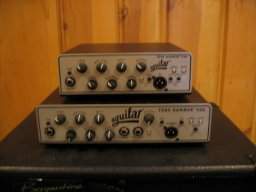
Yes, it is funny how associations work, which was what I addressed at the end of my last post. I must admit that my experience with the brands you mention is limited by the danish market, and I wouldn't for a moment doubt that any type of power supply could potentially achieve any general type of bass sound.

My experience, as I described it, stands, although it is nothing more than my experience from my particular test situations, and might not hold any universal truth. Anyhow, I take it from your answer that you do not believe that designers are generally utilizing any particular qualities of class D power to voice their amps in a darker/warmer way. Fair enough, there might very well be nothing to it, but I think that it would make sense from both a marketing and a design perspective, and brings to mind my experience with micro amps from brands such as Ampeg, Markbass and especially Ashdown.

It's just a thought.

Martin