• TalkBass has been independent since 1998. Add your voice.
    Create a free account to reply to discussions, view embedded media, and browse with fewer display ads.
    Join freeLog in
    Want zero display ads or expanded classifieds tools? Compare plans.

Mini 0r Micro Amps.... I Must Be Missing Something?

Ampeg... ...had more trouble than most with their new class D offerings. I would think that if they did not have that unfortunate roll-out of the SVT7Pro , there would be a number of other solid state offerings from their product line on the block.

Ashdown... ...tried the class D thing, and it seemed to be a disaster for them in design and reliability.

...etc., etc.

The impact of those early failures can't be over-estimated.

You've got a high proportion of adventurers, gear hounds and other people who tend to be "early adopters" on TB, but that's not the real world...

In the mass market, I think it's going to be quite a while before micros make it big, because so many companies stumbled coming out of the gate.

It's not just players who noticed the teething pains with early offerings from Ampeg, Ashdown, G-K, SWR, etc. It's also dealers and distributors. I live in a small Canadian city, and it's near-impossible to sample micros in local music stores. What store owner wants to take chances on a product with high failure rates?

As understanding of the technology matures, and people realize that they're surrounded by other class D and SMPTS devices that don't routinely self-destruct, they will inevitably take over at the low and mid price points.

Cheaper/smaller/more powerful always does...
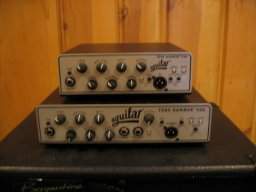
 
As an early buyer of the Traynor YBA200, I know all about the problems that can be encountered with a new product, they did eventually do a factory upgrade to the "-2" version, including a new set of KT88's. This is the amp that I like to use, and I never use it without a backup (it has never failed since their upgrade.) I was also looking to use the smaller amp by itself occasionally.

An early small, light, powerful amplifier, the BX500 was introduced, and I almost bought one. I'm sure the early problems with this amp have been addressed, but lets just say I bet they wished that had delayed the release of this product until further testing. The TC250 has just been recalled, voluntarily, a sign of a great Company. Also check the post on TB with the pictures of the smoke coming out of a mini amp. The truth is any product can and eventually will have a failure if used long enough.

I understand that a lot of this technology is still being refined and is getting better. I also understand that most of the manufacturers have released great products that have not had problems after release. Many of the problems may also be the consumer not using them in the correct manner. If the future is small and portable, get a set of wireless in ear's, and a DI. Now where can I find a full size 3 lb. bass?
 
If the future is small and portable, get a set of wireless in ear's, and a DI.

Many high end concert acts have done just that, and even some local gigging bands. However, there are many of us who freelance who often have no front of house systems, so a rig will still be key for many for a long time. And, often, even when I am doing a large corporate show or dance gig, I do not have my own monitor mix (many times, it seems the gigs I do are limited to 4 monitor mixes), and often the monitor system is not set up to really pump a pleasing bass tone onto the stage, so a rig as personal and/or band monitor is still often key.
 
Well, this is a pretty simple issue.

First, the answer is 'yes they can and in some cases they do'. Genz has only one full weight head left in their product portfolio, and most believe the tonality is quite similar to their higher power SMPS offerings (although there are some feature and absolute power level differences, etc.). The 2ohm operation feature is also an 'advantage' to some players, although even there, the Shuttle Max 12.2 would make most of those guys happy IMO.
This is not what I've heard, but I've not played the big iron GB heads, only the Shuttles. But others who have on here report that there are differences.

Most GK lovers hear very minor differences between the full weight heads and their micro offerings, when you line up the appropriate models. However, I assume their full weight models are still selling, and the bigger boxes allow more features, like the 'automatic knob' design of the full size Fusion, along with the dual power amp/electronic crossovers for the tweeters in the remaining RB line of heads.
They sound and feel different to me.

Aguilar eliminated the AG500,

News to me. They still have the AG500sc on their website and websites still sell them.

and now has a very powerful,
tube front end, large model, and a very small and lightweight class D./SMPS model.My guess, if they wanted to use a higher wattage class D/SMPS module, and put a similar preamp on the front of that amp, they could get even closer to the DB751 tone than they already are with the lower wattage, all solid state TH line of heads. I assume the DB is still selling and that the margins are good on that product, so might not be a smart marketing decision.
Well look how many manufacturers try to copy the SVT. Certainly they'd do it to the letter if it was possible.

Ampeg is a bit different, since they have a lot of low end class A/B stuff, a classic all tube product that still sells, and as you painfully know, they have had more trouble than most with their new class D offerings. I would think that if they did not have that unfortunate roll-out of the SVT7Pro , there would be a number of other solid state offerings from their product line on the block.
I don't painfully know that. All I know is that for a few months the PF500 had over 10% of the solid state bass amp market, and that is a buttload of bass amps. Some people did have problems, but the vast majority don't. Wouldn't call the 3 and 4 Pro low end class AB stuff, either. I'll give you the B2RE, though ;)

Edit: Glockenklang. As a former owner of a lead sled Heartrock, the new 11 pound Blue Soul is ALL THE WAY there compared to the big iron model. However, the big iron model does do 2.67 ohm operation at a much higher power level than the Blue Soul, so has an advantage for those guys who want to use the Glock 610 cab, which can't be driven by the Blue Soul standard model. You can order a Blue Soul to work safely at 2.67 ohms, but they have to keep the power output constant, so there is a disadvantage there for that single application. If the Blue Soul is accepted by the Glock community (many players still 'listen with their eyes'), my guess is, the lower powered, much heavier 'Soul' will be soon discontinued.

etc., etc.
Maybe you're right about Glock. Don't know much about them.
 
I can't because they haven't publish that chart for it in bridge mode. They just state 10% THD+N @ 8 Ohms at the power spec. It's not charted. I would not think though that the performance of the bridge mode would be any more spectacular than stereo. Do we really need another try? Ever amp I've encountered has higher THD in bridged than in stereo.

This is fun though; popping the covers and seeing whats inside. And this discussion. It's not like we need to know this at a gig and pass out spec sheet as pointed out. But it's nice to know the inner-workings of amplifiers. It appeals to my inner geek.

I think I've discovered why we were looking at different plots. The pics you've posted are off the ICEpower front page, the ones I (and Kjung) have been looking at are in the datasheet for the module. There is a much more detailed breakdown there. :)

The MB500 (surprisingly?) uses the 125ASX2 module. It's definitely spec'd for 4 Ohm operation (minimum 3 Ohms) in BTL mode and the specs are close enough to what GK is quoting that a few OEM-type tweaks could easily make it exceed them. I would have guessed (and Agedhorse's post confirms) that there are options available for OEM use that wouldn't be available in the off the shelf modules.

Most amps would be well into power supply rail voltage clipping at 10% THD. The point where the signal voltage reaches the power supply voltage is where that sharp knee is on the THD plots occurs. As Agedhorse stated in his excellent post, the distortion characteristics of the amplifier can be modified by changing the behaviour of the power supply under load and you can see how increasing the rail voltage increases the amount of power the amp can supply before hitting that point (assuming it can deliver the necessary current). Small differences in rail voltage can make significant differences in the power output. The difference between 450W and 500W is 3VDC on the rail. So things like how much the power supply sags under load can radically affect maximum clean power output.
 
This is not what I've heard, but I've not played the big iron GB heads, only the Shuttles. But others who have on here report that there are differences.


They sound and feel different to me.


News to me. They still have the AG500sc on their website and websites still sell them.


Well look how many manufacturers try to copy the SVT. Certainly they'd do it to the letter if it was possible.


I don't painfully know that. All I know is that for a few months the PF500 had over 10% of the solid state bass amp market, and that is a buttload of bass amps. Some people did have problems, but the vast majority don't. Wouldn't call the 3 and 4 Pro low end class AB stuff, either. I'll give you the B2RE, though ;)


Maybe you're right about Glock. Don't know much about them.

Again, rock on with the big iron if it works for you. Nothing wrong with that. I'm glad my ear is not as sophisticated as yours. It seems I don't have the ability to hear these big, consistent topology differences among all these very different sounding amps:p I'll just suffer with the 'looseness' of my little amps in ignorant bliss:hiding::D:ninja:
 
I think I've discovered why we were looking at different plots. The pics you've posted are off the ICEpower front page, the ones I (and Kjung) have been looking at are in the datasheet for the module. There is a much more detailed breakdown there. :)

The MB500 (surprisingly?) uses the 125ASX2 module. It's definitely spec'd for 4 Ohm operation (minimum 3 Ohms) in BTL mode and the specs are close enough to what GK is quoting that a few OEM-type tweaks could easily make it exceed them. I would have guessed (and Agedhorse's post confirms) that there are options available for OEM use that wouldn't be available in the off the shelf modules.

Most amps would be well into power supply rail voltage clipping at 10% THD. The point where the signal voltage reaches the power supply voltage is where that sharp knee is on the THD plots occurs. As Agedhorse stated in his excellent post, the distortion characteristics of the amplifier can be modified by changing the behaviour of the power supply under load and you can see how increasing the rail voltage increases the amount of power the amp can supply before hitting that point (assuming it can deliver the necessary current). Small differences in rail voltage can make significant differences in the power output. The difference between 450W and 500W is 3VDC on the rail. So things like how much the power supply sags under load can radically affect maximum clean power output.

Interesting! This again makes it clear that there is more to the execution and integration of the power stage than pure topology (or specific class D module used), and also (per Any's wonderful post) preamp voicing is a primary driver in tonal and even performance differences (hi passing, etc.).
 
Again, rock on with the big iron if it works for you. Nothing wrong with that. I'm glad my ear is not as sophisticated as yours so. It seems I don't have the ability to hear these big, consistent topology differences among all these very different sounding amps:p I'll just suffer with the 'looseness' of my little amps in ignorant bliss:hiding::D:ninja:
Hey, I use them, too ;) although I'm using the big iron for today's gig...a BA110 :bassist:
 
If you're happy with the sound; reliability and ease of transportation are at the top of my list.

I've owned or gigged: SVT, GKRB series, Demeter Preamp, BBE MaxT Preamp, YAMAHA P500, Carver, SM900, Trace Elliot, GK MB500 & MBFusion 500, MarkBass F1 & SD800, Shuttle 6.0, Walter Woods 450/600, Eden WT405, 550 & WTX500, MESA M6, Aguilar DB751, AG500 & TH500.

For the money. I like the Eden WTX500 and Aguilar TH500 equally. They both produce the tone of the instrument. The TH 500 seems "louder" and "flatter" to my ear, but I assumed that's their intententional "out of phase" design that is a huge part of the "Eden" sound. So, I open up the gain and Master on the WTX more than the TH.

I'm in the world of shrinking and lightening the load. When I had a road crew coming by my garage to take road cases and bass trunks, weight and size wasn't that important to me.

As I approach the 6th decade on earth, a herniated disk at C6-7 and fragmented disks at L3-4-5, inspire me to embrace light weight. Ever since MESA introduced the "Boogie" guitar amp, I've been seeking the same concept. In the late 80s I used a Walter Woods 450/600 watt 8/4ohm head and an SWR Goliath. This was small and mighty for the day. WW was 7 lbs and the cab was about 75. I was in heaven.

Now.... I'm returning a LDS custom 1010/6 and going for a hybrid of the Aguilar SL/DB112 that will achieve the 25-30 pound range I need. The gigs I do these days are backlined on the large concert stage and/or there's PA support. I blew my ears out and don't wanna play that loud anymore. As KJung put it, (paraphrased), "I don't need to play any louder than ther drummer"

Genz-Benz Streamliner and Aguilar TH series seem to be solid and consistant. If it sounds good and you can transport it.... I say play it. :cool:
 
This is not what I've heard, but I've not played the big iron GB heads, only the Shuttles. But others who have on here report that there are differences.

Note that the preamp on the GBE-1200/750 is not the same as the preamp on the Shuttle's or ShuttleMax's, therefore they do not sound the same.

If you eliminate the difference in the preamps by using the identical preamp, the tonal differences are slight to inaudable.
 
Note that the preamp on the GBE-1200/750 is not the same as the preamp on the Shuttle's or ShuttleMax's, therefore they do not sound the same.

If you eliminate the difference in the preamps by using the identical preamp, the tonal differences are slight to inaudable.

:D But Andy, the 1200 is bigger:D

And... have a great NAMM. I'll miss seeing you guys!
 
I've always felt that if I were at a large outdoor event with multiple bands, that I could always spot the all-tube Ampegs a mile away. And for many years I was always right. But last summer I got fooled. I told my wife I was going over to 'that stage' because the bassist was using Ampeg. Wrong. She was playing through the Randy Jackson Markbass head into the 8x10 SVT. It was spot on. Fooled me.
 
One thing that may be obvious but people tend to forget is that we do not all approach the instrument amp the same way. Someone looking for the big P sound is going to look for different signal chain from someone looking for a cutting J sound from someone looking for a biting MTD sound etc etc. Making global pronouncements out of context of the instrument can be a little confusing. Just sayin'.
 
6. Class D bass amps do not all sound the same, and if one were to think about it I suspect that this is rather obvious in fact. There are a couple of dominating factors in what make a bass amp sound and feel different. The preamp design is probably the biggest influence on the sound, our Streamliners sound considerably different than our Shuttles. Feel is another aspect that separates the different products, and attention to dyamics management throughout every stage of the preamp and power amp are critical to the feel and playability.

This does not discount the possibility of a consistent audio artifact of some sort that can be picked out though.

I can't do it now, but back in the day after a bunch of ear training for mp3 detection - I could pick out an mp3 from a wav, no matter the encoder or encoding resolution.

... and it was very specific encoding artifacts that were common to mp3 coding, no matter the algorithm, that could be picked out.

Now - I haven't heard anything like that with any of the class D implementations I've used, but that doesn't mean it doesn't exist. I couldn't hear those things in mp3 without training myself to do so.
 
I don't think this is the case. If you are comparing say an MB-500 to TH-500 to a Shuttle 6.2, I would expect (and hope) that they sound different even though they are all based on the same class D platform. There are way too many significant differences in the preamp and power amp implimentations to ignore or to expect otherwise.

This does not discount the possibility of a consistent audio artifact of some sort that can be picked out though.

I can't do it now, but back in the day after a bunch of ear training for mp3 detection - I could pick out an mp3 from a wav, no matter the encoder or encoding resolution.

... and it was very specific encoding artifacts that were common to mp3 coding, no matter the algorithm, that could be picked out.

Now - I haven't heard anything like that with any of the class D implementations I've used, but that doesn't mean it doesn't exist. I couldn't hear those things in mp3 without training myself to do so.
 
I've been experimenting with the light weight gear for as far back as I can remember. Got my first Walter Woods amp in 1979. I've found myself going from amp to amp trying to find "my sound". For the most part they've all been good but different. There is however one thing that still blows me away.

The Genz 9.0 was not "my sound", but it was remarkable in that it has amazing headroom. I literally couldn't make it fart out. At a point similar to most other heads in the same class, I would reach the volume limit. But as I turned the master up even more it just got a bigger. Not louder but bigger. Headroom! Tone goals aside, I think the Genz amps are tech marvels, and very reliable.

For whatever reason, I've found the biggest difference between the micro heads and the lead sleds is the feel of the note under my right hand. More weight and nuance in the right hand with the sleds. I was able to mitigate some of this by going to a larger power cable (14 or 12awg) with my micro's, but there's still a difference.

All that said, I still don't get why Markbass stopped making the F500. One of the more tonally flexible, powerful amps I've used. The parallel effects chain still bugs the crap out of me though. meh....