• TalkBass has been independent since 1998. Add your voice.
    Create a free account to reply to discussions, view embedded media, and browse with fewer display ads.
    Join freeLog in
    Want zero display ads or expanded classifieds tools? Compare plans.

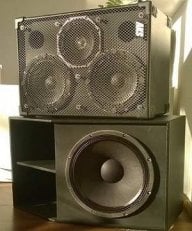
Mixed Driver Size Myopia!

Been a long time since I had one, but I think the SWR Triad didn't "have a crossover as much as a couple of stepped high pass filters."
They worked ok-ish, but, certainly weren't anything approaching optimal.
 
I remember a few bass heads back in the day that had a built in crossover section.

There some physics involved that can scientifically explain why mixed cabs can create a non-prefect situation. Fortunately, I play rock, so the laws of physics do not apply.

If it sounds good it's good. Put your clipboards down and play bass!

For the record, I enjoy a rig with 2 matched 4x10s.
 
Dont know. Why did Ampeg and mesa build a 410+115 cab? Designed by looks.

Not that I'm saying it was a good design, but that cab also had somewhat of a crossover. You could run it full range or biamped and had a crossover for the tweeter. The idea was to run two signals into one cab.

5437d1242863465-ampeg-2a.jpg
 
Not that I'm saying it was a good design, but that cab also had somewhat of a crossover. You could run it full range or biamped and had a crossover for the tweeter. The idea was to run two signals into one cab.

5437d1242863465-ampeg-2a.jpg

No cross over in there. Just an input for the 15 and then one for the 10's. Looks like there is a attenuator for a horn as well.

You would still need a cross over and two power sections to split the signal. Not sure about the Ampeg, but I know the mesa powerhouse's drivers share the same air space, which is another fail.
 
The old Peavey 1820's were another mixed driver cab from the past.
I ran those biamped with a pre/power amp rig; pre amp had a corssover.
Lows to the 18, highs to the 10's.
 
You would still need a cross over and two power sections to split the signal. Not sure about the Ampeg, but I know the mesa powerhouse's drivers share the same air space, which is another fail.

Right, as I said, the idea was likely more geared towards biamping, not accurate sonic reproduction like the fearful designs. Either way, my point was these kinds of designs have been around for a long time, and though the execution was comparatively lacking, they have been tried by major manufacturers to little fanfare.

As far as the ampeg vs mesa cabs, the ampeg one as far as I know was separate sections, but not having ever owned one...
 
Right, as I said, the idea was likely more geared towards biamping, not accurate sonic reproduction like the fearful designs. Either way, my point was these kinds of designs have been around for a long time, and though the execution was comparatively lacking, they have been tried by major manufacturers to little fanfare.

Yes mid loaded cabs have been around, but mostly in the PA world, not in the bass world. Both the Mesa and Ampeg use full range drivers. The 15's possibly contribute more to the highs than the 10's.

It is also not even about sonic reproduction. Its about pisspoor "designs" being marketed. In both Mesa and Ampeg's cases they have full range cabs that, for most, are ojectivly and subjectivly way better than their mixed driver cabs.

As far as the ampeg vs mesa cabs, the ampeg one as far as I know was separate sections, but not having ever owned one...

I would expect the Ampeg to, they split the 10's into seperate chambers on their other cabs.
 
Yes mid loaded cabs have been around, but mostly in the PA world, not in the bass world. Both the Mesa and Ampeg use full range drivers. The 15's possibly contribute more to the highs than the 10's.

Not having ever used the Ampeg 1510 cabs or being able to find the manual I can't say if you're right or wrong. Did mesa ever make a specifically three way cab like that? Either way the SWR manual is pretty clear:

Triad is a full-range, 3-way speaker system that utilizes a single 15" woofer, a
10" mid-range driver, and a high frequency horn tweeter. Each component is
housed in its own sealed chamber to maximize efficiency and eliminate any interaction between components...Triad's internal (passive) crossover divides the incoming signal into three frequency bands. The crossover points for the Triad are 5kHz and 100 Hz.

This discussion is a bit pointless. If you don't like the cab don't buy it. Make your point known with your dollars as other obviously did (likely why all these cabs have been discontinued).
 
Not having ever used the Ampeg 1510 cabs or being able to find the manual I can't say if you're right or wrong. Did mesa ever make a specifically three way cab like that? Either way the SWR manual is pretty clear:


This discussion is a bit pointless. If you don't like the cab don't buy it. Make your point known with your dollars as other obviously did (likely why all these cabs have been discontinued).

The 'classic' three way bass cabs, designed kind of like a PA cab (i.e., with woofer and then a relatively low crossed over smaller driver for the upper mids/lower treble, and then a tweeter for the upper treble, were the EA VL line of cabs in the 90's, and the Acme, a touch later and still on the market in relatively similar format. Don Oatman, of LDS was also relatively early in the use of mid drivers for the top end of cab response. Way back in the day, EV had a mid driver loaded cab. There were a few others through the years... the Peavey with the 18" and 8" mentioned above, etc.

The SWR Triad is kind of a different thing, with a couple of mid voiced drivers with various hi pass and lo pass filters. Lots of blow up issues with the 10" driver in those cabs, but they sounded pretty good when working!
 
No true.
It doesn't matter if it's an active or passive crossover, the phase response depends on the slope and it's Q (acoustic response, not electric, so drivers are included in this matter)

I shouldn't have written that so it reads like it's an absolute, but passive crossovers cause more phase shift than most active ones, although the filters on the early CD players are well-known for the bad effects they caused.
 
Dont know. Why did Ampeg and mesa build a 410+115 cab? Designed by looks.

Wait... the Mesa 4x10/1x15 has no crossover?

That explains why it sounded like a big pile of muddy ****.

When I commented to the staff member the cab has no high end and sounds muffled his honest to god response was "it's a bass cab, they don't have high end"
 
If I were running a 410/115 rig I'd sure as hell be running the LF to the 410 and using the 115 for mids.

I mean, remember how great a Fender Vibrosonic sounds for electric guitar?

Dick Dale's Guitar was thunderous through 2 fifteens.

Also, a 410 can handle more power, thus would (to my puny brain) probably be better for massive responsive lows. For me, the highs can have more flub.
 
I gigged through half the 80's and all the 90's with a Carvin rig that had a 2x15 and a 4x10. It was entirely awesome. I never noticed any science.

I am listening to the TB collective though and when I get around to getting a new rig I'll probably try matching cabs.

I do think that sometimes what works best on paper is not always the only way to roll. My rig right now has 3 combos consisting of 2 15's and a 12. I can switch between any or all of them with pedals and honestly it sounds the best with all three working together, mismatched or not.

Cheers!

MJW