• TalkBass has been independent since 1998. Add your voice.
    Create a free account to reply to discussions, view embedded media, and browse with fewer display ads.
    Join freeLog in
    Want zero display ads or expanded classifieds tools? Compare plans.

Multi-band compression: We can, but should we?

robert_stuart

Gold Supporting Member
Mar 28, 2017
626
673
Denver
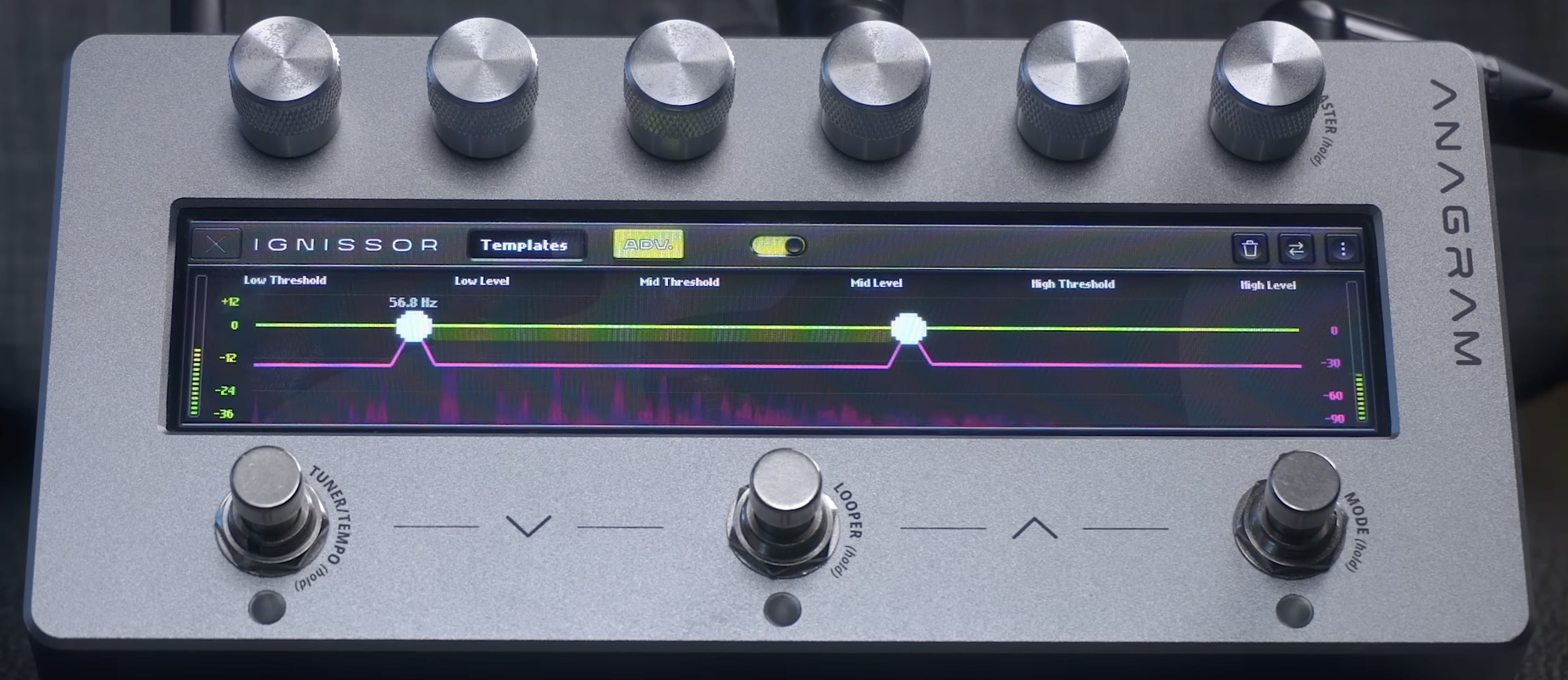
I’ve been thinking about the recent excitement around multi-band compression for bass, maybe because of the Anagram Ignissor.
1776402741550.png


It splits the signal, compresses lows/highs separately, then recombines. It raises a bigger question for me: we can do this… but should we? On paper it solved this problem (low notes triggering gain reduction that drags down your harmonics). I'm guessing about the appeal; is it more consistent tone across the neck, clearer articulation, less mud?

But could multi-band be breaking something subtle and musical ("natural" sounding)? Traditional single-band compression ties the fundamental and its harmonics together, so when the low end gets compressed, everything moves as one coherent “object.” That coupling might actually be part of what makes bass feel deep, unified, and “instrument-like.”

With multiband, you get more spectral independence (louder harmonics on low notes, more detail) but possibly at the cost of cohesion, where the note starts to feel like layers instead of a single event. Curious how others hear this: does multiband make your bass sound clearer, or does it start to feel a bit… disassembled?
 
From my perspective, you've got it a bit backwards. Moderate to heavy single-band compression, to me, sounds unnatural. Compressors apply gain reduction in a flat way, but the audibility of your signal does not react in a flat way. Usually how this plays out is the lows tend to "drop out" when subjected to heavy compression. Meanwhile, with a multi-band compressor, you can adjust the compression of high and low so that it IS consistent-- the whole thing moves as one.

Of course, it's not the only solution to this problem. It's just the most complicated (and perhaps the most effective). I don't personally consider multi-band compressors to be so critical that I own one myself. I think parallel compression and sidechain HPF are great solutions (even if they are, ultimately, band-aids).

Of course... we're also sort of under the assumption that "natural" is the desirable quality in compression. I would actually argue that it's not... compression itself is not a natural effect. Normally, our dynamics are limited by the physics of a vibrating string. Compression changes the resulting signal in ways that are not strictly possible based on those physical principles. If we wanted to be "natural", we wouldn't use it, but most of us would agree that doing so wouldn't sound as good.
 
From my perspective, you've got it a bit backwards. Moderate to heavy single-band compression, to me, sounds unnatural. Compressors apply gain reduction in a flat way, but the audibility of your signal does not react in a flat way. Usually how this plays out is the lows tend to "drop out" when subjected to heavy compression. Meanwhile, with a multi-band compressor, you can adjust the compression of high and low so that it IS consistent-- the whole thing moves as one.

Of course, it's not the only solution to this problem. It's just the most complicated (and perhaps the most effective).
I agree with the above.

Personally, I consider dual-band compression the preferred solution for bass guitar. IMO, it does not come at the cost of cohesion...if done properly.

Furthermore, for rock and similar genres, I prefer to combine clean compressed lows with overdriven/saturated mids and highs.

Such an arrangement can be, in a broader sense, considered a dual band compressor. Lows are compressed with clean compressor, mids/highs get their compression from the drive...
 
I’ve been thinking about the recent excitement around multi-band compression for bass, maybe because of the Anagram Ignissor.

View attachment 7476065

It splits the signal, compresses lows/highs separately, then recombines. It raises a bigger question for me: we can do this… but should we? On paper it solved this problem (low notes triggering gain reduction that drags down your harmonics). I'm guessing about the appeal; is it more consistent tone across the neck, clearer articulation, less mud?

But could multi-band be breaking something subtle and musical ("natural" sounding)? Traditional single-band compression ties the fundamental and its harmonics together, so when the low end gets compressed, everything moves as one coherent “object.” That coupling might actually be part of what makes bass feel deep, unified, and “instrument-like.”

With multiband, you get more spectral independence (louder harmonics on low notes, more detail) but possibly at the cost of cohesion, where the note starts to feel like layers instead of a single event. Curious how others hear this: does multiband make your bass sound clearer, or does it start to feel a bit… disassembled?
Your harmonic coherence is already skewed by the global negative feedback in your amp. And if you have tone controls, they shift the phase of your harmonics several degrees depending on position.
 
Every musical question always boils down to either you like it or you don't or more importantly does it or does it not fit the music in your opinion? I doubt the an audience is going to think a band sucks because the bass players notes don't sound "cohesive". ;) Interesting topic though if you want to get nerdy about a very misunderstood effect.

Totally agree on "it's good if you like it".

Regarding people not thinking... well, I came to the conclusions that indeed many don't think. :) But they feel.

Plus, sometimes many small improvements lead to a bigger one. Sometimes, not always. Certainly not if there are other bigger bottlenecks.
 
  • Like
Reactions: robert_stuart
Is multi-band compression a useful tool for what it does? Yup.
Is multi-band compression a must-have, necessary part of every bassist's signal chain? Not really.
Is standard single-band compression a must-have, necessary part of every bassist's signal chain? Also, not really.

IMHO from my audio engineering background, musicians have a hard enough time understanding and properly employing single-band compression. Asking them to do that across multiple bands AND have the result both musical and solving an actual audio issue is asking a lot. And if the harmonics are getting so noticeably crushed by the fundamental frequency and destroying your tone, you're not setting up your single-band compressor properly. Having more bands at your disposal just means setting up 3 or 4 compressors poorly.

I only ever use multi-band compression when i'm mastering full mixes. Just because i only ever use it there doesn't mean it should only be used there. It's not some sort of rule that you can't find it useful elsewhere. But i find, personally, its usefulness is limited beyond that.

A lot of times it seems like musicians treat audio tools as solutions in search of problems, and point out in theory why features on gear is going to be better. But really, if you're using sing-band compression and you're not running into any issues that multi-band compression would solve, you don't really need it. And really, you might not even need the single-band compression unless your dry signal has an issue that the compressor can address.

All that said, if you have a multi-band compressor, and you can set it up well enough to address the needs of your signal and it sounds good, you're not doing any harm. (To reiterate, you're not doing any harm if it's set up properly and sounds good. The "sounds good" bit is the most important there. It's music. If it sounds good, it sounds good.) It could be overkill and it could be unnecessary, and it could be the exact tool you need. It really depends on how things sound without it.

Ultimately, a Multi-band compressor is a great tool to have if you need it. But need is a strong word, in my decades of playing, engineering, and producing, i've only really found it all that useful for Mastering, or occasionally some bizarre FX chain that mangles audio in a new fun way. $0.02
 
Last edited:
0314221930_HDR~2.jpg


That's what I did with my rack comp and pedal board. I split the signal before it goes into my fx so that one channel is clean and one goes through my pedal board. The clean signal gets low passed at around 120 hz and eventually sent through one side of my comp that is set to ~4:1 and gets around -6db of gain reduction while the other channel is high passed at like 90 hz (I used to have a traditional crossover, but found that I couldn't get a good balance between the two without having a little overlap in frequencies, so each channel gets a dedicated pass filter). That channel has my overdrives and other goofy bs and runs it's own signal chain that eventually hits the other side of my comp that gets set to 2:1 with very subtle gain reduction - like you would on a guitar track. It sounds awesome even when it's clean. The mids and highs have room to breathe while the lows are fat and consistent. On my rig, those two channels never get joined back up, instead each going to dedicated power amps and speakers (Crown solid state into 18" subs for the lows, Mesa tube power amp into 2x10 cabs for the highs) but I'm sure it would sound just as good reporting to the same set of speakers.

Multiband compression is where it's at, but it's also a lot to worry about live. I have the benefit of doing this with a rack comp that is easy to adjust on the fly, but doing it with one pedal that has settings you have to scroll through might be a lot of headache. I doubt most people would really be able to tell the difference between a traditional single ended comp and a multiband unit - player and audience both.

78741.webp
 
...

IMHO from my audio engineering background, musicians have a hard enough time understanding and properly employing single-band compression. Asking them to do that across multiple bands AND have the result both musical and solving an actual audio issue is asking a lot. And if the harmonics are getting so noticeably crushed by the fundamental frequency and destroying your tone, you're not setting up your single-band compressor properly. Having more bands at your disposal just means setting up 3 or 4 compressors poorly.

...

It would also depend on how capable/willing one is to engineer audio. <- I typed this up before your post, but I 100% agree. I've learned basic mixing and am an amateur musician, but I've seen the gap between proper audio engineers and musicians with regards to audio sculpting ability. It's huge.

For me it's about how I want to be thinking about the compression.
In a live setting, simple and easily adjusted is ideal for me. Cali76 Bass with ATT/REL combined and a HPF is a good example.

In a studio mixing setting. The sky is the limit. 2-band, 3-band, N-band compression.
You could in theory even have 'infinite band' compression (imagine a line graph across frequencies per compression parameter).
I'm sure a competent audio engineer could make effective use of something like that if they had reason to.

We can do this… but should we?
If I have a reason to, why not?
If I have no reason, why?
There are endless ways to do things, but you really should have a reason before you do something, not create a reason to do something.
 
Multi-band compression is a surgical tool to fix specific problems. I use it in mixing and occasionally in mastering if there's something which demands it. I can't see myself ever using it live, or in a basic tracking session. That said, the Seymour Duncan Studio Bass compressor pedal has a 'multi band' switch that allows you to choose which frequencies get priority in the wet/dry mix (lows/mids/full), and I found that to be VERY useful for live work and in recording. So it's not a true multi-band compressor per-se, but it offers a similar, yet different take on the concept that is very useful... probably more useful than a true multiband compressor in most regular situations.
 
Multi-band compression is a surgical tool to fix specific problems. I use it in mixing and occasionally in mastering if there's something which demands it. I can't see myself ever using it live, or in a basic tracking session. That said, the Seymour Duncan Studio Bass compressor pedal has a 'multi band' switch that allows you to choose which frequencies get priority in the wet/dry mix (lows/mids/full), and I found that to be VERY useful for live work and in recording. So it's not a true multi-band compressor per-se, but it offers a similar, yet different take on the concept that is very useful... probably more useful than a true multiband compressor in most regular situations.

Just to reiterate: The SD DoubleBack and Studio Bass are not multi-band. They do have a blend (...for parallel compression) and EQ profile selection for the dry signal which is blended back into the mix. One of the simplest, idiot-proof configs I've used.

I get more mileage from blend-featured comps with a HPF on the front end. Sidechains and multi-band are really neat but teetering on the cusp of diminishing return in my limited universe.

Riis
 
Just to add (since it's too late to edit my previous post)...

I said i use Multi-band Compression when Mastering. But sometimes i'll also put a single-band compressor in the signal chain somewhere after the Multi-band. Again, because they're two different tools that do different things.

- The multi-band helps target different ranges in the spectrum to apply compression as needed to them. Different parts of the spectrum have different compression needs and you can treat them independently.
- The single-band helps everything in the mix become one cohesive unit. It's like a glue that takes a mix of different instruments and makes it a single song. (And if you use it properly, the mix and individual instruments will still breathe an shine on their own at the same time.)

Both of these, especially when used in conjunction with one another, especially when used judiciously and transparently, are extremely useful.

But, my point is, Multi-band and Single-band compression are two different tools that do different things. Multi-band isn't a magic tone enhancer. One isn't better than the other. They just have different purposes with different strengths and can be used accordingly.
 
I have no meaningful training other than editing lots of my own silly little home recordings..

I find a multiband compression to generally, when used in moderation, provide a more natural sounding result.
particularly with my bowed string instruments, I find it tends to sound more how it does in the room after mild multiband compression.

I've gotten very good results in particular when putting a microphone on a bass speaker cabinet.
 
Multiband compression has been around for a long time! The challenge with compression is that most people don't know how to use it. For a while, I had multi-band compression on my pedal board. It's definitely not a set it and forget it type of pedal. I would frequently tune it per venue when we were playing small/mid-sized clubs.

Depending on the style of music, the environment, and desired effect, it can be really useful!

wyokuussek9zn90lscei.jpg
 
Just to reiterate: The SD DoubleBack and Studio Bass are not multi-band. They do have a blend (...for parallel compression) and EQ profile selection for the dry signal which is blended back into the mix. One of the simplest, idiot-proof configs I've used.

I get more mileage from blend-featured comps with a HPF on the front end. Sidechains and multi-band are really neat but teetering on the cusp of diminishing return in my limited universe.

Riis

Agreed.. that's why I included this disclaimer:

So it's not a true multi-band compressor per-se, but it offers a similar, yet different take on the concept that is very useful... probably more useful than a true multiband compressor in most regular situations.

And, agreed that true multiband compression specifically often isn't the best solution in most cases.... it works best in a recording situation, IMO. I don't know if I've ever seen anyone carry around a truly full-featured multiband compressor in their live rig unless they need it for a highly specific purpose.
 
Last edited:
  • Like
Reactions: Zooberwerx
I find the whole "a tool to fix a specific problem" narrative...problematic. To me, utility devices such as EQ and compression are primarily "tone shaping" tools. I use them in order to achieve certain tone. IMHO, one doesn't need to wait until a "specific problem" arises to be able to use them...

My 2 cents...

Why is it problematic if it is decidedly true? Multiband compression in general is not needed unless there is a very specific problem needing to be remedied. If you compress a boomy section of your tone without taking out the boom first, then you're just leaving the boom and reducing its dynamic range, so EQ (like a HPF) might be the better solution, period. The important question is 'does this issue/problem require compression, or just EQ? Or both?' For example, in mixing/mastering, it can be used to pull out (or boost) and tighten up a certain segment of the frequency band (depending on the Q settings, etc) of the overall mix (not just one specific instrument) and enhance or tame it in the overall context, without having to apply more global compression solutions. That's a specific problem. Or, can that problem be remedied by specific processing on X instrument's individual channel? EQ on an amp is used to fix a specific problem area of the bass sound in the room from the amp. You are shaping the tone to fix a problem, or to sculpt it to a given situation/environment.
 
Last edited: