• TalkBass has been independent since 1998. Add your voice.
    Create a free account to reply to discussions, view embedded media, and browse with fewer display ads.
    Join freeLog in
    Want zero display ads or expanded classifieds tools? Compare plans.

Double Bass My bass came unglued?

robert_stuart

Gold Supporting Member
Mar 28, 2017
626
674
Denver
I bought a carved top 7/8, played it for about an hour, then put it back in its bag for a year.

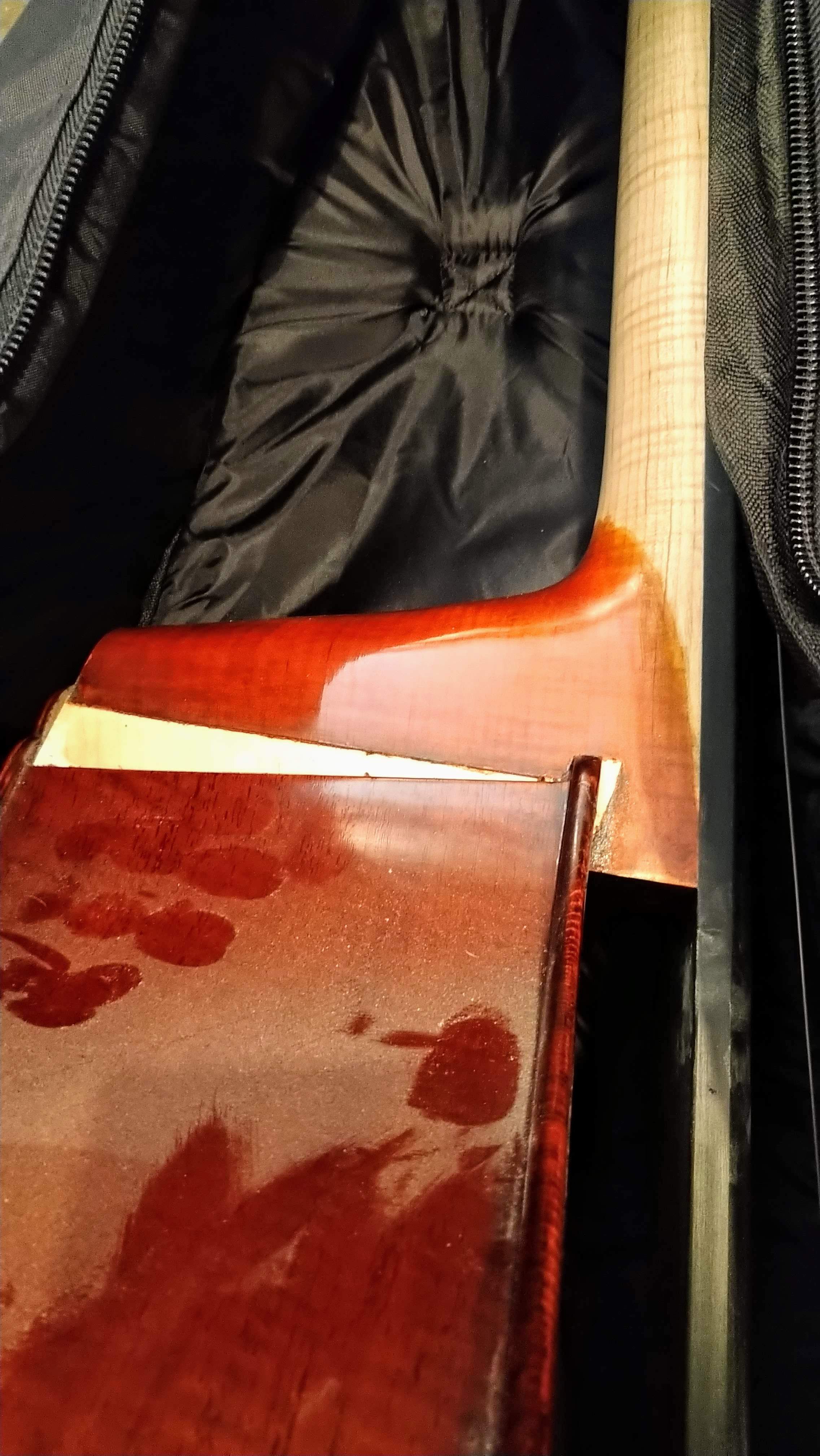
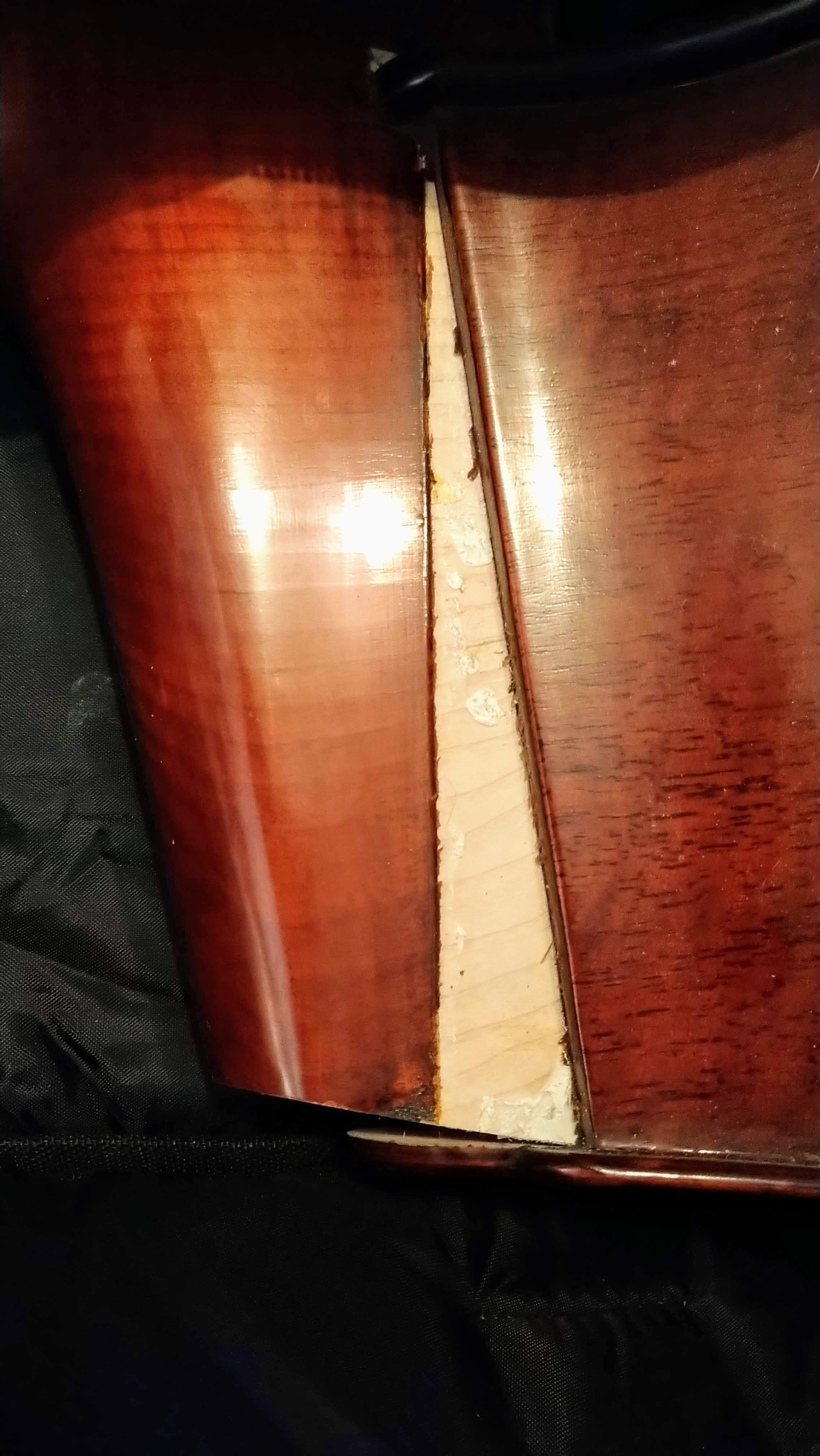
Last night, I went to get it out and play it, and discovered that it looks like this. The neck joint seems to have rotated up.

What do you all think? Is this a typical problem? Is it a manufacturing defect, i.e., too little glue?

DSC_0067.jpg
DSC_0068.jpg
 
Good photos. Actually that glue residue looks funky to me. Yeah, you don't want to store for long periods under tension, but this one may be the maker's doing. Best take it to a luthier. Hopefully, if it's as intact as it looks, it shouldn't be a big job to glue it correctly.

The button, that bit of the back sticking up behind the heel of the neck, is very vulnerable now. It's key to holding the neck on so handle with care and don't let it break or you will have an expensive repair. Dial string tension way down if not off entirely.
 
Last edited:
What's the make?

And why in the world haven't you played it for a year?!?! Lol. This question is half a joke, but only half....

I would personally not let my bass stay unplayed under tension that long. That said, I agree it should pop the neck like that, (not that I know a TON about such things) .
 
What's the make?

And why in the world haven't you played it for a year?!?! Lol. This question is half a joke, but only half....

It's an Eastman VB-95 7/8 carved top. I posted a short video of it last year. It has (had) amazing sound. But my left hand hurt playing it, and the neck shape is pretty thick. Plus, it's on the heavy side a bit unwieldy, so I was thinking of selling it.
 
  • Like
Reactions: 210superair
It's an Eastman VB-95 7/8 carved top. I posted a short video of it last year. It has (had) amazing sound. But my left hand hurt playing it, and the neck shape is pretty thick. Plus, it's on the heavy side a bit unwieldy, so I was thinking of selling it.

Man, my last post I forgot the 'not', lol. That should NOT come loose even under tension.

I have an Eastman ply and have reglued a few things with no issue. I'd imagine if you feel like making the repair yourself it would be fairly straight forward.
 
  • Like
Reactions: unbrokenchain
I've got a quandary. I hear mention that centuries of tension and basses do just fine.

I'll agree my basses (and guitars) seem happy for years and years under tension, when I play them regularly and adjust tension to keep them in tune.

But storage seems to be another matter. When my interest in guitar flagged for some years, and I left it in my locker, it ended up with both a bent neck and a bulged belly behind the bridge. The only odd variable I can think of that's in play there is temperature, perhaps increasing string tension when it's cold?

Even a bass neck will bend under string tension (just under 300 lbs - more for my 5-strings) if the fingerboard glue joint fails. I had a bass that all of a sudden had way more scoop than had been carved into it. Turned out, the lower half of the fingerboard had come unglued. I couldn't see a gap but it was enough to allow the neck to bend appreciably. It was caught right away, re-glued and everything straightened out. What would had happened if it had been left over time...?

Most of my making/repairing experience is with bows. When I first camber a bow, pretty much invariably I end up with some twist. Some of it comes from me unintentionally introducing a torque with my hands when bending. But most of it is the wood fibers releasing stress and finding a new normal, post carving, while the lignin is soft in the presence of heat.

A bow isn't as beefy as a bass neck and over time it will eventually lose camber just from normal playing. But again, storage seems to be a special issue. I recently re-cambered my stand partner's spare bow. He's totally in love with his primary bow and never uses the spare if he has a choice. Or takes care of it. So he had left it in his bag both under tension and with the hair mostly gone from the playing side. By the time he asked me to look at it, it had both lost most or its camber and had a hell of a side bend towards the strings. No bunsen burner involved, it just moved over time responding to the hair tension.

And just for kicks and nothing to do with wood, when I bought my Pollman 5-string, my previous Juzek moved (like my partners bow) to backup status. It was bagged and in a closet for years before a hit and run musician or stage crew left the Pollman in the green room on its belly with a broken tailpiece. A mad dash home to retrieve the Juzek got me on stage just in time and it played fine but I found zipper impressions in the varnish of the ribs on one side. That varnish had had 60 years to dry and if I remember right the bag zippers were plastic but time, with the bass laid on its side pressed against those zippers left me with a Frankenbass.

So I don't know if it's over-caution but for basses, guitars and certainly bows, when they're not going to be played for an extended period, I put the tension way down. It's not that I worry about the neck joint failing. I agree, I think your separation was probably a poor glue up in the first place. But I do worry about warping. Or the belly caving. And beware zippers!

BTW, when you get it fixed, please let us know what the verdict was.
 
Last edited:
I've got a quandary. I hear mention that centuries of tension and basses do just fine.

I'll agree my basses (and guitars) seem happy for years and years under tension, when I play them regularly and adjust tension to keep them in tune.

But storage seems to be another matter. When my interest in guitar flagged for some years, and I left it in my locker, it ended up with both a bent neck and a bulged belly behind the bridge. The only odd variable I can think of that's in play there is temperature, perhaps increasing string tension when it's cold?

Even a bass neck will bend under string tension (just under 300 lbs - more for my 5-strings) if the fingerboard glue joint fails. I had a bass that all of a sudden had way more scoop than had been carved into it. Turned out, the lower half of the fingerboard had come unglued. I couldn't see a gap but it was enough to allow the neck to bend appreciably. It was caught right away, re-glued and everything straightened out. What would had happened if it had been left over time...?

Most of my making/repairing experience is with bows. When I first camber a bow, pretty much invariably I end up with some twist. Some of it comes from me unintentionally introducing a torque with my hands when bending. But most of it is the wood fibers releasing stress and finding a new normal, post carving, while the lignin is soft in the presence of heat.

A bow isn't as beefy as a bass neck and over time it will eventually lose camber just from normal playing. But again, storage seems to be a special issue. I recently re-cambered my stand partner's spare bow. He's totally in love with his primary bow and never uses the spare if he has a choice. Or takes care of it. So he had left it in his bag both under tension and with the hair mostly gone from the playing side. By the time he asked me to look at it, it had both lost most or its camber and had a hell of a side bend towards the strings. No bunsen burner involved, it just moved over time responding to the hair tension.

And just for kicks and nothing to do with wood, when I bought my Pollman 5-string, my previous Juzek moved (like my partners bow) to backup status. It was bagged and in a closet for years before a hit and run musician or stage crew left the Pollman in the green room on its belly with a broken tailpiece. A mad dash home to retrieve the Juzek got me on stage just in time and it played fine but I found zipper impressions in the varnish of the ribs on one side. That varnish had had 60 years to dry and if I remember right the bag zippers were plastic but time, with the bass laid on its side pressed against those zippers left me with a Frankenbass.

So I don't know if it's over-caution but for basses, guitars and certainly bows, when they're not going to be played for an extended period, I put the tension way down. It's not that I worry about the neck joint failing. I agree, I think your separation was probably a poor glue up in the first place. But I do worry about warping. Or the belly caving. And beware zippers!

BTW, when you get it fixed, please let us know what the verdict was.

How much tension do you recommend releasing. Maybe you could tune down a major third or perfect 4th? I notice my electric bases go sharp in the winter. I don't think they ever shift much more than a whole step, and it varies by instrument. I don't think you want to release too much tension on a stored string bass, or you risk the sound post falling when the seasons change again.

Sometimes things just come unglued. The last string bass I played regularly was a 7/8 Lakeburg Baer. The bass was purposely designed to be as loud as possible, so the wood was thin and contact surfaces for glue small. The bass was constantly in the shop. One day in the middle of rehearsal the neck joint came unglued, and it sounded like a cannon going off. I was not hurt, but everyone was so freaked out that rehearsal was cancelled.
 
It's an Eastman VB-95 7/8 carved top. I posted a short video of it last year. It has (had) amazing sound. But my left hand hurt playing it, and the neck shape is pretty thick. Plus, it's on the heavy side a bit unwieldy, so I was thinking of selling it.

IMHO, you should spend an extended time playing the bass before you make a decision. If the neck is a different size than you are used to, it will take a bit of time for you hand to adjust. You need to strengthen different muscles and work out the kinesthetics. Although it may seem odd, it's possible to experience similar problems when you switch from a thick neck to a thin neck, or a neck with a different contour.

For example, I used to play an NS Design US series electric upright. The back of the neck is actually concave and this is supposed to make it easier to play. But if I had been playing upright exclusively for an extended time, the NSD would wear my hand out.

Here is an image of what the NSD neck looks like. This is an EU series bass, but they are made to the same spec as the original US series.
images?q=tbn:ANd9GcQRXPP318Po5ti6Al7rzKxRppMl6qRZNgUK3GXinx9IFbzyzuN_DQ&s.jpg


Of course, it's also important that the bass has a good setup. The nut was too high on my NSD bass, so the strings were a bit hard in low positions.
 
Ben, the zipper issue may have been a plastic/finish chemical reaction. I've seen lots of this, where the chemicals that keep the plastic (like the plastic zipper) soft enough to be flexible instead of breaking, also soften lacquer or varnish. It doesn't take much besides contact and time for this kind of reaction to happen.

That said, like you, I've seen some interesting things happen with cold (and hot too but that's a different story)... Cold makes metal constrict, so for metal strings it makes them tighter and increases the tension (as you suggested). So in the case of a double bass neck that has too little glue holding it together anyway, cold could be the trigger for the failure. And, while glue is more commonly affected by heat, some glues can also be affected by cold.

I suspect that the OP DB neck failure case was the perfect storm. Too little glue in the neck joint, perhaps higher tension metal strings, perhaps new (not ideal) setup (high nut, high bridge, deep relief = higher than normal tension at the neck joint), and just perhaps, cold and/or cold-and-dry weather at just the right (wrong) time.

To the OP, I hope this can be resolved for you in a quick and satisfactory manner.
 
How much tension do you recommend releasing. Maybe you could tune down a major third or perfect 4th? I notice my electric bases go sharp in the winter. I don't think they ever shift much more than a whole step, and it varies by instrument. I don't think you want to release too much tension on a stored string bass, or you risk the sound post falling when the seasons change again.

Sounds about right to me. It doesn't take much tension at all to keep the sound post in place. That said, you might want to consider just getting a mirror and setting tool. Kolstein used to sell a nice kit with instructions that was pretty intuitive to use. Resetting a sound post is kind of a "life skill" that's really not a bad idea for most players to have. If you're happy with your setup, just outline where the post touches the inside of top and bottom plates with a pencil fastened to a stick.Then if it falls, it's just a matter of minutes to put it back in place and get you playing again. I always have a basic fixit kit in the car.
 
Last edited:
  • Like
Reactions: Wasnex