• TalkBass has been independent since 1998. Add your voice.
    Create a free account to reply to discussions, view embedded media, and browse with fewer display ads.
    Join freeLog in
    Want zero display ads or expanded classifieds tools? Compare plans.

Double Bass My DB project

Hi guys thanks for ur comments.... I was intending for the distance from the bridge to the tailpiece to be the same distance that the distance from the Finger board to the bridge... that was the only info that I could gather about it... however the tail of the E string as it right now it got only 1" of silk cover... and I'm still need to tune it right... if I move the tail forward the E string will end up winding with the wound part, witch I think It could be very bad...

Now how can i solve this??? shorter tail.. I am not sure that will help me... may be my strings are to long???

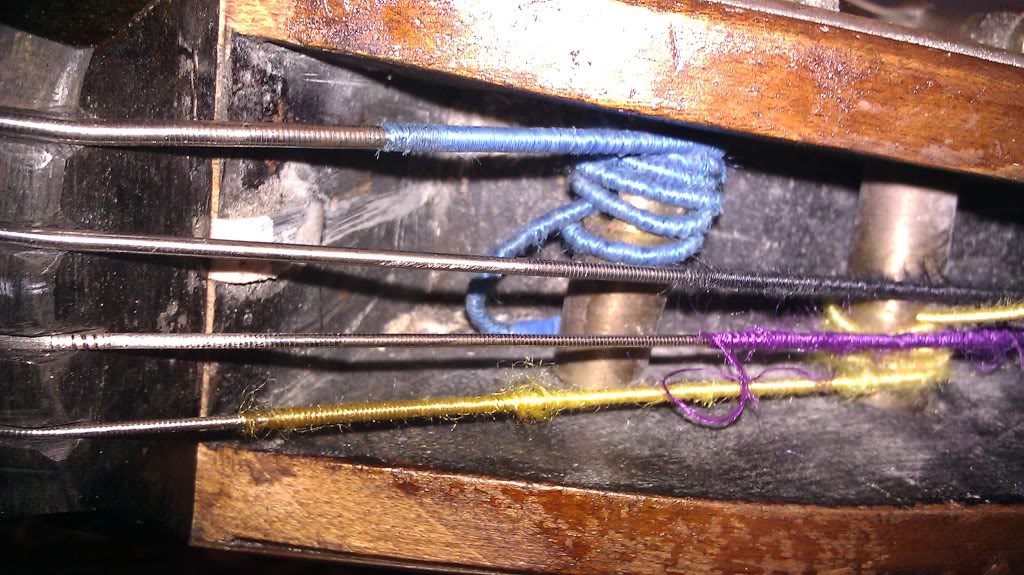
Is my D string doom?
IMAG0068.jpg
 
no you're fine. Loosen the tailpiece wire so the tailpiece doesn't stick out. Between the bridge and the tailpiece will be about 6", and - unless you're like Jake :) - the exact distance at this stage is not so critical.

Then make sure the nut and bridge slots are smooth and lubed with graphite. Then tune up the bass. You'll find the "stripped" part of the D string will probably end up in the pegbox not over the fingerboard. Lucky you. The core of the string is what is strong, not the wrapping, so as long as you don't cut the wrapping I think you'll be OK.

If the metal part of the string runs around the winder, well, its no big drama. Most strings can handle this OK and its very common ...

I like no more than 4 turns around the string post so I measure the string to the post, then add about 5" and cut off any surplus. I find this is usually ample and gives a very neat winding which is what you want to achieve. You don't want great big knots of wire bunching up against the cheeks of the pegbox.

Now you can loosen one string at a time and adjust nut slot clearance, then bridge slot to set the string height, then when everything is how you like it remove the bridge and trim the crown so the bridge slots are a shallow U shape, not a deep U.
 
no you're fine. Loosen the tailpiece wire so the tailpiece doesn't stick out. Between the bridge and the tailpiece will be about 6", and - unless you're like Jake :) - the exact distance at this stage is not so critical.

Then make sure the nut and bridge slots are smooth and lubed with graphite. Then tune up the bass. You'll find the "stripped" part of the D string will probably end up in the pegbox not over the fingerboard. Lucky you. The core of the string is what is strong, not the wrapping, so as long as you don't cut the wrapping I think you'll be OK.

If the metal part of the string runs around the winder, well, its no big drama. Most strings can handle this OK and its very common ...

I like no more than 4 turns around the string post so I measure the string to the post, then add about 5" and cut off any surplus. I find this is usually ample and gives a very neat winding which is what you want to achieve. You don't want great big knots of wire bunching up against the cheeks of the pegbox.

Now you can loosen one string at a time and adjust nut slot clearance, then bridge slot to set the string height, then when everything is how you like it remove the bridge and trim the crown so the bridge slots are a shallow U shape, not a deep U.

Wow I got lucky this time... I will keep you posted :D
 
Today I adjust the action its better now, still need to be fine tune, but i dont want to go too fast.. I want to avoid buzzing...

I did also shave the extra wood in the top of the bridge to make the notches shallow... still working on it

Its kind of hard to pay but i am GB player, no previous experience with DB.. so I am taking easy.. here where I am at the end of the finger board:

E 1/4"

A 5/16"

D 3/8"

G 3/16" and a hair

Tail piece was moved forward at: 5 1/2" from the bridge...


IMAG0071.jpg


IMAG0072.jpg


IMAG0073.jpg


Money well spend

IMAG0075.jpg


The bridge..the curve looks kind of funny... the tallest part the of the bridge is 6 3/4"

IMAG0076.jpg
 
here where I am at the end of the finger board:

E 1/4"

A 5/16"

D 3/8"

G 3/16" and a hair

Generally, the lowest string (E) should have the greatest clearance, and each above, a little less. Different styles, and different tastes require different heights overall. Since you are new to double bass, you may find less clearance desirable than a callous hardened grizzled old timer might. Another complicating factor is clearance for the bow. If there is not enough arc to the bridge/fingerboard, it may be hard to bow the A or D strings without accidently bowing their neighbors.
I think this means for you to go slow, but keep adjusting. It's a lot harder to add to than to subtract from the bridge or fingerboard.

I recently rebuilt a wreck, and the final adjustments have taken as long as the rebuild. In part because I didn't want to put on a new fingerboard, and the old one was getting thin and had an evil gut scoop to it. Patience!

Steven
 
here where I am at the end of the finger board:

E 1/4"

A 5/16"

D 3/8"

G 3/16" and a hair

Generally, the lowest string (E) should have the greatest clearance, and each above, a little less. Different styles, and different tastes require different heights overall. Since you are new to double bass, you may find less clearance desirable than a callous hardened grizzled old timer might. Another complicating factor is clearance for the bow. If there is not enough arc to the bridge/fingerboard, it may be hard to bow the A or D strings without accidently bowing their neighbors.
I think this means for you to go slow, but keep adjusting. It's a lot harder to add to than to subtract from the bridge or fingerboard.

I recently rebuilt a wreck, and the final adjustments have taken as long as the rebuild. In part because I didn't want to put on a new fingerboard, and the old one was getting thin and had an evil gut scoop to it. Patience!

Steven
Thanks for the pointers... this is an old bridge that a friend of mine gave me (Wayne H), I though that this would be a good staring point for the setup, but I still have a blank.. I will keep making minors adjustments till I feel like I getting somewhere
 
Looks great. Not having a ton of cash, I had to get a CCB and set it up myself, as well; there are various threads and posts here and there about what I did.

The reason for this post is to further comment on bridge clearances. Since I'm playing pizz jazz, I was able, with the proper fingerboard scoop (which took almost an entire day along with some slight narrowing of the neck and fingerboard on the G side from corner post size down to fence post size, like it should be) I have been able to get the action down at the end of the fingerboard to G 4mm D 5mm A 6mm E 7mm with Spiro Weich S42 set installed on a 3/4 with about an 1 1/8 inch false nut to shorten scale for my left hand (way too short pinky and index actually slightly curved in instead of straight) and to solidify the heel as a D neck instead of halfway between D & Eb.
 
I'm still working on getting the action right, I'm going to see a luthier (Bruce W in Key Largo) soon to have my work evaluated... now for the time being I am working in the cosmetic part

This was the top before...

IMAG0063.jpg


I applied ebony color stain for the scratches to look Black, I like the distress look...
NOTICE: The lither spot just by the above bottom part of the tailpiece on the left side of the pic.... that mark was made by the packing tape that I used when I moved to FL ... the finish is very fragile, anything will damage the varnish

IMAG0112.jpg


IMAG0113.jpg


Now there are scratches all over the bass body and everywhere where the hide glue dried the varnish peel off

IMAG0114.jpg


IMAG0115.jpg


Now what you will recommend me to use, I am applying Linseed Oil all over... I will stain a little the scratches to make it look darker
 
Looks great. Not having a ton of cash, I had to get a CCB and set it up myself, as well; there are various threads and posts here and there about what I did.

The reason for this post is to further comment on bridge clearances. Since I'm playing pizz jazz, I was able, with the proper fingerboard scoop (which took almost an entire day along with some slight narrowing of the neck and fingerboard on the G side from corner post size down to fence post size, like it should be) I have been able to get the action down at the end of the fingerboard to G 4mm D 5mm A 6mm E 7mm with Spiro Weich S42 set installed on a 3/4 with about an 1 1/8 inch false nut to shorten scale for my left hand (way too short pinky and index actually slightly curved in instead of straight) and to solidify the heel as a D neck instead of halfway between D & Eb.

Wow thanks for the very detailed Information... for me I don’t know what I want to do because just yet because I don't have any DB experience, so that's why I can't pick an very specific action... I love Pizz what the reason why I repaired this DB, but I heard that to learn DB the bow is very important...
 
I am happy to report that after a year and few months my DB have not imploded or show sings of cracking...

My DB teacher said that he likes the sound (I should be posting sound samples soon). And I took it to a luthier and he said that all majors repairs are taking care.. but we still got some work ahead.

1-Issue seems like the FB is too thick... due the shin that I add to compensate for the lost of wood when i tool the FB from my old project. its making the FB+Neck too thick. This is king of major repair I don’t want to have my bass out of commission for too long so I will hold on this one.

2.New bass Bridge (The current have very little wood under it foots).

I was working yesterday on the new bridge... but after 3hrs of work I notice that the angle between top and Bridge towards the south part, is less that 90 Degrees. Now I need to see if I need to correct the foots or complicate this angle by removing wood from the Bridge surface. I still need to add Adjusters to it... I will take some pictures

2013-03-04_10-31-12_190.jpg


3. He recommended to dress the FB, I don’t think I will do that, there is not buzzing on the strings and the action is low.

4. NEW Sound post

He said that the upper part of the F-hole its setting a lower lever that the top, not for much, and its because the SP is low. ($50 new sound post)

By the way I check the one that I installed and it looks very good, there are not gaps or anything bet SP and the back and top, and also is sitting like 1” behind the Bridge foot. They said it should be like 1/2"

506d012b-6f30-48d5-8af2-29c79e9f47c5.jpg