• TalkBass has been independent since 1998. Add your voice.
    Create a free account to reply to discussions, view embedded media, and browse with fewer display ads.
    Join freeLog in
    Want zero display ads or expanded classifieds tools? Compare plans.

My Dirt Bender - Another Jounal

i bought one but quickly returned it. i didn't like the sound of the distortion at all. I do have his Colorbox v2 and prefer it of the hard drive by a lot.

Oh, that is interesting!

Because with no offense and all due respect and all such, our tastes seem to be polar opposites on occasion - and I did really dislike the Colourbox.

I like the idea of having a parametric mid EQ pre drive and a Baxandall post drive.

The Violet seems to follow the same idea, but with less gain ?
 
  • Like
Reactions: tidbits
Also, it's getting crowded on the test bench.
WhatsApp Image 2025-01-23 at 13.39.24.jpeg
 
Oh, that is interesting!

Because with no offense and all due respect and all such, our tastes seem to be polar opposites on occasion - and I did really dislike the Colourbox.

I like the idea of having a parametric mid EQ pre drive and a Baxandall post drive.

The Violet seems to follow the same idea, but with less gain ?
Here is a demo, seems decent.
 
Interesting - I saw an older thread about where to put EQ in the signal chain popped back up today. Then there's this, and indeed, the parametric mid EQ is ahead of the drive circuit.

Looking at my board I have the Empress Bass Comp at the beginning (with the tone+color switch that can boost mids around 2k) and the rest of the EQ at the end of board after the dirt pedals. I was messing with comparing boosting mids at the front vs end, and through the headphones at least I liked that boost at the front. I'll have to try it out in the mix with the band tonight.

It certainly changes how the drives behave, and it's an interesting tool to consider. It also seems like this concept could be pretty easily applied with something like a Brought RFE or Sine Effects microPara or nanaPara single band EQ at the front and your preamp/EQ of choice at the end.
 
Oh, that is interesting!

Because with no offense and all due respect and all such, our tastes seem to be polar opposites on occasion - and I did really dislike the Colourbox.

I like the idea of having a parametric mid EQ pre drive and a Baxandall post drive.

The Violet seems to follow the same idea, but with less gain ?
i'm not fond of the colourbox's distortion at all but other than that, i think i sounds very good for clean tones.
the JHS hard drive's distortion wasn't to my liking either and it didn't sound anything like the demos that i've heard in the online videos.
 
i'm not fond of the colourbox's distortion at all but other than that, i think i sounds very good for clean tones.
the JHS hard drive's distortion wasn't to my liking either and it didn't sound anything like the demos that i've heard in the online videos.
For me personally that gain staging felt terrible, plus the filter was not useful for bass, which basically made it a very large three band EQ for five hundred bucks.
The Broughton Studio One felt like it held what the Colour Box promised, plus it was a fair bit cheaper.
 
I'm down with the flu for the moment, so my playing is limited and since my brain is clogged with slimy fog, I have problems creating coherent thoughts.

Here's what impressions the RAT was able to cast through albeit my health situation:

-The Filter knob seems to be a regular low pass filter of some order. When set at minimum, it's wide open and when you turn it up, it kills treble. The RAT circuit creates an insane amount of treble, though. Even with my 4+ year old flatwounds, I got some solid screeching results that warranted the knob to be turned 'down' (which is actually up) a little.

-This pedal works much better at low gain settings than I would have anticipated.

-It feels more touch responsive than the D+ and 250.

-The harmonics are gnarly and mean solid state distortion, but nonetheless quite rich.

Of the bunch, I actually like it best, because it feels very versatile.

And I'm itching even more to go and try it out with a band, but as I already said, the next chance to do so is by the end of Feb.
 
After playing it a bit, I can immediately see how this rodent takes things a step further than the classic distortion units that came before it. It's not only more gnarly, but also much richer in harmonics.
That makes it more useful in low gain settings, and of course unleashes a swarm of bloodthirsty locusts on your ear canals when you run it higher. Luckily, there is the filter knob to aid you, should the prickling sensation on your ear drums be too much.
If you're used to low gain Overdrive and tube saturation, playing a cork sniffer's pedal and amp collection and try out the RAT by itself, you might get the impression that you ran across a pocket calculator that fell upon hard times (meth addiction, leaking battery, crack in the solar panel) a while ago and now, for some obscure reason is so livid with you, it's literally foaming and trembling.

All that anger is good, but it's also not the product of an "organic" contraption like a tube amp that is pushed hard and in turn pushing the cabinet hard.
The RAT is not trying to emulate any of that. It gets you hard clipping from a microchip and a diode, two components you can place on your thumbnail and still have room to spare, given your thumbs are regular sized.
 
Long time participant and this threads official philosopher @sloppy_phil did the unthinkable.

He spent countless hours over the span of what I think must be years to conceive, construct, and fine tune the ultimate drive pedal for me.

Just look at this detail shot:
WhatsApp Image 2025-01-28 at 12.05.55.jpeg


After carefully constructing it, he took it out and through a great variety of situations, including but not limited to rehearsals, jams and live concerts. From playing to 25 people without any PA support, relying on his amp to carry the room to stadiums filled with Canadians, through the finest of large venue PA systems. This thing was heavily road tested and took everything Sloppy_phil could throw at it, it's scars and blemishes are witness to the fact that our sloppy philosopher did not hold back at any moment.

The gut shot of the pedal shows that modifications have been piled on modifications, just to get the pedal perfect - I can only imagine the nights our local philosopher sat in his chair by the fireplace, a glass of maple syrup in one hand and scratching his beard with the other, musing about the nature of perfection and whether or not it is possible to achieve it.

All his rigor, valor and the seven knightly virtues spent on the relentless hunt for the perfect tone, sacrificing a significant portion of his limited lifespan and work tirelessly to make this moment happen, where I, Jounalist of Dirt, finally come to receive a parcel that has traveled for thousands of kiloyards from Canada to a small island in the Baltic Sea. The great moment of unboxing this life's work of epic proportions.

With slightly sweaty and not so slightly shaking hands, I carefully operate the blade that cuts into the parcel. I remove the single item inside, a cloth bag aptly labeled "Crown Royal" in golden letters. I remove the item inside and let my weary eye behold the fruit of all this effort.
 
...so when you pick @sloppy_phil 's boring settings, you only get some magical tone sweetening when you run a bass with low output in, and a very mild and well behaved overdrive with a regular P bass. A tone so none offensive he'd say sorry when you bump into him on the street. Canadians.

I did the only sensible thing and raised all the knobs to the maximum and found a really nice tone there. Something that invited me to stay and play around.

This pedal is "based" on the Zack Wylde overdrive, which is based on the Boss SD-1, which is an all original circuit and has nothing whatsoever to do with the Tube Screamer at all.
Having that terrible low frequency cut of the original, it's completely useless for bass use, but this one has a knob that says bass. And is a clean blend. You can use it to bring back bass. And since the Tube Screamer SD-1 is a very transparent drive, you don't really get the feeling of blending two signals at all.
 
  • Like
Reactions: GrowlerBox
...so when you pick @sloppy_phil 's boring settings, you only get some magical tone sweetening when you run a bass with low output in, and a very mild and well behaved overdrive with a regular P bass. A tone so none offensive he'd say sorry when you bump into him on the street. Canadians.

I did the only sensible thing and raised all the knobs to the maximum and found a really nice tone there. Something that invited me to stay and play around.

This pedal is "based" on the Zack Wylde overdrive, which is based on the Boss SD-1, which is an all original circuit and has nothing whatsoever to do with the Tube Screamer at all.
Having that terrible low frequency cut of the original, it's completely useless for bass use, but this one has a knob that says bass. And is a clean blend. You can use it to bring back bass. And since the Tube Screamer SD-1 is a very transparent drive, you don't really get the feeling of blending two signals at all.

Those boring settings are indeed a little boring. Sorry!** But I rarely use that pedal in scenarios where I need anything besides light drive/bit of saturation. But, as you have seen, it can bring some proper growl and dirt to the party when coaxed. One cover band I sub in for sometimes does a fair bit of RAWK, so with them, the pedal definitely gets to live its best life!

One procedural note; the "bass" knob is a parallel clean volume knob, which can go beyond unity gain when cranked. It's not a wet/dry blend. So, despite the name of the pedal, if you turn the "volume" down all the way and crank the bass, you get a clean boost :eyebrow:

Another important thing worthy of note: The sound of the bass that plays the pedal really shines through.
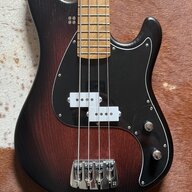
With my Le Fay, I get deep wooden tones that smell of a musty morning in the woods.
The P bass gets a much more aggressive sound going.

I have found this as well. I suspect it's the lack of LPF on the clean signal, so you get the full spectrum sound of your bass. And I think the fact the drive side of the pedal cuts so much low end, you avoid some of the weirder things that can happen when blending full-range clean and wet sounds.


**Not actually sorry, but I know no other way to express myself... :roflmao:
 
  • Like
Reactions: GrowlerBox
I am really itching to give that Farewell to Cleans a solid try out in band context. It is a lot of fun.
**Not actually sorry, but I know no other way to express myself... :roflmao:

Canadians.

But really, I wanna see how dense it can get.
Since the clean blend is full frequency and the wet side has a HPF after a fashion, it's quite easy to set. Dial in the clean sound until the heft is there and you're good to go. There's no feeling of running two voices parallel, it works quite well in that regard. I'm gonna try and see what happens when running the pedal itself 100% wet in the loop of the Broughton Filter Loop, with LPF on the clean signal, but my gut feeling tells me it's fine as is.

I can understand that you were reluctant to give other dirt pedals a try, because having this is somewhat satisfying. Then there is the added bonus of having something unique here.

From one session of playing, I want to say that compared to the Tube Screamer variants I tried so far, the tone knob feels like it attacks a frequency range that sits slightly lower than that of the green gang, but I might be forced to take that statement back when A/B testing it.

What I can confirm is that like most Tube Screamer variants, it hangs there in the middle between amp like and overdrive like feeling. It's neither pushing nor pulling, just hanging there on your fingertips willingly going in either direction, following your dynamics.
With the P bass running a bit hotter than the Le Fay, and being a P bass with Chromes, it feels a bit like taking an angle grinder to a piece of hardwood.
You know, after you've attacked that piece with several low quality tools and it put up a fight that felt quite frustrating, you get that old Flex from your buddy who's a car mechanic. It comes in the "Pro setup" - which means that all the things it came with - the guard piece over the cutting disc and the handle have been removed. When you fire it up, you have a healthy dose of panic respect for the thing.
But when you take it to this piece of unyielding hardwood, the ex-tree understands that it was able to resist your weak low quality wood tools, but now is confronted with a high-rpm disc that eats hardened steel for breakfast.
Slightly worrying, but oh so satisfying how it melts away at a mere touch.