

Enjoy the benefits of a premium membership!
Upgrade Account
-
TalkBass has been independent since 1998. Add your voice.
Create a free account to reply to discussions, view embedded media, and browse with fewer display ads.
Join free Log in
Want zero display ads or expanded classifieds tools? Compare plans.
You are using an out of date browser. It may not display this or other websites correctly.
You should upgrade or use an alternative browser.
You should upgrade or use an alternative browser.
My Dirt Bender - Another Jounal
- Thread starter el murdoque
- Start date
More options
Who Replied?


I'd love to try the Teeth at some point!EAE Halberd?
Horrothia Teeth?
Colorsound Powerboost?
And I love how @davelowell2 guessed it, but no one noticed ;-)

lol, I still don’t know which one, though. I’ve had my eye on the transformer pedals he makes so I’m curious to hear what you think.
Bad news, everyone:
The German Post has a few select locations where they are on strike. It's really only a few, but the solution to this little riddle seems to be affected by this.
The parcel was shipped Monday morning. With things running normally, it could have arrived today or tomorrow, but the tracking says it has yet to move from the starting location. I hope they resolve the issue quickly.
The German Post has a few select locations where they are on strike. It's really only a few, but the solution to this little riddle seems to be affected by this.
The parcel was shipped Monday morning. With things running normally, it could have arrived today or tomorrow, but the tracking says it has yet to move from the starting location. I hope they resolve the issue quickly.
So you’re going to keep us all in suspense till next week?Bad news, everyone:
The German Post has a few select locations where they are on strike. It's really only a few, but the solution to this little riddle seems to be affected by this.
The parcel was shipped Monday morning. With things running normally, it could have arrived today or tomorrow, but the tracking says it has yet to move from the starting location. I hope they resolve the issue quickly.
If it takes this long, then yes. If it takes even longer, then I'll have to buy something else first ;-)So you’re going to keep us all in suspense till next week?

FYPIf it takes this long, then yes. If it takes even longer, then I'll have to buy something else first in person ;-)
I mean you’ve had a few suggestionsIf it takes this long, then yes. If it takes even longer, then I'll have to buy something else first ;-)
RAT!
I finally managed to take the rodent to a band practice.
In my band setup, I run the Origin Bassrig SV as my preamp and feeding the rat into that adds a component of pushed amp that kindly masks the angry pocket calculator a bit and gets more into "moose that suffers from throat cancer, but heat is heat"-howling territory.
One thing that quickly becomes apparent: The lows do not feel as massive in the mix as I would have hoped from listening to the pedal while playing solo. I could not really detect that lows get lost while playing with the gain about halfway up and the filter all the way open, so I assume that the added harmonics and the distortion push the upper midrange to a bit more which leads to the impression of a weaker low end. In the mix, the pedal does not cut through with force, but sits rather nicely, even though it's on the harsher side of hard clipping. Direct comparison with the Way Huge Green Rhino showed what a little EQ in the right position can do - the Rhino has that 100Hz knob that I run full-on.
Switching off the RAT and kicking in the Rhino mid song brings some of that pants-flapping-earth-shaking thunder that rock and metal bassists usually enjoy quite a lot, and when I did that after I had played a couple of songs with the RAT exclusively so my ears were accustomed to that sound, I felt a huge grin spreading on my face when I changed over to the Rhino.
The RAT absolutely works for bass, but if you're looking for something to produce a huge sound with a massive booty, there are several RAT based pedals that offer clean blends and other means of bringing the RAT circuit deeper into the bass players hearts.
I finally managed to take the rodent to a band practice.
In my band setup, I run the Origin Bassrig SV as my preamp and feeding the rat into that adds a component of pushed amp that kindly masks the angry pocket calculator a bit and gets more into "moose that suffers from throat cancer, but heat is heat"-howling territory.
One thing that quickly becomes apparent: The lows do not feel as massive in the mix as I would have hoped from listening to the pedal while playing solo. I could not really detect that lows get lost while playing with the gain about halfway up and the filter all the way open, so I assume that the added harmonics and the distortion push the upper midrange to a bit more which leads to the impression of a weaker low end. In the mix, the pedal does not cut through with force, but sits rather nicely, even though it's on the harsher side of hard clipping. Direct comparison with the Way Huge Green Rhino showed what a little EQ in the right position can do - the Rhino has that 100Hz knob that I run full-on.
Switching off the RAT and kicking in the Rhino mid song brings some of that pants-flapping-earth-shaking thunder that rock and metal bassists usually enjoy quite a lot, and when I did that after I had played a couple of songs with the RAT exclusively so my ears were accustomed to that sound, I felt a huge grin spreading on my face when I changed over to the Rhino.
The RAT absolutely works for bass, but if you're looking for something to produce a huge sound with a massive booty, there are several RAT based pedals that offer clean blends and other means of bringing the RAT circuit deeper into the bass players hearts.
Apart from that, good news!
Here's the final solution to the little riddle:

Here's the final solution to the little riddle:
First thing about the Wessex is of course a look inside the thing, to see how the putative centerpiece of the whole thing looks like:

Yup, that is a transformer in there and it's massive for a small format 9V pedal.
Nice little detail: When you close it up, there is a hole in the lid that lets the top of the transformer poke out:

Yup, that is a transformer in there and it's massive for a small format 9V pedal.
Nice little detail: When you close it up, there is a hole in the lid that lets the top of the transformer poke out:


- Feb 16, 2008
- 21,240
- 23,638
- Disclosures
- John K Custom Basses
i've owned my Wessex for years now and i still dig it.First thing about the Wessex is of course a look inside the thing, to see how the putative centerpiece of the whole thing looks like:
View attachment 7167780
Yup, that is a transformer in there and it's massive for a small format 9V pedal.
Nice little detail: When you close it up, there is a hole in the lid that lets the top of the transformer poke out:View attachment 7167781
Here is a rundown of what I discovered so far. The manual is worthless.
The "Pedalboard Bling" LED is actually triggered by the output of the pedal. When you set gain to max and level very low, then it won't turn blue. You need to ride both gain and level pretty high to get a lightshow.
The EQ works a bit strange. The treble is easy, its a passive low pass, just like the tone knob on a passive bass.
The bass knob, however. I want to explain it like this: My ear tells me that there is a crossover, where everything above the crossover point gets fed into the clipping section while everything below the crossover point bypasses the clipping and stays clean. The bass knob sets the frequency of the crossover point. Run it high and the low notes growl, run it low and your bottom end stays clean.
Since the pedal passes sound with the Gain at zero, you can actually use it as a clean boost. With the gain at zero and the treble knob maxed, it sounds about identical to the dry signal. The position of the bass knob does not matter, since it does nothing when no breakup is happening.
The more efficient tone control thing is the little switch, which does what I assumed it would: It adds a bathtub EQ to the signal.
In my scenario, I do like it when a drive paddle is able to add some top end, so I did everything from here on with the treble knob wide open.
I must admit that my very first impression was somewhat of a bummer, because I had hoped for active tone controls and thought both treble and bass knobs were cut only passive blends. When I had figured out how the EQ works ( at least I think I do... @johnk_10 can you confirm that? ) and played around a bit with the gain knob, I must admit that I was quite impressed.
IMHO, transformer breakup is somewhat of a hit or miss scenario with little grey between the black and white. I did not like the terrible noise the JHS Colourbox made when you pushed it past breakup. The Wessex sounds great. You get a wide range dripping with saturation, a gooey and thick texture that reacts to your playing dynamics in a very musical way. There is no sweet spot you got to find and mark with a sharpie, you kind of feel how the pedal reacts and your playing adjusts accordingly. When you raise the gain it manages to stay very organic for a long time before it pushes over to an artificial sound.
The stuff the Wessex adds to your playing reminds me of an Italian Portafilter dripping coffee. One of those expensive ones that are all chrome, perfectly adjusted so it oooooooozes a thick crema into the waiting cup while the smells waft off into the room. That analogy works best if you are very much a coffee person and absolutely not a morning person. It's a bit too early to get up (for your taste) and you just came down into the kitchen where said machine is doing its thing, you see it, you smell it and you know you'll taste it pretty soon. That's how the added harmonics ooze out of the speakers, enveloping your notes with a thick and creamy goodness. It's not overly bright, and it's not overly dark either.
BRB, I wanna play some more.
The "Pedalboard Bling" LED is actually triggered by the output of the pedal. When you set gain to max and level very low, then it won't turn blue. You need to ride both gain and level pretty high to get a lightshow.
The EQ works a bit strange. The treble is easy, its a passive low pass, just like the tone knob on a passive bass.
The bass knob, however. I want to explain it like this: My ear tells me that there is a crossover, where everything above the crossover point gets fed into the clipping section while everything below the crossover point bypasses the clipping and stays clean. The bass knob sets the frequency of the crossover point. Run it high and the low notes growl, run it low and your bottom end stays clean.
Since the pedal passes sound with the Gain at zero, you can actually use it as a clean boost. With the gain at zero and the treble knob maxed, it sounds about identical to the dry signal. The position of the bass knob does not matter, since it does nothing when no breakup is happening.
The more efficient tone control thing is the little switch, which does what I assumed it would: It adds a bathtub EQ to the signal.
In my scenario, I do like it when a drive paddle is able to add some top end, so I did everything from here on with the treble knob wide open.
I must admit that my very first impression was somewhat of a bummer, because I had hoped for active tone controls and thought both treble and bass knobs were cut only passive blends. When I had figured out how the EQ works ( at least I think I do... @johnk_10 can you confirm that? ) and played around a bit with the gain knob, I must admit that I was quite impressed.
IMHO, transformer breakup is somewhat of a hit or miss scenario with little grey between the black and white. I did not like the terrible noise the JHS Colourbox made when you pushed it past breakup. The Wessex sounds great. You get a wide range dripping with saturation, a gooey and thick texture that reacts to your playing dynamics in a very musical way. There is no sweet spot you got to find and mark with a sharpie, you kind of feel how the pedal reacts and your playing adjusts accordingly. When you raise the gain it manages to stay very organic for a long time before it pushes over to an artificial sound.
The stuff the Wessex adds to your playing reminds me of an Italian Portafilter dripping coffee. One of those expensive ones that are all chrome, perfectly adjusted so it oooooooozes a thick crema into the waiting cup while the smells waft off into the room. That analogy works best if you are very much a coffee person and absolutely not a morning person. It's a bit too early to get up (for your taste) and you just came down into the kitchen where said machine is doing its thing, you see it, you smell it and you know you'll taste it pretty soon. That's how the added harmonics ooze out of the speakers, enveloping your notes with a thick and creamy goodness. It's not overly bright, and it's not overly dark either.
BRB, I wanna play some more.
Having played some more, I want to say that I was spot on with my first impression.
The Wessex works great and gets you a thicc kind of saturation that sounds very civilized without being too brash in the lower gain settings. If you're looking for something transformer driven that can deliver some delicious cream, give it a try!
Or maybe wait until I brought it to band practice and gave it a shot in a real mix.
The Wessex works great and gets you a thicc kind of saturation that sounds very civilized without being too brash in the lower gain settings. If you're looking for something transformer driven that can deliver some delicious cream, give it a try!
Or maybe wait until I brought it to band practice and gave it a shot in a real mix.
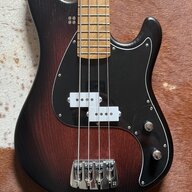
I'd like to hear more about the bass control (and if it really is a XO that determines how much of the low gets fed into the clipping circuit) it sounds very interesting. Sounds fairly novel compared to most controls, and particularly useful for retaining clarity in lows vs boosting lows to compensate for loss
The manual says:
My keen ears and my exceptionally sharp mind figured out what I already told above
-Since the pedal passes signal with Gain at zero, and there is no audible distortion then, turning the bass up and down does not change the sound.
-With the gain set higher, playing the B string with bass at zero sounds almost completely clean. The low end does not get distorted, and there is the faintest sizzle up top - but using the Le Fay with flatwounds that will have their fifth birthday later this year yields not much in terms of overtones and high frequency content.
-Increasing the bass knob while playing lower notes will gradually increase the amount of drive those notes get.
I'm no expert when it comes to electronics, but the crossover theory was the best I could come up with to explain what my ears tell me.
BASS:
Lets you gradually increase the low frequencies and control the tightness of the bass.
My keen ears and my exceptionally sharp mind figured out what I already told above
-Since the pedal passes signal with Gain at zero, and there is no audible distortion then, turning the bass up and down does not change the sound.
-With the gain set higher, playing the B string with bass at zero sounds almost completely clean. The low end does not get distorted, and there is the faintest sizzle up top - but using the Le Fay with flatwounds that will have their fifth birthday later this year yields not much in terms of overtones and high frequency content.
-Increasing the bass knob while playing lower notes will gradually increase the amount of drive those notes get.
I'm no expert when it comes to electronics, but the crossover theory was the best I could come up with to explain what my ears tell me.

It exists (not mine):
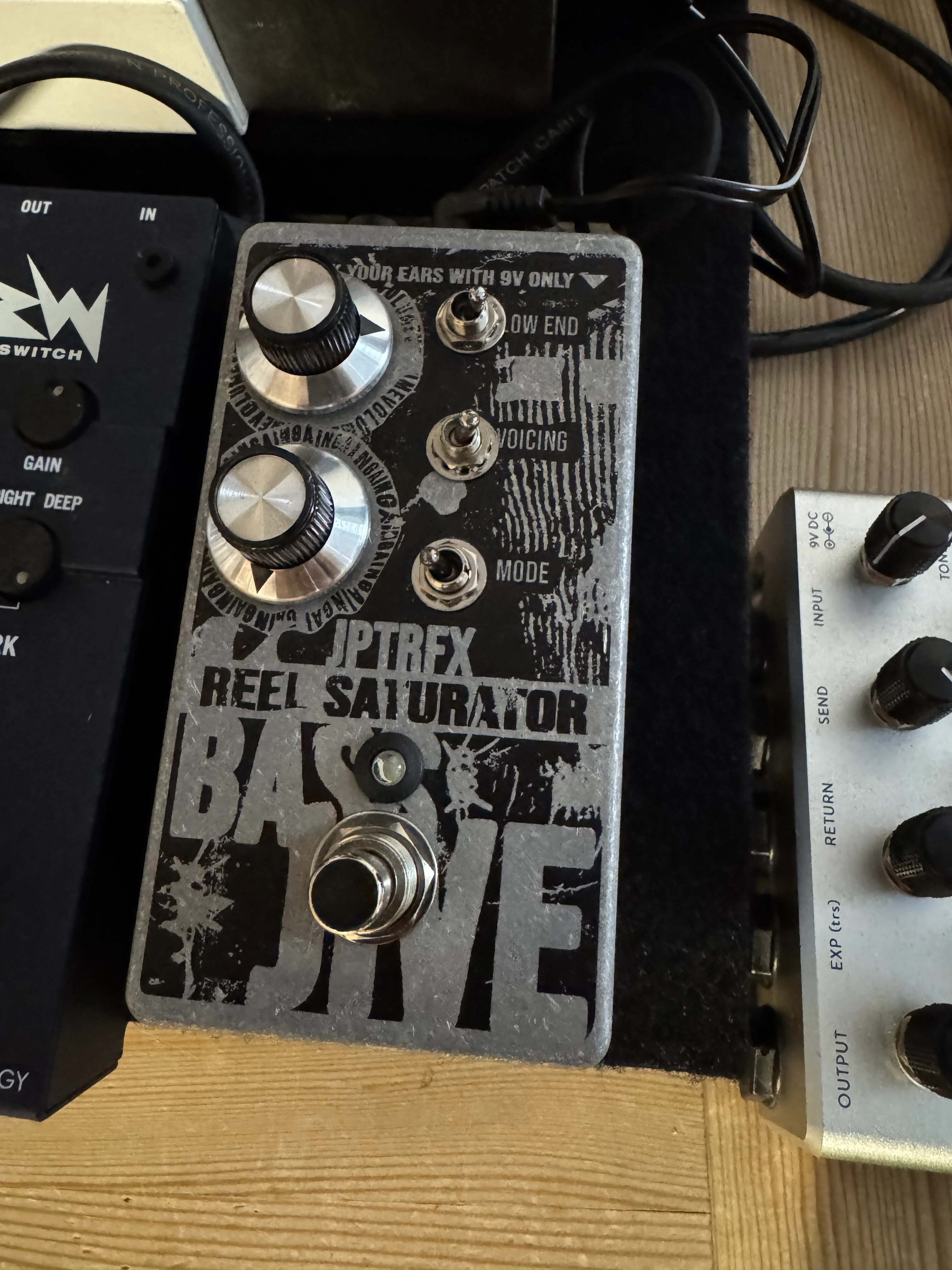
Well played JPTR, well played. Now I’ll have to grab it too..

Well played JPTR, well played. Now I’ll have to grab it too..
- mouthmw
- Replies: 695
- Forum: Effects [BG]
It exists (not mine):
View attachment 7169404
Well played JPTR, well played. Now I’ll have to grab it too..
- mouthmw
- Replies: 695
- Forum: Effects [BG]
...and sitting right next to a Lehle RMI Sonic Spark!


