• TalkBass has been independent since 1998. Add your voice.
    Create a free account to reply to discussions, view embedded media, and browse with fewer display ads.
    Join freeLog in
    Want zero display ads or expanded classifieds tools? Compare plans.

My DIY Pedalboard

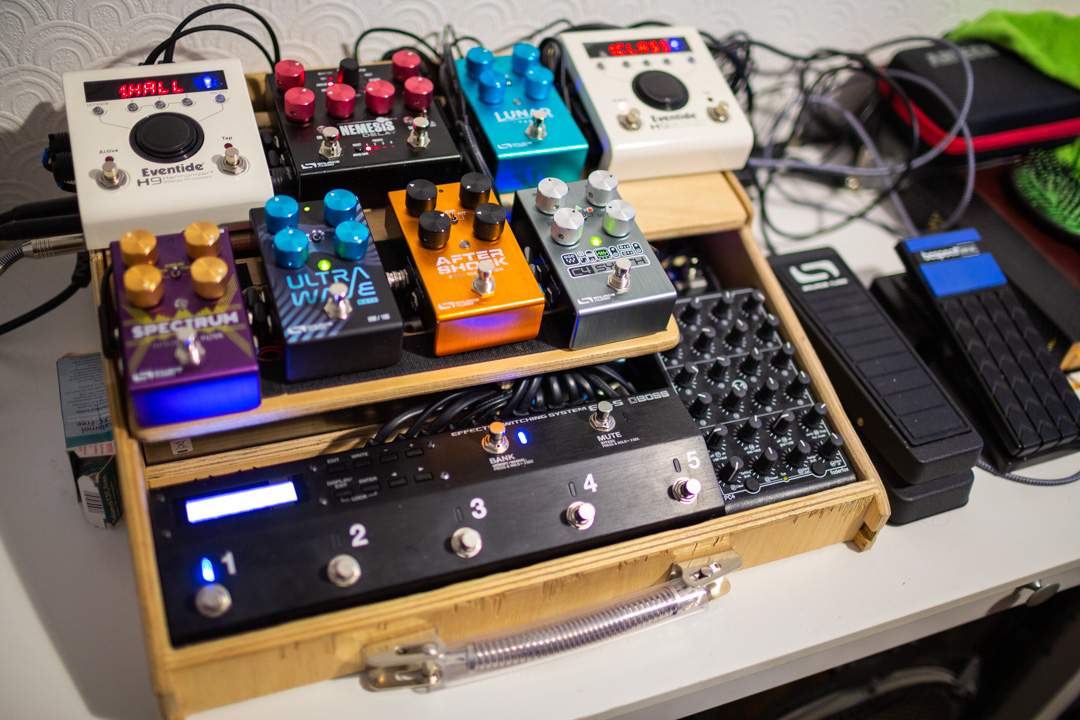
I've had a morning of re-wiring and re-positioning my effects pedals. It occurred to me that my pedal order on my board looked a bit random. I think a lot of my pedals are placed aesthetically and because that's where they have been for a long time. So it was high time for a pedal re-arrange. So now my pedals on the bottom row better represent their loop order. My new loop / chain order is:
input
L1 SA C4
L2 EHX Hog 2 (undercroft)
L3 Aftershock and Ultrawave. These are switched / bypassed via Midi CC.
L4 Eventide H9 Prime
L5 SA Spectrum Filter
So the big change here is putting my dirt into a single Loop and then moving my Spectrum to the 5th loop too. This means that I can now move my filter about and use its octaver a bit more if I want too.
From the output of my Boss ES-5: Every pedal is then Stereo.
SA Lunar > SA EQ2 > SA Nemesis > Eventide H9 (ambience)
I've also swapped my SA EQ2 and SA Lunar on my board as I need better access to it and I hardly need to see the EQ2...even though it's a very hansom pedal. Functionally and practically, they are in same spot in the chain, just swapped physical locations.
The Undercroft is looking a bit more tidy, the new power and cable routings seem to be better. At some point in 2022, I'll need to swap over to Cioks power. The Strymon Ojai is excellent, but it's now maxxed out wattage wise. I think the Cioks DC7 and DC5 will serve me well.
Photographically, it doesn't look much for 4 hours re-cable! It's sounding better too, I managed to separate a lot of the audio feeds from the power and midi feeds.
20220108-_W5A0389.jpg
20220108-_W5A0391.jpg
20220108-_W5A0395.jpg
 
Earlier iterations were neater in the under-croft, mainly due to less pedals. When I had my Strymon Mobius, the top row was all mono. The Mobius was in my 5th loop and only the H9 Ambience was stereo. Last year, I flipped my Mobius and added 4 new Source Audio pedals. The Mobius (although a great pedal) isn't missed, the SA Lunar more than nails everything I wanted from the Mobius. My EQ2 gets used as a buffered volume / swell at lot. A low pass and High pass filter and occasionally a foot controlled 4 pole low pass filter (a really sweet option) as well as the usual 10 band stereo graphic EQ. This time last year, I didn't expect to a Nemesis or a Spectrum and I didn't expect to go Stereo with my Lunar, EQ2, Nemesis and H9 Ambience. I have to say that the Spectrum is the finest filter I've owned and takes a lot of the load off my C4, especially now that I have it in a loop. I can move it about the chain. filters work best after dirt (but before modulation) where as octaves tend to work before dirt.
One day it'll be nice to have a Midi controller that offers 5 stereo loops.
The Nemesis is another fantastic pedal that I'm really thrilled about. In stereo it really opens it up. However adding stereo cabling has added to the curls and nests of cables in the Under-Croft. Hopefully I can simplify this as the year progresses.
 
I've been considering moving to MorningStar midi gear for about 6 months or so. When I bought the Boss ES-5, the only competition was the ES-8. It was a trail blazer product and I've really enjoyed it's features over the last 5 years that I've owned one. In fact, the wood work for this board was designed around it's physical dimensions. It's a bespoke shape for the ES-5 and other pedals and it's why something exactly like it isn't available commercially.
From a features point of view, I would prefer a MC-8. But I suspect that it's too deep for my current board layout and I want my midi controller in the bottom row left. So I think the MC-6 is a better option / fit for me. Currently, all my early pedals are wired mono and I don't particularly need them to be stereo. In fact I could easily just have my Eventide H9 (primary) in stereo. I would only choose an ML5x (in development) because the current ML5 isn't a matrix switcher and as a result the loop orders are static.
Input>
L1: C4
L2: EHX Hog2
L3: Aftershock
L4: Ultrawave
L5: Spectrum
L6: H9 (stereo)
L7: Lunar (stereo)
Output > EQ2 > Nemesis > H9 All in stereo.
Leaving me one mono loop spare for future expansion. If I combine my Aftershock and my Ultrawave in a single loop and midi switch them, I gain a spare stereo loop. Ready for what ever amazing pedal they release this year.
One of the other advantages of the MC-6 / ML5x option is the smaller foot print of the complete package and I can move the switcher box to the rear right side of the "under-croft" (shortening cable paths significantly). While keeping the Midi controller to my preferred bottom left of my board. It also means I then have the space for 2 Source Audio One Series pedals next to it. Or maybe a Larger box One Series (Ventris maybe) and something like a Zio as my 1st pedal in my chain.
The new Source Audio Zio looks like a great pedal, however for my current needs, my Boss ES-5 already has a great buffer in it's input section. But If I go MorningStar, then I will need an input buffer and the Zio is a great choice.
There's the cost implication, selling my Boss ES-5 will give me about £275. But a new MC6 and ML5 (although I'd want a ML5x) is currently around £425. That's quite a price difference for what is mostly a side grade.

Another hesitation I have about jumping over to a MorningStar MC-6 / ML5x (apart from the fact that it
's not yet released to market) is the current draw. The Boss ES-5 has a draw of 125mA. The MC-6 has 120mA and the ML5 is 160mA. That's quite a lot more, especially If I add a Zio too. although 25mA isn't much more it's an accumulative 180mA I will need. My current (soz for the pun) PSU is a Strymon Ojai with an Ojai expansion. When I specced it, it was way more than I needed...so very future proof. However...I've hit that "future" with it and wattage wise, my board is already maxxed out.
I'd like to swap to a Cioks DC7 and DC5 expander PSU. It'll offer me a lot more wattage, a few more isolated feeds and a dedicated USB power outlet. Selling my Strymon Ojai and expander will probably give me about £180 S/H (it's boxed etc). However a new DC7 and 5 will set me back £380...so again another fiscal consideration.
If I put these two costs together, I have around £400 to find, just to side grade and I gain only a few features.
So it's food for thought.
 
  • Like
Reactions: Derek Williams
I've been considering moving to MorningStar midi gear for about 6 months or so. When I bought the Boss ES-5, the only competition was the ES-8. It was a trail blazer product and I've really enjoyed it's features over the last 5 years that I've owned one. In fact, the wood work for this board was designed around it's physical dimensions. It's a bespoke shape for the ES-5 and other pedals and it's why something exactly like it isn't available commercially.
From a features point of view, I would prefer a MC-8. But I suspect that it's too deep for my current board layout and I want my midi controller in the bottom row left. So I think the MC-6 is a better option / fit for me. Currently, all my early pedals are wired mono and I don't particularly need them to be stereo. In fact I could easily just have my Eventide H9 (primary) in stereo. I would only choose an ML5x (in development) because the current ML5 isn't a matrix switcher and as a result the loop orders are static.
Input>
L1: C4
L2: EHX Hog2
L3: Aftershock
L4: Ultrawave
L5: Spectrum
L6: H9 (stereo)
L7: Lunar (stereo)
Output > EQ2 > Nemesis > H9 All in stereo.
Leaving me one mono loop spare for future expansion. If I combine my Aftershock and my Ultrawave in a single loop and midi switch them, I gain a spare stereo loop. Ready for what ever amazing pedal they release this year.
One of the other advantages of the MC-6 / ML5x option is the smaller foot print of the complete package and I can move the switcher box to the rear right side of the "under-croft" (shortening cable paths significantly). While keeping the Midi controller to my preferred bottom left of my board. It also means I then have the space for 2 Source Audio One Series pedals next to it. Or maybe a Larger box One Series (Ventris maybe) and something like a Zio as my 1st pedal in my chain.
The new Source Audio Zio looks like a great pedal, however for my current needs, my Boss ES-5 already has a great buffer in it's input section. But If I go MorningStar, then I will need an input buffer and the Zio is a great choice.
There's the cost implication, selling my Boss ES-5 will give me about £275. But a new MC6 and ML5 (although I'd want a ML5x) is currently around £425. That's quite a price difference for what is mostly a side grade.

Another hesitation I have about jumping over to a MorningStar MC-6 / ML5x (apart from the fact that it
's not yet released to market) is the current draw. The Boss ES-5 has a draw of 125mA. The MC-6 has 120mA and the ML5 is 160mA. That's quite a lot more, especially If I add a Zio too. although 25mA isn't much more it's an accumulative 180mA I will need. My current (soz for the pun) PSU is a Strymon Ojai with an Ojai expansion. When I specced it, it was way more than I needed...so very future proof. However...I've hit that "future" with it and wattage wise, my board is already maxxed out.
I'd like to swap to a Cioks DC7 and DC5 expander PSU. It'll offer me a lot more wattage, a few more isolated feeds and a dedicated USB power outlet. Selling my Strymon Ojai and expander will probably give me about £180 S/H (it's boxed etc). However a new DC7 and 5 will set me back £380...so again another fiscal consideration.
If I put these two costs together, I have around £400 to find, just to side grade and I gain only a few features.
So it's food for thought.
One thing to note: the Cioks DC5 is old tech, and I don’t think it can link with the DC7. The 4 Expander and 8 Expander are the ones meant for expanding the DC7 (it’s an unfortunately confusing naming scheme).
 
  • Like
Reactions: ceetee and GMC
I've been considering moving to MorningStar midi gear for about 6 months or so. When I bought the Boss ES-5, the only competition was the ES-8. It was a trail blazer product and I've really enjoyed it's features over the last 5 years that I've owned one. In fact, the wood work for this board was designed around it's physical dimensions. It's a bespoke shape for the ES-5 and other pedals and it's why something exactly like it isn't available commercially.
From a features point of view, I would prefer a MC-8. But I suspect that it's too deep for my current board layout and I want my midi controller in the bottom row left. So I think the MC-6 is a better option / fit for me. Currently, all my early pedals are wired mono and I don't particularly need them to be stereo. In fact I could easily just have my Eventide H9 (primary) in stereo. I would only choose an ML5x (in development) because the current ML5 isn't a matrix switcher and as a result the loop orders are static.
Input>
L1: C4
L2: EHX Hog2
L3: Aftershock
L4: Ultrawave
L5: Spectrum
L6: H9 (stereo)
L7: Lunar (stereo)
Output > EQ2 > Nemesis > H9 All in stereo.
Leaving me one mono loop spare for future expansion. If I combine my Aftershock and my Ultrawave in a single loop and midi switch them, I gain a spare stereo loop. Ready for what ever amazing pedal they release this year.
One of the other advantages of the MC-6 / ML5x option is the smaller foot print of the complete package and I can move the switcher box to the rear right side of the "under-croft" (shortening cable paths significantly). While keeping the Midi controller to my preferred bottom left of my board. It also means I then have the space for 2 Source Audio One Series pedals next to it. Or maybe a Larger box One Series (Ventris maybe) and something like a Zio as my 1st pedal in my chain.
The new Source Audio Zio looks like a great pedal, however for my current needs, my Boss ES-5 already has a great buffer in it's input section. But If I go MorningStar, then I will need an input buffer and the Zio is a great choice.
There's the cost implication, selling my Boss ES-5 will give me about £275. But a new MC6 and ML5 (although I'd want a ML5x) is currently around £425. That's quite a price difference for what is mostly a side grade.

Another hesitation I have about jumping over to a MorningStar MC-6 / ML5x (apart from the fact that it
's not yet released to market) is the current draw. The Boss ES-5 has a draw of 125mA. The MC-6 has 120mA and the ML5 is 160mA. That's quite a lot more, especially If I add a Zio too. although 25mA isn't much more it's an accumulative 180mA I will need. My current (soz for the pun) PSU is a Strymon Ojai with an Ojai expansion. When I specced it, it was way more than I needed...so very future proof. However...I've hit that "future" with it and wattage wise, my board is already maxxed out.
I'd like to swap to a Cioks DC7 and DC5 expander PSU. It'll offer me a lot more wattage, a few more isolated feeds and a dedicated USB power outlet. Selling my Strymon Ojai and expander will probably give me about £180 S/H (it's boxed etc). However a new DC7 and 5 will set me back £380...so again another fiscal consideration.
If I put these two costs together, I have around £400 to find, just to side grade and I gain only a few features.
So it's food for thought.

You cant go wrong with MorningStar. I bought the MC6 /ML5 a long time ago. Their customer service is bar none the best. They are constantly updating and improving still. Their latest update included an update for ipad editing. Something Ive long wanted. Now I can access the midi editor using the widimaster wirelessly. Im sure you have researched the MC6 but it changes almost daily. Its the best money I have ever spent on my board. The ML5 is just a switcher and works well also, I just have it for switching on and off my non midi pedals. With the MC6 and Source audio you still need the hub though as the MC6 isnt a host.
I encourage you to check out the MorningStar Forum if you haven't already. They take suggestions from users and implement them when possible. I tought about upgrading to the MC8 but I dont think its neccessary. The MC6 does everything I need and more. Im not affiliated with MorningStar in any way, Im just a very happy user of their products.
Matt
 
I've been considering moving to MorningStar midi gear for about 6 months or so. When I bought the Boss ES-5, the only competition was the ES-8. It was a trail blazer product and I've really enjoyed it's features over the last 5 years that I've owned one. In fact, the wood work for this board was designed around it's physical dimensions. It's a bespoke shape for the ES-5 and other pedals and it's why something exactly like it isn't available commercially.
From a features point of view, I would prefer a MC-8. But I suspect that it's too deep for my current board layout and I want my midi controller in the bottom row left. So I think the MC-6 is a better option / fit for me. Currently, all my early pedals are wired mono and I don't particularly need them to be stereo. In fact I could easily just have my Eventide H9 (primary) in stereo. I would only choose an ML5x (in development) because the current ML5 isn't a matrix switcher and as a result the loop orders are static.
Input>
L1: C4
L2: EHX Hog2
L3: Aftershock
L4: Ultrawave
L5: Spectrum
L6: H9 (stereo)
L7: Lunar (stereo)
Output > EQ2 > Nemesis > H9 All in stereo.
Leaving me one mono loop spare for future expansion. If I combine my Aftershock and my Ultrawave in a single loop and midi switch them, I gain a spare stereo loop. Ready for what ever amazing pedal they release this year.
One of the other advantages of the MC-6 / ML5x option is the smaller foot print of the complete package and I can move the switcher box to the rear right side of the "under-croft" (shortening cable paths significantly). While keeping the Midi controller to my preferred bottom left of my board. It also means I then have the space for 2 Source Audio One Series pedals next to it. Or maybe a Larger box One Series (Ventris maybe) and something like a Zio as my 1st pedal in my chain.
The new Source Audio Zio looks like a great pedal, however for my current needs, my Boss ES-5 already has a great buffer in it's input section. But If I go MorningStar, then I will need an input buffer and the Zio is a great choice.
There's the cost implication, selling my Boss ES-5 will give me about £275. But a new MC6 and ML5 (although I'd want a ML5x) is currently around £425. That's quite a price difference for what is mostly a side grade.

Another hesitation I have about jumping over to a MorningStar MC-6 / ML5x (apart from the fact that it
's not yet released to market) is the current draw. The Boss ES-5 has a draw of 125mA. The MC-6 has 120mA and the ML5 is 160mA. That's quite a lot more, especially If I add a Zio too. although 25mA isn't much more it's an accumulative 180mA I will need. My current (soz for the pun) PSU is a Strymon Ojai with an Ojai expansion. When I specced it, it was way more than I needed...so very future proof. However...I've hit that "future" with it and wattage wise, my board is already maxxed out.
I'd like to swap to a Cioks DC7 and DC5 expander PSU. It'll offer me a lot more wattage, a few more isolated feeds and a dedicated USB power outlet. Selling my Strymon Ojai and expander will probably give me about £180 S/H (it's boxed etc). However a new DC7 and 5 will set me back £380...so again another fiscal consideration.
If I put these two costs together, I have around £400 to find, just to side grade and I gain only a few features.
So it's food for thought.
If it helps, make me a silly offer here and you can take the first step :D

https://reverb.com/uk/item/49427916-morningstar-ml5
 
  • Like
Reactions: GMC
You cant go wrong with MorningStar. I bought the MC6 /ML5 a long time ago. Their customer service is bar none the best. They are constantly updating and improving still. Their latest update included an update for ipad editing. Something Ive long wanted. Now I can access the midi editor using the widimaster wirelessly. Im sure you have researched the MC6 but it changes almost daily. Its the best money I have ever spent on my board. The ML5 is just a switcher and works well also, I just have it for switching on and off my non midi pedals. With the MC6 and Source audio you still need the hub though as the MC6 isnt a host.
I encourage you to check out the MorningStar Forum if you haven't already. They take suggestions from users and implement them when possible. I tought about upgrading to the MC8 but I dont think its neccessary. The MC6 does everything I need and more. Im not affiliated with MorningStar in any way, Im just a very happy user of their products.
Matt
One of the attractions of the MorningStar range is supporting a small independent company and not a big faceless Japanese corporation. However, I have a lot of respect for Boss. in an alternative universe where there is no Boss...the effects world would be very limited.

I really like the press and hold and the double tap options in the MorningStar range of controllers. However, I'm less impressed with the ML5. It's a sweet unit, small and neat. It's just that it's not a matrix switcher (both the ES-5 and ES-8 are). So I can't rearrange my loop orders. So compared to my ES-5 I'm loosing major functionality. Until the ML5x is finally launched. My ES-5 is still my best option at the moment. So I'll wait until the ML5x is launched and is available in the UK.

If it helps, make me a silly offer here and you can take the first step :D
https://reverb.com/uk/item/49427916-morningstar-ml5
Thanks for the offer Derek, but I don't want to buy hardware that I'll need to off load again later in the year. Compared to my current ES-5, I'd be loosing some critical functionality. I think the ML-5 is a great product but it's not a great fit for me.
 
I've created a FaderFox PC4 page here: FaderFox PC4 - Wonder of Midi Control

I've spent a little more thought on my power supply upgrade options. As much as I like the Cioks DC7/8 range. it's a lot money for not a lot of extra benefits. I really don't need a 50+ watt supply. My board at the moment is drawing around 23w, so a mild upgrade will give me the option of some power overhead and future pedal expansion. My physical board size is also my pedal expansion limiter too. However, my current PSU is nearly at it's max and it has to be upgraded before I can consider any other changes.

The Strymon Zuma or Zuma 300 are really good options for me. Both will require a little wood work to fit. The Zuma has the benefit of loading feeds from the long edge. This would need my Hog2 to be moved closer to my ES-5. That's quite a lot of work, but certainly possible. I don't need all of the Zuma's wattage, in fact I can't ever imagine I'd need that kind of power. The Zuma 300 is a similar size, half the weight and offers me 36w. 1.5x what i currently have from my Ojai. I can keep my existing Ojai expansion units to add more feeds. It'll need a little woodwork (but not as much as the Zuma) and could easily provide more than enough power requirements that I am likely to need. So it's likely one of these will find it's way to my door soon.
 
I've had a slight swap around with my pedal board wiring. I had a patch where I needed both fuzz and overdrive separated in different loops. So I've moved my primary H9 out of the mono loops and placed it in my static Stereo chain. I've split my two SA dirt pedals into separate loops. My Aftershock is staying in Loop 3, but my Ultrawave is now inheriting the H9's old loop 4. I've run through all of my Boss ES-5 patches to edit the changes (numerous assigns and patch calls) to implement the change.
My mono matrix loops are now
1) SA C4.
2) EHX Hog2
3) SA Aftershock
4) SA Ultrawave
5) SA Spectrum
So there 5 pedals can be placed in any order via my Boss ES-5. They are all run as mono devices.
Then my Static Stereo chain is
a) Eventide H9 (primary)
b) SA lunar
c) SA EQ2
d) SA Nemesis
e) SA H9 (ambience)
These are my Stereo effects and I rarely have a need to change their order, although I might consider a Morningstar ML10x when it's finally available.

I've also run a feed from my EXH Hog2's direct out port to Input 2 on my Spectrum. This is so I can side chain some of my Filtered patches as get greater flexibility / control over my MF-101 patch. To get the side chain working I swap the loop order for my Hog2 and C4. I use an active John East Preamp on my bass to hit the Hog 2 with a high gain. I then pull back the C4's input volume to bring the signal back to unity. I might add this feed to my SA Aftershock's 2nd input output and run a clean boost patch for that channel so I can control the boost via a digital pedal.
 
  • Like
Reactions: mdalamond
I've just upgraded my Strymon Ojay PSU to a Zuma R300. I've kept one of my Ojay extension units so I can make the necessary isolated connections that my board needs. Why the upgrade? The Ojay is rated for 24w max and on 1st boot, my board comes in just under that figure. If I get a slightly under-voltage supply on stage, then my board's power up suffers. Why the R300? it was a combination of cost vs features. The new unit is rated for 36w, which is more than ample for a few extra pedals down the line. It sort of fits the old spot (with a bit of wood work to make the IEC power cable fit and the extension cable route. It's a little heavier (but not much) but a lot lighter than some other units that I've looked at. Because I already had an Ojay, I could keep all my existing cables and I didn't need to rip everything apart and rewire the whole board. Most of this I fitted in-situ and I just removed my EQ2 and Hog2. It took me about 2.5 hours from arrival to fire up and it all fired up first time with no cabling issues. I did Seriously consider the Cioks CD7 and 8. It would have been nice to had a dedicated USB power option and the few extra ports would have been nice too. However, it physically didn't fit quite so well and meant a lot more wood work would be required. I like the Cioks a lot, but I didn't want to have to move my Hog2, that would require a lot of re-work and it might have been easier just to start again and rebuilt it all from scratch. It was also and expensive option (£379) and I'd only get about £150 for my Used Ojay kit. Where as, the Zuma R300 was only £179 delivered and I can still sell my old Ojai for around £110. Giving me an upgrade cost of about £70.
I like the unit, it's pretty much the same as the last one only bigger and less prone to power starvation issues.
It's a bit irksome to be spending money on ancillary stuff...ironically paying for something to be very quiet and not warbly! However, this upgrade will provide ample juice for my board up for the next few more years. Hopefully it's the last PSU I'll buy. LOL....With the lid closed there is no discernible visual difference.
With such a reasonable upgrade...I have some cash in the bank waiting for the next big thing to arrive.

20220330-_75C1000.jpg
20220330-_75C1003.jpg
20220330-_75C1005.jpg
20220330-_75C1007.jpg
20220330-_75C1006.jpg
 
  • Like
Reactions: Derek Williams
I've just upgraded my Strymon Ojay
Would you mind some quick questions as an experienced Ojai user? I'm thinking about buying one, and am wondering about the 24V power connector: in the pictures online the connector seems to be plastic - is it robust? And does the power cable fit tightly enough that it wouldn't be pulled out accidentally (within reason, I'm not going to stomp on it)?
 
Would you mind some quick questions as an experienced Ojai user? I'm thinking about buying one, and am wondering about the 24V power connector: in the pictures online the connector seems to be plastic - is it robust? And does the power cable fit tightly enough that it wouldn't be pulled out accidentally (within reason, I'm not going to stomp on it)?
Hi, I've used both the Strymon Ojai with another Ojai expander and the Zuma R300, with an Ojai expander. Both work great, very stable and I've had no issues with cables or connectors. The Strymon Ojai has a power brick that connects to the Ojai unit, this is robust. It uses the same jack / connector as the expansion 24v feed. The R300 has an IEC cable straight (in the UK) into the back of it. The R300 and Ojai units pass 24v power by a cable that's a bit bigger than the feeds to the pedals. These seem robust and I've not had any issues with them with the Ojai, Ojai's Power brick, R300 or the Ojai expansion boxes. The feeds to the pedals from the distribution boxes are standard 2.1mm connectors at both ends, so you don't need fancy / custom cabling. You can easily source 3rd party cables if you want custom feed lengths. The Strymon feed cables are angled at one end and straight at the other. I would advise using the angled at the pedal end and the straight connectors at the feed end, this will help keep your cabling neat and organised. I'm regularly pulling the cabling apart / re-routing cables on my board and over the last 3-4 year I've literally had no issues with the Strymon cables or connectors. I can't say that about the audio 1/4" interconnects between my pedals. However, that's another subject.
The only issue I've had with Strymon power is that it is a switched PSU and circuit protection causes the power to ramp on first boot. this can spook or starve some pedals that are expecting full wattage in the first few seconds. Source Audio have added necessary code into their firmware for a number of their more complex pedals.
 
  • Like
Reactions: nnnnnn
Hmm where to place a Source Audio Atlas Compressor? I may need to swap out my Aftershock for a bit until I grow my pedal board base a bit more.
I currently toying with the idea of selling my Boss ES-5 and moving over to a Morningstar MC-6. I'm thinking of not having a switcher / looper and just using midi to control my pedal on / offs. It would halve the size of my Midi controller and reduce the wire tangle substantially. I really like the ES-5's ability to swap around the loop order, however it's a function I hardly ever use. I could re-add the feature later with a Morningstar ML10x, when ever that actually gets released!
Currently, when I open the lid, the C4, Hog2, Aftershock ands Spectrum all route send and returns to the ES-5 via the longest path on my board.
The Boss ES-5 functions in very different way to the Morningstar MC6. Each patch on the ES-5 allows for three option button presses with in a patch. Looking at the MC-6, I can kind of replicate this by using the double tap, long tap and double long tap controls. The difference is that on the ES-5 I can isolate buttons within a patch and re-assign them to midi / loop functions. Where as, each button on the MC-6 is a pre-set recall button and I don't think they can be re-assigned. If I could assign additional function to the other buttons while staying in the same patch...I would be instantly sold. To adopt the ES-5 requires me to re-think all of my current patches, which is current in the 30-35 category and that's a lot of work documenting them all and then re-creating a similar set on the MC-6.
What is selling the MC-6 to me is it's far smaller size. I can fit two more pedals in space difference between the ES-5 and MC-6 and I also gain a reduction in cabling / routing. I get two new pedal placements / hardpoints and I don't have to do any wood work to accommodate them!
 
Last edited:
  • Like
Reactions: Derek Williams
After reading a few forum posts from some use cases, I think I can use a MC-6 Bank as my primary patch (is what I have set as a single patch on my ES-5) and then use the buttons as controls to each patch. Although the MC-6 will treat each button as a separate patch, effectively to me it will be the same patch (bank). So my entry point would always be button A in a Bank. I could then make button B my Midi commands to my Lunar (keeping all the other device settings unchanged, C could be my dirt, D could be my compressor, E Ultrawave, F could be my Ambience. I could then assign additional functions to each letter buttons. Double tap, long tap, double long tap etc. That could work very nicely for me. I could easily add three buttons to one of the exp ports too.
 
  • Like
Reactions: Derek Williams
20220401-_75C1027.jpg
20220401-_75C1020.jpg
Last posterity shot of my current board before I rip everything apart and start a major re-work / wood work re-model. The incoming Source Audio Atlas Compressor has cause me to re-think a lot of my board and I've been putting off a re-model for about a year. Change as they say...creates change!
I'm currently playing more Church gigs now that lock down is finally over and life is gradually resuming again. I'm finding that I have to disassemble part of the expression pedal wiring each gig and I want to integrate my primary expression pedal into / onto my board. I want to bring my EQ2 back to the top row and I need some more board space going forwards.
So I'm adding 10cm to the right side of my board. I'm adding a full front to back, with a custom cut out for the Source Audio Dual Expression pedal. I'll need to make a new top plate to accommodate the extra width and I'll need to make some holes in the current side panel. Photos to follow as I progress!
 
Last edited:
Whether you buy them or build them, they are always too small :D
Nice ! And inspiring :hyper:
Thanks, appreciated!
Funnily enough, the reason I built it back in Jan 2018 was because I had out grown my existing pedal board and i couldn't fit a Boss ES-5 on it. I built a bigger board than I needed but it also needed to be compact. So I stuck with a 18" square format. It's done me well for the last 4.5 years and after this expansion, it should do me well for a long while to come.
 
@GMC I have and continue to enjoy the ongoing saga of your effect journey and pedal board build conundrums as I also grapple with my own wants and needs. Keeping the footprint to a minimum is necessary as I can no longer dance a larger board, nor deal with transport issues [should I ever play live again, fingers crossed]. Luckily I am nonplussed by Atlas as the Ultrawave will fulfill any of my compressor needs, but I certainly do see the appeal as it is another brilliant pedal from SA.
 
  • Like
Reactions: Howardzark and GMC

Latest posts