
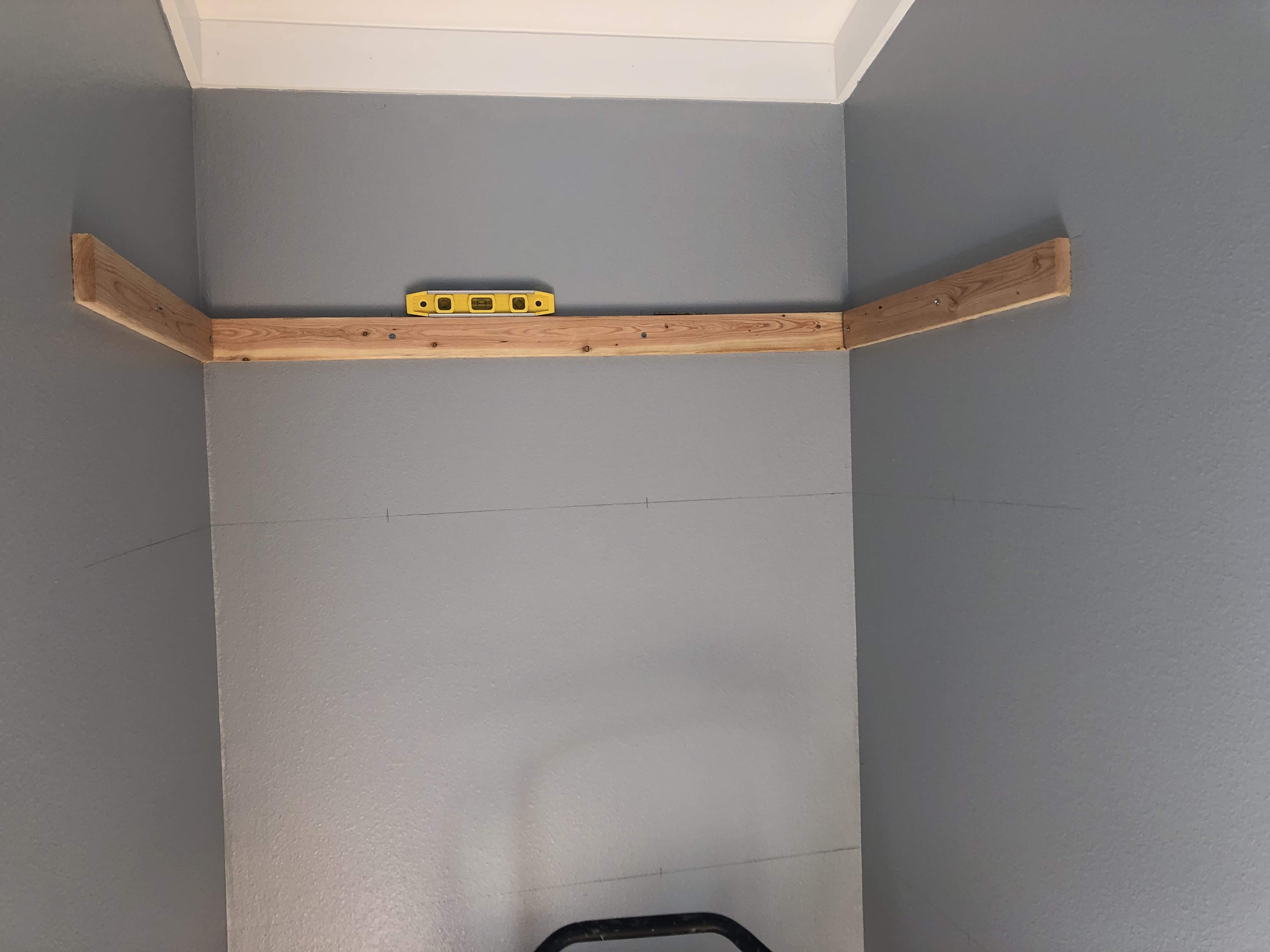
1 of 8 shelf furring strip supports installed.

TalkBass has been independent since 1998. Add your voice.
Create a free account to reply to discussions, view embedded media, and browse with fewer display ads.
Join free Log in
Want zero display ads or expanded classifieds tools? Compare plans.

No, they have 3” screws into two studs each and then toggle bolts on the ends to ensure that everything was level. They’re quite stout.Are you applying construction adhesive behind the support strips?
For those that haven’t heard of this, the over under cable winding technique is good for all cables. It helps keeps winding stress out of the shield and prevents it from opening with time.

For those that haven’t heard of this, the over under cable winding technique is good for all cables. It helps keeps winding stress out of the shield and prevents it from opening with time.

2. I could cut the siding in the area of the boxes to create a flat mounting surface. The siding is Hardie (ie cementuous fiber board) and extremely difficult to cut. I’d need an angle grinder with a diamond blade, and then would still have trouble with getting clean corners. On top of that if need to not damage the plywood sheathing and building wrap under the siding.
I found an example of someone doing that very thing, but they had major issues at the corners. Same would hold true with an angle grinder, or any circular cutting device. So... Any way you slice it (pun intended) this will be tough.Would a circular masonry saw work? Set appropriate blade depth and use plunge cuts. Tedious and difficult, but more accurate than an angle grinder.

I don't think they'll be all that minuscule. A flat plain butting up against a sawtooth leaves a lot of triangles to fill with some form of sealant. There's also the issue of having some sort of backer to stop the sealant from continuously pouring into the void. Foam backer rod doesn't do well outside, nor does expanding foam. Some expanding foam is made for outdoor applications, but I also need something that won't expand to the point of mis-aligning the baffle box. It's a lot of complications that make this a less than ideal solution, even if the application is easier.can't you just put in on the siding as is and caulk/seal the zig zag pattern holes, they will be miniscule.
What sound putty? The stuff I put around the light and outlet boxes? Those putty pads need something to adhere to. This will have an open gap directly behind it. I'm also not sure that they're made for outdoor use.or fill them with that sound putty you used and then caulk it sealed.
I don't disagree, I just worry about the viability in an exterior setting, especially one as moist as Seattle.seems a hell of a lot easier that cutting siding.
Wouldn't be pretty straightforward to make a template from the sawtooth pattern?I’m struggling with methods for mounting the baffle boxes.
1. I could mount them on top of the siding, but then I have a series of large gaps to deal with due to the sawtooth pattern created by lap siding.
It could be, but I can’t conceive of how that would be done. Any suggestions?Wouldn't be pretty straightforward to make a template from the sawtooth pattern?


