• TalkBass has been independent since 1998. Add your voice.
    Create a free account to reply to discussions, view embedded media, and browse with fewer display ads.
    Join freeLog in
    Want zero display ads or expanded classifieds tools? Compare plans.

Mysterious Made in Mexico P Bass???

May 29, 2020
320
1,242
Scrolling through used basses on GC's site, this at first looked like a standard MIM precision bass, but then I noticed there is no truss rod adjustment by the nut. Presumably, based on the pickguard, it's located at the heel. This is the only photo I have.

000000117556049-00-2000x2000.jpg


It has a very early Mexico serial number, MN100xxx making it a 1991, which from what I gather is the first year they produced basses in Ensenada. I have not been able to find another 1991 mim bass online to compare. The earliest I'm able to find is 1992, MN2xxxxx.

Screen Shot 2021-12-07 at 10.57.11 AM.png


I further noticed that in comparing the headstock to other early examples that the "Made in Mexico" label is not in the exact same location. On the 1991 "Mexico" ends under the end of the A in "BASS" while on this 1992 "Mexico" ends under the BA.

Screen Shot 2021-12-07 at 10.57.28 AM.png


Any ideas what's going on?

Some theories:

It's a fake, like an allparts neck with fender logo. Ok, but then why fake an early MIM? Doesn't really make sense.

Fender America supplied necks, or at least neck parts to facilitate the transition of production from Japan to Mexico? I can't find any evidence or even anecdotes to support this.

It's an alien life form or ALF Fender. If you've made it this far, thank you!
 
Last edited:
I feel like I'm on some strange quest to solve this. Very interested to hear any thoughts, apocryphal or otherwise. I also found another 1991 headstock, this one with the truss rod access, serial number MN100954.
 

Attachments

  • Screen Shot 2021-12-07 at 3.31.34 PM.png
    Screen Shot 2021-12-07 at 3.31.34 PM.png
    357.6 KB · Views: 129
  • Like
Reactions: FranF
Up until probably early 2000ish (when the highway one series came out ) , the Ensenada plant did not manufacture necks or bodies.

The majority of necks and bodies were supposed to have been made in California ( it makes financial sense , since there’s free-trade between all of North America, meaning Canada , USA and Mexico). However , I’m pretty sure that fender probably sourced parts from other places throughout the years, including any other o fb the facilities that manufactured products for them.


So basically, you’re gonna run into a ton of small different variations, in the decal or elsewhere. As long as the decal doesn’t look like a waterside (which it doesn’t) , I wouldn’t worry too much.
 
  • Like
Reactions: Lujon and tindrum
Thank you for the info! And just to clarify I’m not worried or concerned about this. I simply thought it was interesting and noteworthy that one of the most defining features of the Mexican basses is different on the earliest examples.
 
  • Like
Reactions: elgranluis
I doubt that it's a replacement neck with a MIM Fender logo on it. I would almost buy that Fender might have used some USA stock for the early ones but the contour at the heel looks different than that era American Standard Precisions. Probably just something that changed after the first year.
I can't comment on the truss rod access but the heel contour i have noticed before. A long time ago i made this thread and it went nowhere.
fender standard jazz MIM neck comparisons
 
  • Like
Reactions: shojii and Lujon
Thank you for the info! And just to clarify I’m not worried or concerned about this. I simply thought it was interesting and noteworthy that one of the most defining features of the Mexican basses is different on the earliest examples.

truss rod acces is not a defining feature of MIM basses. American basses have had headstock truss rod accesss as early as 1974, the the American standards (early 90s), then the highway one basses.

and also, some of the Mexican basses started having body truss rod access when the roadworn series came out. And according to your pics , this actually started right off the bat , when the Ensenada factory opened its doors!
 
I doubt that it's a replacement neck with a MIM Fender logo on it. I would almost buy that Fender might have used some USA stock for the early ones but the contour at the heel looks different than that era American Standard Precisions. Probably just something that changed after the first year.

I can't comment on the truss rod access but the heel contour i have noticed before. A long time ago i made this thread and it went nowhere.
fender standard jazz MIM neck comparisons

Very interesting. I wonder what accounts for so much variation?

For anyone searching this in the future, I found another headstock that further muddies the water. This one has the truss access by the nut with serial number MN1007xx (or possibly MN1002xx). Either way, it's earlier than the first one I posted, MN1008xx.

To recap what I've found so far:
MN1007xx (or MN1002xx) headstock truss
MN100764 heel truss
MN1008xx heel truss
MN100954 headstock truss
 

Attachments

  • Screen Shot 2021-12-07 at 10.26.34 PM.png
    Screen Shot 2021-12-07 at 10.26.34 PM.png
    217.1 KB · Views: 96
More evidence of early MIM’s using different necks, this one posted here on TB: Is this Fender P-Bass Fake? Should I buy it?

Very early serial number: MN100183 with heel truss access.

C1934186-E153-4EEA-98EB-03EA7119E701.jpeg


This is also the second 1991 I’ve seen that’s missing “Made in Mexico” under PRECISION BASS. Perhaps they weren’t being labeled as such yet.

On a related note, most all of these 1991 examples have a space between MN and the serial number. 1992 has MN2 then a space before the serial number. I mention it because I see it being sited to question authenticity but it’s consistent across multiple examples.

The list so far
MN100183 heel truss
MN1007xx (or MN1002xx) headstock truss
MN100764 heel truss
MN1008xx heel truss
MN100954 headstock truss
 
Last edited:
  • Like
Reactions: jd56hawk
Thanks for this thread. I'm always fascinated by the seemingly endless little variations in Fender basses. I have a great 1995 "black label" MIM Fender "Squier Series" Jazz Bass which several TB Fender scholars helped me learn about.
One angle that I particularly enjoy is that Fenders have always been essentially "workingman's tools", and my guess is that, in the same way that Leo picked alder and ash only because they were cheap and readily available, the tiny details (like the millimeter difference in the placement of "Made in Mexico" in the decal) have always interested us far more than they have Fender.
 
  • Like
Reactions: Lujon and shojii
I now have the bass in my possession so I thought I would post a final update:

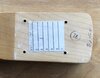
I was hoping to find some markings inside to help determine where the parts were made, but unfortunately it's pretty nondescript inside. The pocket is only labeled "P Bass". The neck has a QC tag similar to other MIM necks with the name Martina on it. The maple and the rosewood used is particularly nice, but the fretwork isn't the greatest. That could be due to wood shrinkage over time. If I had to take a guess based on all the evidence, I think the neck was built in the US, then sent to Mexico where the fret and finish work were done.

That makes more sense to me than the Ensenada factory starting neck production one way and then halfway through the year switching to a completely different method. In fact, while digging for info I found that early MIM Strats were made the same way, starting in the US and finishing in Mexico.

Fender Ensenada History.png


As a side note, in all my searching I never came across a mim Jazz bass from 1991, so I'm guessing those didn't roll out until the precisions were good to go. Anyway, so there it is, the first MIM basses indeed had different necks!

IMG_3026.jpg
 

Attachments

  • IMG_2954.jpg
    IMG_2954.jpg
    464.6 KB · Views: 139
  • IMG_2964.jpg
    IMG_2964.jpg
    1.2 MB · Views: 179
  • IMG_2965.jpg
    IMG_2965.jpg
    665.5 KB · Views: 118
  • IMG_2969.jpg
    IMG_2969.jpg
    394.9 KB · Views: 127
  • IMG_2972.jpg
    IMG_2972.jpg
    933.4 KB · Views: 121
  • IMG_2973.jpg
    IMG_2973.jpg
    439.8 KB · Views: 130
I now have the bass in my possession so I thought I would post a final update:

I was hoping to find some markings inside to help determine where the parts were made, but unfortunately it's pretty nondescript inside. The pocket is only labeled "P Bass". The neck has a QC tag similar to other MIM necks with the name Martina on it. The maple and the rosewood used is particularly nice, but the fretwork isn't the greatest. That could be due to wood shrinkage over time. If I had to take a guess based on all the evidence, I think the neck was built in the US, then sent to Mexico where the fret and finish work were done.

That makes more sense to me than the Ensenada factory starting neck production one way and then halfway through the year switching to a completely different method. In fact, while digging for info I found that early MIM Strats were made the same way, starting in the US and finishing in Mexico.

View attachment 4503156

As a side note, in all my searching I never came across a mim Jazz bass from 1991, so I'm guessing those didn't roll out until the precisions were good to go. Anyway, so there it is, the first MIM basses indeed had different necks!

View attachment 4503147
NBD: 1991 MIM Fender Standard Jazz Bass Oddity
 
truss rod acces is not a defining feature of MIM basses. American basses have had headstock truss rod accesss as early as 1974, the the American standards (early 90s), then the highway one basses.

and also, some of the Mexican basses started having body truss rod access when the roadworn series came out. And according to your pics , this actually started right off the bat , when the Ensenada factory opened its doors!
Highway One basses always had truss adjustment at the butt of the neck.
You're thinking of Highway "1" basses which were very different than the later Highway "One".