
Enjoy the benefits of a premium membership!
Upgrade Account
-
TalkBass has been independent since 1998. Add your voice.
Create a free account to reply to discussions, view embedded media, and browse with fewer display ads.
Join free Log in
Want zero display ads or expanded classifieds tools? Compare plans.
You are using an out of date browser. It may not display this or other websites correctly.
You should upgrade or use an alternative browser.
You should upgrade or use an alternative browser.
More options
Who Replied?

I think D standard on a four makes the most practical sense with the exception being that 99.72% of all music was written with e tuned 4 strings or b tuned 5s

IMHO, this a bad question. Better question "why is electric bass tuned eadg...?",
The upright is typically tuned eadg,
Now electric bass, fenders 1951 patent based his design on the telecaster. So guitar based.
Imo, Fender bassman's design restrictions limit lower frequency to E1. The design limit is the output transformer. The bassman's ot is larger than some of other available amps. Another problem fender had was a high failure rate with 15" speakers. Not sure if this was a problem because of ampiflying uprights or the pbass.
So the OP has three possible reasons, 1) upright tuning, 2) telecaster tuning, 3) technology restriction.
Now choose an answer
The upright is typically tuned eadg,
Now electric bass, fenders 1951 patent based his design on the telecaster. So guitar based.
Imo, Fender bassman's design restrictions limit lower frequency to E1. The design limit is the output transformer. The bassman's ot is larger than some of other available amps. Another problem fender had was a high failure rate with 15" speakers. Not sure if this was a problem because of ampiflying uprights or the pbass.
So the OP has three possible reasons, 1) upright tuning, 2) telecaster tuning, 3) technology restriction.
Now choose an answer

With BEAD, there no money above the 10th fret. It changes everything.
I also wonder if the EADG scheme is not also done to match a piano? On a grand piano, E is the lowest note. Just wondering?
Have you ever seen a grand piano???
Lowest note on a modern piano is A which is at 27.5Hz. That frequency is where the human ear can begin to hear the sound. Any lower and we can't hear it.
In addition to mimicking the upright, there weren't many amps that could deliver anything that low, when the 'standard' electric bass guitar was firmly established


Last edited:
some of us sub-humans (pun int.), hear down to 20hz.Lowest note on a modern piano is A which is at 27.5Hz. That frequency is where the human ear can begin to hear the sound. Any lower and we can't hear it.
The first low B five stringer was made for Jimmy"Flim"Johnson by Alembic in 1975.
First 5 String (NWYT)
Bass guitar - Wikipedia
View attachment 2889068
it is funny because in the same year, Anthony Jackson had Carl Thompson build him his first 6 strings bass.
Because with BEAD, it's a pain in the *** to shift up and down the neck?
It didn't occur to you that ... music would've been different if this was the standart tuning ?
If I had to hazard a guess I'd include that most stereos can't go down to the 41Hz of E let alone 31Hz of B.
AM radio, FM radio and most stereos, let alone the recording equipment.
EADG is the open tuning for the common equally tempered scale.
I ran sound for a guy here in Denver who has a 5 string upright from the 40's
Oh, I'll play! The bass viol of the mid 17th century had five strings. It lost a string somewhere and became the cello though one of Bach's cello suites WAS written for 5 string 'cello. Somewhere around Handel-Mozart's time, orchestras were getting bigger and composers were calling for more bass so they commissioned what we now call the upright bass to "double" the bass parts played by the 'cellos. Leo Fender hybridized that instrument with a guitar and the "precision" bass (because of the frets) was born. Fast forward about 30 years, and someone "invents" the NEW five string bass because people who don't learn their history are doomed to repeat it.
Mugre

It didn't occur to you that ... music would've been different if this was the standart tuning ?
I really don’t think it would have. Music didn’t radically change when modern low-B 5-string basses came out and amp and speaker technology was finally able to handle the lower range. It was just incorporated into our regular music and became another resource. Bass isn’t going to cause a seismic shift in musical direction like the advent of the electric guitar or the synths did. It’s just not that kind of instrument. People can “push the envelope” if they like. And it’s good they do. But at the end of the day, the bass still has its critical role to play. And that hasn’t really changed that much despite all the new tech that’s come along. The core role and function of the bass line in a piece of music endures. It is what it is.

It is? I count 7 notes lower than a low E on my piano... as it is on every single grand piano I’ve played for the last 30 years.I also wonder if the EADG scheme is not also done to match a piano? On a grand piano, E is the lowest note. Just wondering?
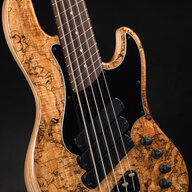
Because B strings sound like crap on standard 34" scale basses.
let me guess, going down, Eb1, D1, Db1, C1, B0, Bb0, A0, seven notes, But then again, I haven't seen a new piano, in40 years.It is? I count 7 notes lower than a low E on my piano... as it is on every single grand piano I’ve played for the last 30 years.
I’d agree with “most”, but not all.Because B strings sound like crap on standard 34" scale basses.

And also used at the beginning of " La Bamba ", by Ritchie Vallens. Not to mention, a lot of Duane Eddy songs.The history of the electric bass part four: how many strings? | MusicRadar
"The first time a bass guitar received more than four strings was when Danelectro introduced the UB-2 bass as early as 1956."
It was 6-string, though:
View attachment 2888928
Last edited:


