Enjoy the benefits of a premium membership!
Upgrade Account
-
TalkBass has been independent since 1998. Add your voice.
Create a free account to reply to discussions, view embedded media, and browse with fewer display ads.
Join free Log in
Want zero display ads or expanded classifieds tools? Compare plans.
You are using an out of date browser. It may not display this or other websites correctly.
You should upgrade or use an alternative browser.
You should upgrade or use an alternative browser.
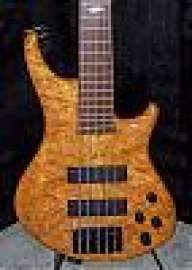
NBD: Wilkins 'Cayenne' (Roasted) PJ5
- Thread starter G On Bass
- Start date
More options
Who Replied?


I've been asked to write about why I've positioned the J bass pickup where I did on G's bass. Originally I was asked by Mickey, the owner of Grandma's in NM to build him a WRTP with a J pickup in the back position. He didn't like the way a J pickup sounded all the way in the back so he wanted me to put that pickup closer to the P. It sounded like a very reasonable request to me so I started work on finding a harmonic point closer to the P pickup. I've also known for quite a while that when you put a P and J pickup together on a bass body something happens to the sound of the P pickup. It seems to lose that characteristic P sound to me. It still sounds good but not quite like a P by itself. I think it has something to do with the magnetic fields interacting with each other and causing a phase cancellation. What I noticed was that as I put the J pickup close to the P something changes with the way the 2 fields interact and either the phase cancellation goes away or is replaced with an improved (IMHO) interaction. Now the P has regained the depth and character that I've been used to all these years. The added benefit is that the J pickup now sounds fatter, more full and the mids and lows quite are a bit more focused. When you play on the P pickup and slowly start to bring in the J a real nice low mid tone happens that gives the bass a very punchy sound without adding more top end than I like to hear. I've found that it works real well with either 4 or 5 string basses. That's my story and I'm sticking to it. I'll be very interested to hear what your responses are to my theories and my sonic impressions.
Finally got to take it to a rehearsal.
I'm doing Country stuff with this band, from old school Patsy Cline and Loretta Lynn to more modern Lady Antebellum/Sugarland type songs. The signal path: Bass w/Wilkins light gauge nickels>ZoomB3 (usually bypassed)>Carvin BX500>Carvin 10.2 Non-neo sitting on one of those Auralex pads. I don't ever adjust my amp once it's set up, so everything comes off the bass.
Of course the first line of these things must always read about how amazing and fantastic it is. And it was, so let's move on. B-string= tight, huge and clear.
Mostly, I use my PJ's as P's. Occasionally I'll roll in some of the J, but really never past 50/50. There are some tones on a P/J that I just never used or need (like a soloed bridge pickup), so that kinda dictates where my tweakability limits are. What surprised me last night is just how 'functionally versatile' this config is for me, meaning that there are lots of tones in it that I need, like and use.
I used the passive setting for some of the old school P-only-stuff, active with VTC rolled off for some standard songs and went with the full-up VTC with a touch of some treble/bass boost with the blend at 50/50 for the more modern stuff. I think that at times, I even went more towards just the bridge pickup to hear how it was and it also sounded very useable without getting thin and doing that popp-y/fart-y thing that bugs me so about soloed bridge pups. Everything in-between sounded great and very musical, and not much if anything is wasted, tonally. Towards the end of the night, I had this growl thing going that was just really crazy. No effects, no overdriving anything, just a great growl that was not that mid-range honk that is often mistaken for growl. Sounded really cool. But I was able to take it back to Thump City really easily. And of course, the bass is just dripping with the Wilkins ergonomics that I love in my other Roadtested bass (with flats). It's insanely comfortable, and at under 8 pounds, it's barely there. I'm really looking forward to gigging these 2 side-by-side.
One of the fun points of the night was just thumping on the open B string (under the guise of tuning) just to see what it would do. It was so tight and so solid and clear that it was just a joy to hear. The whole thing just sounds killer. Even the drummer noticed.
I'm a huge fan now of the Sadowsky Pre, as I think it offers a lot of versatility, at least for me and the tones I seek. This combo, with that pre, and the Nordstrand pickups right next to each other, seems to work really well for what I'm after.
I don't slap or use a pick, so I have no tests or comments to add there (even snarky ones...).
I'm doing Country stuff with this band, from old school Patsy Cline and Loretta Lynn to more modern Lady Antebellum/Sugarland type songs. The signal path: Bass w/Wilkins light gauge nickels>ZoomB3 (usually bypassed)>Carvin BX500>Carvin 10.2 Non-neo sitting on one of those Auralex pads. I don't ever adjust my amp once it's set up, so everything comes off the bass.
Of course the first line of these things must always read about how amazing and fantastic it is. And it was, so let's move on. B-string= tight, huge and clear.
Mostly, I use my PJ's as P's. Occasionally I'll roll in some of the J, but really never past 50/50. There are some tones on a P/J that I just never used or need (like a soloed bridge pickup), so that kinda dictates where my tweakability limits are. What surprised me last night is just how 'functionally versatile' this config is for me, meaning that there are lots of tones in it that I need, like and use.
I used the passive setting for some of the old school P-only-stuff, active with VTC rolled off for some standard songs and went with the full-up VTC with a touch of some treble/bass boost with the blend at 50/50 for the more modern stuff. I think that at times, I even went more towards just the bridge pickup to hear how it was and it also sounded very useable without getting thin and doing that popp-y/fart-y thing that bugs me so about soloed bridge pups. Everything in-between sounded great and very musical, and not much if anything is wasted, tonally. Towards the end of the night, I had this growl thing going that was just really crazy. No effects, no overdriving anything, just a great growl that was not that mid-range honk that is often mistaken for growl. Sounded really cool. But I was able to take it back to Thump City really easily. And of course, the bass is just dripping with the Wilkins ergonomics that I love in my other Roadtested bass (with flats). It's insanely comfortable, and at under 8 pounds, it's barely there. I'm really looking forward to gigging these 2 side-by-side.
One of the fun points of the night was just thumping on the open B string (under the guise of tuning) just to see what it would do. It was so tight and so solid and clear that it was just a joy to hear. The whole thing just sounds killer. Even the drummer noticed.
I'm a huge fan now of the Sadowsky Pre, as I think it offers a lot of versatility, at least for me and the tones I seek. This combo, with that pre, and the Nordstrand pickups right next to each other, seems to work really well for what I'm after.
I don't slap or use a pick, so I have no tests or comments to add there (even snarky ones...).


That's it! My next band name! Dangerous GAS!This is a dangerous, GAS inducing thread...
Not to derail, but there's a band named "Celine Neon" here in Chicago which I think is hilarious...
Pickup placement is important to optimize the sound of a PJ. Thanks for posting the details of your development with this model - looks like a fine instrument. What kind of wood is the body?I've been asked to write about why I've positioned the J bass pickup where I did on G's bass. Originally I was asked by Mickey, the owner of Grandma's in NM to build him a WRTP with a J pickup in the back position. He didn't like the way a J pickup sounded all the way in the back so he wanted me to put that pickup closer to the P. It sounded like a very reasonable request to me so I started work on finding a harmonic point closer to the P pickup. I've also known for quite a while that when you put a P and J pickup together on a bass body something happens to the sound of the P pickup. It seems to lose that characteristic P sound to me. It still sounds good but not quite like a P by itself. I think it has something to do with the magnetic fields interacting with each other and causing a phase cancellation. What I noticed was that as I put the J pickup close to the P something changes with the way the 2 fields interact and either the phase cancellation goes away or is replaced with an improved (IMHO) interaction. Now the P has regained the depth and character that I've been used to all these years. The added benefit is that the J pickup now sounds fatter, more full and the mids and lows quite are a bit more focused. When you play on the P pickup and slowly start to bring in the J a real nice low mid tone happens that gives the bass a very punchy sound without adding more top end than I like to hear. I've found that it works real well with either 4 or 5 string basses. That's my story and I'm sticking to it. I'll be very interested to hear what your responses are to my theories and my sonic impressions.
So if it's both Roadtested and roasted, is it Roa(dte)sted?
This one is Roasted:
This one is one of his Roadtested. I'm lucky to have one of each!
@5StringPocket The body is roasted alder. The neck is roasted honey maple on the back and roasted dark figured maple for the fingerboard. As far as names are concerned, the RoadTested name is the "umbrella" name for all the instruments I build that I consider "affordable". Any RoadTested bass that I build with roasted woods becomes a Cayenne model whether it's roasted body and neck or just one or the other. The Cayenne models are a bit more pricy but I really feel like they're worth the extra money because of the positive results that are achieved. ie: tone, stability and weight. BTW, the latest RoadTested artist picked up his bass last week. Kelly T. LeMieux from Buckcherry. Alder body, roasted maple neck, Aguilar 60's P & J pups, Aguilar OBP-3 preamp. This bass sounds HUGE. Perfect for arena rock.
Alder is the classic P-bass body and I've heard the Aguilar 60's P & J pups are really being well received. This sounds like a killer spec. One thing I'd really like to try is the Aggie P/J set with passive tone control (push/pull for active/passive) and a Dark Glass Tone Capsule. I find myself not using the treble control since the passive tone control rolls off about 6.7 kHz and no rolloff is as much treble as I ever need. The DG tone capsule has bass at 70 Hz and two bands of mid at 500 and 2800 Hz. This upper mid seems like it would be very useful for tweaking articulation without sounding harsh.@5StringPocket The body is roasted alder. The neck is roasted honey maple on the back and roasted dark figured maple for the fingerboard. As far as names are concerned, the RoadTested name is the "umbrella" name for all the instruments I build that I consider "affordable". Any RoadTested bass that I build with roasted woods becomes a Cayenne model whether it's roasted body and neck or just one or the other. The Cayenne models are a bit more pricy but I really feel like they're worth the extra money because of the positive results that are achieved. ie: tone, stability and weight. BTW, the latest RoadTested artist picked up his bass last week. Kelly T. LeMieux from Buckcherry. Alder body, roasted maple neck, Aguilar 60's P & J pups, Aguilar OBP-3 preamp. This bass sounds HUGE. Perfect for arena rock.
Last edited:

Any chance you would tell us the temperature and duration of the wood roasting process?
WAG: If I had to give it a guess I would say 250 F for two to four hours. The temperature would have to be above the boiling point of water and also high enough to compensate for the internal wood cells creating pressure that increases the boiling temperature of water. The heat would need to penetrate to the core be sustained long enough for the steam to work its way to the surface. As for the time guess, for the sugars in the wood to "caramelize" at that low of a temperature would quite a bit of take time. I don't actually have any idea how long.
Would love to know the real answer.
WAG: If I had to give it a guess I would say 250 F for two to four hours. The temperature would have to be above the boiling point of water and also high enough to compensate for the internal wood cells creating pressure that increases the boiling temperature of water. The heat would need to penetrate to the core be sustained long enough for the steam to work its way to the surface. As for the time guess, for the sugars in the wood to "caramelize" at that low of a temperature would quite a bit of take time. I don't actually have any idea how long.
Would love to know the real answer.
Truly amazing stuff, thanks!@5StringPocket The body is roasted alder. The neck is roasted honey maple on the back and roasted dark figured maple for the fingerboard. As far as names are concerned, the RoadTested name is the "umbrella" name for all the instruments I build that I consider "affordable". Any RoadTested bass that I build with roasted woods becomes a Cayenne model whether it's roasted body and neck or just one or the other. The Cayenne models are a bit more pricy but I really feel like they're worth the extra money because of the positive results that are achieved. ie: tone, stability and weight. BTW, the latest RoadTested artist picked up his bass last week. Kelly T. LeMieux from Buckcherry. Alder body, roasted maple neck, Aguilar 60's P & J pups, Aguilar OBP-3 preamp. This bass sounds HUGE. Perfect for arena rock.

@5StringPocketAs far as names are concerned, the RoadTested name is the "umbrella" name for all the instruments I build that I consider "affordable".
Are there road tested pj models?
Are there road tested pj models?
The Red one is a normal 'Roadtested' bass. If such a description could ever be used....