• TalkBass has been independent since 1998. Add your voice.
    Create a free account to reply to discussions, view embedded media, and browse with fewer display ads.
    Join freeLog in
    Want zero display ads or expanded classifieds tools? Compare plans.

Neck Dive...Really?

I wonder if Dug Pinnick has to use some kind of different counterweight to that neck heavy 12 string bass. He's so skinny, and looks so frail that that bass would make HIM fall over. He's so skinny that if he sticks his tounge out, he'd lose balance and trip over forwards... :)
Trust me...dude's skinny but he ain't the least bit frail!
 
  • Like
Reactions: Honch and fhm555
Neck Dive is really very simple to understand. It is caused by the instrument center of gravity not being between the strap mounting points. This results in a neck-heavy instrument. If it is heavy enough to overcome the friction of the strap against your shirt, down goes the headstock. Simple. End of story.

Your instrument has a balance point, the point where it would balance if laid strings-down on a narrow hand rail or chair back. If this balance point is between the strap mounting points you won't have any neck dive at all. If that balance point is close to the upper horn strap mount then you'll find most of the bass' weight is on you left shoulder while playing but still no neck dive. If the balance point is beyond the strap mount, then you'll have a bass that is neck heavy and the neck will want to shift toward the floor. Whether it does or not depends on how far away from the strap mount the CG is and on how much friction you have in the strap.

A better strap can affect whether or not the neck moves but does NOT change whether or not the bass is neck-heavy.

A true solution for neck dive requires moving the CG to between the strap mounts. Removing weight from the neck (e.g. lighter tuners), adding weight to the body (e.g. heavier bridge) will shift the CG and can move it back between the strap mount points. Having a long upper horn will shift the mounting points to get them on the right side of the CG point.

Moving the strap mounting point out to the headstock fixes the balance issue by putting the strap mounting points on either side of the CG so there is no neck dive. Unfortunately it also shifts the bass to the right making right hand plucking and upper fret access awkward so you trade one issue for another.
 
I think the individual player's biomechanics have a lot to do with whether they experience neck dive: How thick their torso is, whether or not their stomach protrudes beyond their ribcage, what angle they like to hold the neck at, how much (and what part) of their plucking arm touches the body, how high or low they wear the instrument, etc.
 
Unfortunately it also shifts the bass to the right making right hand plucking and upper fret access awkward so you trade one issue for another.

Sorry, I agree with you on all other terms but this one. And it's no...
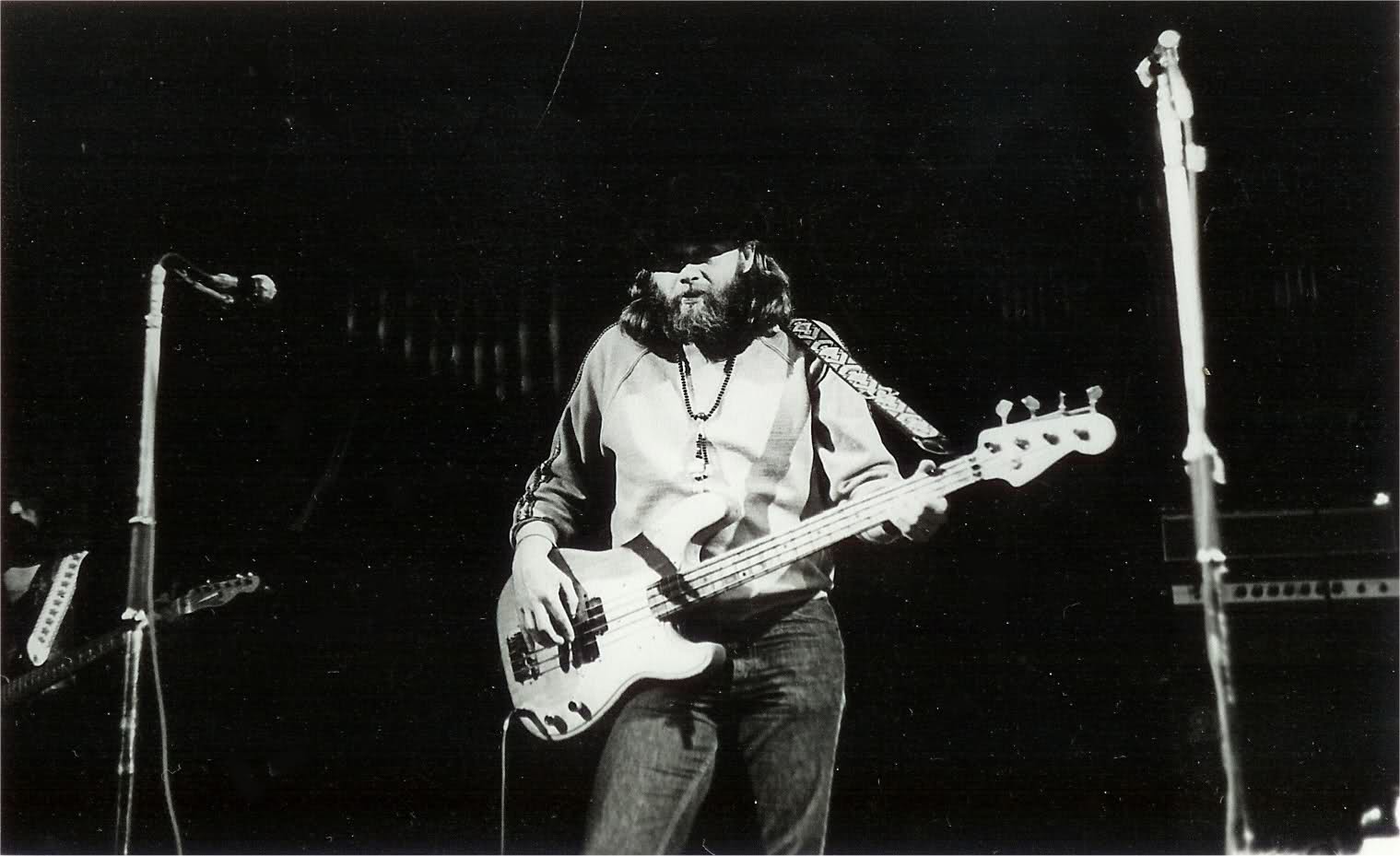
outgky.jpg


You can very well take a good look at this one, and imagine a regular wide strap going down at the horn. It's pretty much the same place. What this DOES do, is hindering sight, maybe for those who care to look and have no obstacles coming in that direction. What it does, though, and is more of the liability on this one, is making the actual bass more of a pendulum point, that it is easier for it to swing, bounce to the left and right quite easily without that much force which of course is as much as a hinder while playing, as any neck dive or something else unergonomic that's happening. It wiggles or bounce around to the left and right easier. And as such it's very much easier to accidentally knock the STRAP over your shoulder and drop it, you know, just like if it would do if you haven't secured your strap (regular) to the strap pins, as can happen occasionally. What you do then, is that you're still holding the bass with two hands so the bass wouldn't be damaged, not dropped, it's just the strap that disappears behind your back, and slides down...

I e if you did the jump test, like you can do with regular strap, this strap will disappear behind your back. And bassists do jump on stage, and dance around too.

But it sure does buck neck dive on all basses. Regardless of weight.

EDIT: BTW, I don't know who that guy is on the pic, can someone give me a clue? Seems to be something from the late 60s early 70s. He does look familiar of some sorts but can't really pinpoint him down. At first I thought Duck Dunn but no way...it's not a tele bass...
 
Last edited:
  • Like
Reactions: Maureen M
what angle they like to hold the neck at
Yes, this is exactly what I am all for. People think I want no neck dive at all when angled at 45 degree but unless I play at 45 degree angle this point is moot. I can tolerate a slight neck dive at 45, if it goes away totally by just moving it upwards a notch for comfortable playing position, for me. Where this line goes is different for different persons and of course different basses. I can tolerate a certain amount of neck dive, if there's enough weight for it to go away and tilt balance the right way, when angling the whole bass. Now, there's too many out there, that this slight slant/angle wouldn't do anything to the neck dive and it still goes south.

What I've discovered with all basses that has no neck dive when 45 degrees, is that they don't start to "body dive" either when angling it to a comfortable playing position. And then you can alter and change the position angle, as well as how low or high you'll wear it. Anyone with Mark King slapping HEIGHT and almost a 45 degree angle when playing, can't use neck diving instruments. So when you sell your bass second hand, your demographic is slightly wider, and you can use a wider customer base, when telling them that. Now, as with weight, you can't have "neck diving" specs inside any specs of a bass. Since weight differs from item to item - they only tell that it is around 8 lbs or something - the neck dive can't be set in stone with some weird numbers or new measurement units. All I can tell that if a bass doesn't have any neck dive at all at 45 degrees angle, it'll be suitable to more playing styles. You can change and adjust it while playing with your regular strap. And it STAYS there with whatever angle you set it at, and just forget it, and play without something bothering you. To check if the bass are carrying these traits, you can do the jump test, after you set it at an angle. If it drops - neck side - after you've jumped, the neck diving is a tad too strong. If it stays, you're good to go.
 
I said: Unfortunately it also shifts the bass to the right making right hand plucking and upper fret access awkward so you trade one issue for another.

Sorry, I agree with you on all other terms but this one. And it's no...
*pic*
You can very well take a good look at this one, and imagine a regular wide strap going down at the horn. It's pretty much the same place.

Hmmm, well I decided to test the idea. My SUB bass on the strap hangs with the 21st fret about even with my belly button. When I moved the strap from the upper horn to the string going to the headstock, the bass moved about 6" to my right with the 13th fret centered against my torso.

What this DOES do, is hindering sight, ... and ... it is easier for it (the bass) to swing, bounce to the left and right quite easily without that much force which of course is as much as a hinder while playing, as any neck dive or something else unergonomic that's happening. ... And as such it's very much easier to accidentally knock the STRAP over your shoulder and drop it, ... it's just the strap that disappears behind your back, and slides down...

But it sure does buck neck dive on all basses. Regardless of weight.

These are some great points!

My shoulders slopes a lot and I found just standing there that the strap was almost sliding off my shoulder when connected to the headstock.
 
  • Like
Reactions: Honch
Hmmm, well I decided to test the idea. My SUB bass on the strap hangs with the 21st fret about even with my belly button. When I moved the strap from the upper horn to the string going to the headstock, the bass moved about 6" to my right with the 13th fret centered against my torso.
.
It all depends too, and most crucial if you have it low slung or Mark "under-the-chin" King hung (!?). The higher up the more it moves to the right of course. And low slung like Dug Pinnick it doesn't move as much either way. If you used your strap directly without adjusting for height of course it did! If you use the same strap as hanged with the horn pin and just move it up to the headstock, the bass will hang right under your chin, or even in front of your face. From that B/W pick of some classic bass player, I can't tell the difference if imagine a strap strapped to the horn pin.

- - - - -

It should be no problem to produce a three point strap. That goes BOTH to the horn, and the headstock. A regular strap which fastens at the regular places, at the horn so it doesn't slip off. And a "string" connected to a point on the strap where the shoulder resides (adjustable point of course) and then an adjustable string so you can get it taught enough (maybe even playing something from it..) and that ends in the "tie-around" that's around the headstock. I wonder if not anyone has already made this. It would buck left-right swinging as well as strap falling behind shoulder.
 
This is the angle that I want my bass to hang at.
All I want to do is bring my hands up to the right positions to play.
Without having to move the bass to play it.
I don't want my right hand to hold the neck while I fret.
Without the Comfort Strapp,it would not stay at this angle.
Snapshot_20160808_3.JPG
 
Last edited:
  • Like
Reactions: Honch
So now I am spamming you with Skip Battin pics. Imagine a strap on him, towards the upper horn, OR neck joint on his P-bass.

1463421134616.jpg


Byrds-10.jpg


the-byrds-play-unc-chapel-hill-in-1971-carmichael-auditorium-clarence-BY71F6.jpg


Mind you that at far right, the shadow of the strap plays tricks on your eyes, and makes us believe he has it strapped to the horn. He has it so low slung that I think there would be very little difference between a "headstocked" strap, and a "horn" strap, so to speak. And in later years he finally gave up on the strap falling behind his back...

sbbigfender.jpg


Possibly due to that Fender removed that strap pin at the headstock, anyway, so he had no choice!
 
  • Like
Reactions: n1as
Hey it's not there the bullet head should be placed for adjusting the truss rod! You got it all wrong...the neck will warp in no time... ;)

It's here it should be placed:
Bullethead_lg.jpg
 
Last edited:
Unfortunately it also shifts the bass to the right making right hand plucking and upper fret access awkward so you trade one issue for another.

This is another problem, I have hard time to deal with. All people who tried headless basses says the neck shifts too much to the left, so the reach to the first frets are a little too far away, and that the missing headstock, visualy throws them off, but when pushed back to the right they don't mind that the 24th fret even is way beyond their belly buttons, because they can reach it even there. The bass is thick anyway so you don't bump into your belly at all, and the reach for the first frets are easier, as well as the tuners, if it should come a headstocked one with 5 in a row tuners. The more I think of this way of strapping a bass on, the more I see the advantages. Neck diving bucked, unhindered reach for tuners. You can have way much leeway and variation to the right than to the left. It must be pretty far to the right before it starts to hinder picking hand.

But again, if you slap, pop, and thumb, then of course it's all a complete no no, as that one needs almost 45 degree angle.
 
So now I am spamming you with Skip Battin pics. Imagine a strap on him, towards the upper horn, OR neck joint on his P-bass.

View attachment 1251579

View attachment 1251580

View attachment 1251581

Mind you that at far right, the shadow of the strap plays tricks on your eyes, and makes us believe he has it strapped to the horn. He has it so low slung that I think there would be very little difference between a "headstocked" strap, and a "horn" strap, so to speak. And in later years he finally gave up on the strap falling behind his back...

View attachment 1251582


Possibly due to that Fender removed that strap pin at the headstock, anyway, so he had no choice!
That looks like one of the UK only slab body p basses from the early 70's. Not too many were made that way. The most famous user was Entwistle. I doubt he used a hootenanny button on the headstock but instead had it "tied" around the headstock, folk guitar style.
 
That looks like one of the UK only slab body p basses from the early 70's. Not too many were made that way. The most famous user was Entwistle. I doubt he used a hootenanny button on the headstock but instead had it "tied" around the headstock, folk guitar style.
Don't know but it seems that using that "hootenanny" button made the safety very unsecure if you don't tied it with a thin wire and secured it with a know or extra wraps. I think - as the later pics showed - he resorted to using the horn button, when those "hootenanny" buttons where abolished. If he wanted to keep on using them that way, he sure would've continued wrapping the end of the strap wire around all of the headstock, regardless of hootennany or not. It looks like he used those basses WITH the button AND used the button too.

EDIT: BTW It looks like several different P basses on those pics. Not just one only.
 
Don't know but it seems that using that "hootenanny" button made the safety very unsecure if you don't tied it with a thin wire and secured it with a know or extra wraps. I think - as the later pics showed - he resorted to using the horn button, when those "hootenanny" buttons where abolished. If he wanted to keep on using them that way, he sure would've continued wrapping the end of the strap wire around all of the headstock, regardless of hootennany or not. It looks like he used those basses WITH the button AND used the button too.

EDIT: BTW It looks like several different P basses on those pics. Not just one only.
If you look at the second picture down you can see the dark line of the strap "tie line", or whatever it's called, beside the white nut as well as a couple of strands of the line dangling underneath. Makes sense, I would definitely NOT trust a hootenanny button to hold a strap.
 
Yeah, looks so to me too, but the second pic, look at the rest of the strap, it looks like it's about to unravel along its length anytime soon. A worn down one. On the others he'd change the strap out to something wider, it seems . But nevertheless, it bucked the neck dive big time, if there was any. Those 70s P's where a tad heavy on the body so I think it would be an even wash anyway. It's just the way he wanted them. No less no more.

But if there's anything to buck neck dive these days, it's that trick. Any bass. You have to keep in mind other things, as we said, but if you JUST want to buck neck dive, that's the way to go. Hence my idea of a three point strap, i e you could have a thing string (of cloth of course not steel string) going FROM the strap out to the headstock, while the rest of the wide leather strap pointed down and got anchored at the horn strap pin. You have to tighten them both, though, but it wouldn't keep flailing around, and it wouldn't fall down behind the shoulders, and back.

It bucks neck dive, that's all there is to it. And it's the simplest and probably least expensive way to buck it. If any cost at all.