Any headless will do. They have absolutely zero neck dive, no matter how many strings they've got.If you want absolutely zero neck dive

Enjoy the benefits of a premium membership!
Upgrade Account
-
TalkBass has been independent since 1998. Add your voice.
Create a free account to reply to discussions, view embedded media, and browse with fewer display ads.
Join free Log in
Want zero display ads or expanded classifieds tools? Compare plans.
You are using an out of date browser. It may not display this or other websites correctly.
You should upgrade or use an alternative browser.
You should upgrade or use an alternative browser.
More options
Who Replied?
Really some headstocks a la Fenders 5 strings with all tuners in a row will neck dive more than if the headstock had a 3+2 or 2+3 configuration.
Hands to your hearts, if there wasn't all these lightweight tuners out there, wide straps, special attachments of straps, horn extender pins, placement of strap pins, why would they exist, if there wasn't a neck diving or imbalance of instruments that was needed to be adressed? Just for shows? Placebo? Are people creating a problem that isn't really there? Just to find something to sell? Really?
- - - - - - -
On another thing: If you're accustomed to play with any kind of neck diving bass, or it has never been an issue, and all of a sudden stumbles up on any bass that hasn't got neck diving at all, do you go "hey, I can't play this!!!!! It's so wrong in the balance!!!" ?
- - - - - - -
On another thing: If you're accustomed to play with any kind of neck diving bass, or it has never been an issue, and all of a sudden stumbles up on any bass that hasn't got neck diving at all, do you go "hey, I can't play this!!!!! It's so wrong in the balance!!!" ?

The only bass with a serious neckdive I owned was a taiwanese made Yamaha BB1100s. Most of the japanese BBs were made of ash, my BB1100s was made of lightweight alder. I guess the tuners were quite heavy.
I've never had a Fender with neckdive. Not even my lightest Jazz (an AVRI '64) has neckdive.
Neckdiving basses are very uncomfortable. I rather play a boatanchor seventies Fender than a bass with neckdive.
Your fretting hand should be relaxed. If you play a bass with neckdive your fretting hand tries more or less all the time unconscious to lift the neck into the right position while fretting.
I've never had a Fender with neckdive. Not even my lightest Jazz (an AVRI '64) has neckdive.
Neckdiving basses are very uncomfortable. I rather play a boatanchor seventies Fender than a bass with neckdive.
Your fretting hand should be relaxed. If you play a bass with neckdive your fretting hand tries more or less all the time unconscious to lift the neck into the right position while fretting.
Last edited:
Yes me too. A lightweight bass with neckdive will feel heavier and cumbersome, than a heavy bass with balance and no neck dive.I rather play a boatanchor seventies Fender than a bass with neckdive.
I am the only one here thinking of neck diving - TOO! - while lying doing on a couch or sofa while playing? If I should release my arms from the bass balancing on the top of my belly the neck wouldn't go down to the left of me?  This headless sure doesn't:

This headless sure doesn't:

When legs are close together it creates a fulcrum point for gravity to work with, spread those feet out and create a triangulation (a stronge base) and neck dive will steer clear of you. Rember this 5 easy step 1.- triangles make strong base. 2.-stand wide. 3.-wider 4.watch the money pour in.

Yes!Yes me too. A lightweight bass with neckdive will feel heavier and cumbersome, than a heavy bass with balance and no neck dive.
This 13.6 lb "boat anchor" is made tolerable with a Comfort Strapp.
Not only does it distribute the weight,it cancels neck dive.

Notice no hands are supporting the bass
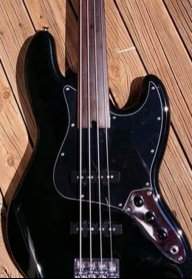
View attachment 1199027[/QUOTE]
If my bass was that pretty, I'm not certain I would notice any diving issues...if I was tired that night, I'd just ask the bevy of chicks around me to hold it...
P.S. I'm new here. I've tried to enlarge it, but no good. What the hell is that?[/QUOTE]
It's by Konig Bassworx, a custom builder here in Australia.
If my bass was that pretty, I'm not certain I would notice any diving issues...if I was tired that night, I'd just ask the bevy of chicks around me to hold it...
P.S. I'm new here. I've tried to enlarge it, but no good. What the hell is that?[/QUOTE]
It's by Konig Bassworx, a custom builder here in Australia.
I had a Hagstrom 8 string almsot like that once. Not the old ones, but a newly made prototype they made before they went bankrupt. They just put on a huge neck with loads of junk at the headstock, and it neck dived as hell as well. Impossible to play. I've never seen neck dive on Kings's X Doug Pinnicks 12 string Hamers or whatever...

The more low slung it is (he´s got arms like one of the harlem globetrotters guys) the less the neck dive, due to the relocation of the lever point. If you'd put that bass (ok, but a right handed one) on Mark King ...:

... and he hold it like he uses to, it would neck dive in no time, and go south, and just drag his clothes with it...that's why he's :

... using his headlesses, high up, under the chin almost, so they won't ever neck dive. They won't neck dive if slung low either.
The more low slung it is (he´s got arms like one of the harlem globetrotters guys) the less the neck dive, due to the relocation of the lever point. If you'd put that bass (ok, but a right handed one) on Mark King ...:
... and he hold it like he uses to, it would neck dive in no time, and go south, and just drag his clothes with it...that's why he's :
... using his headlesses, high up, under the chin almost, so they won't ever neck dive. They won't neck dive if slung low either.
Outside of Fenders I've played a lot of other basses over the years, a lot of different Peavey models, a bunch of hollow and semi hollow bodies, short scale, long scale, ex long scale, and 4 and 5 strings and unless it happened in my sleep I can honestly say I've never experienced any neck dive, or so little I can't recall it happening.
Am I living a sheltered life or is there something I'm missing here.
why do some folks not experience the phenomenon, yet others using the same instrument do experience it?
yet others using the same instrument do experience it?
It just makes me think it is more of a perception thing than reality.
HB6 - 3/8'' Ultralite™ Tuner > Store > Hipshot Products.
I can go on and on, and as you can really see on this vids, it's nothing but reality. It's for real. It's not some brainghost made up by someone. It seems that you guys really DO have been living under a rock. Which by now, regarding comments from you, seems more of an objectively and neutral reality and a matter of fact. Now, please point me to any other YT video saying neck dive doesn't exist at all ON ANY BASS, or GUITAR, and the every instruments balances perfectly on any person, regardless how low slung, high "slung" you wear them, and no matter the numer of strings.
AFAIK this thread was about that if it was a reality or not. Not that some gets bothered by it, and some not. The videos above shows clearly that it does exists, objectively and neutrally. It's not like they have some small midget person that hides behind them and pulls the basses/guitars necks over to make it blatantly in your face obvious.
Whether one should care or not be bothered by it, is another topic that doesn't quite fit in here. The thread was about if it's real or not, and not only about Fenders. And since there are both Fenders that does neck dives, and not neck dives, it shows very well that you can build any bass with the same design and retain balance. And keep tone and whatever intact.
This is exactly the same discussion whenever dead spots thread are showing up. On par with these neck-diving threads. Some wonder what's the fuss is all about, and can't and ever detect it. And has never heard a bass with it. Same there, they just show their "living-under-a-rock" experience. It's NOT something I heard/detected from the start on, but slowly dawned on me. It took decades before I even discovered it by myself without someone pointing it out to me. Mind you, pre-internet days.
When legs are close together it creates a fulcrum point for gravity to work with, spread those feet out and create a triangulation (a stronge base) and neck dive will steer clear of you. Rember this 5 easy step 1.- triangles make strong base. 2.-stand wide. 3.-wider 4.watch the money pour in.
And BTW, unless that was a joke...erhh...no..

 Yuck...!
Last edited:
Look I've never ever understood the reason to dabble with different points of setting the strap pins a selected sweet spots when it's all more simple than that. You don't even need to change out the strap. I don't know why more people bucks neck dives with just the "old" way of attaching straps to the headstock:

What on earth is wrong with this solution on any neckdiving bass? You can even continue to use whatever strap you had before, just buy the wrap around the neck. Or buy something like this then and be done with neckdiving forever:

.. and you can set the strap points wherever you like...the fringe benefits are that you probably will get rid of dead spots too, or at least moved them up to "no money" frets. Clearly a win-win situation.
What on earth is wrong with this solution on any neckdiving bass? You can even continue to use whatever strap you had before, just buy the wrap around the neck. Or buy something like this then and be done with neckdiving forever:
.. and you can set the strap points wherever you like...the fringe benefits are that you probably will get rid of dead spots too, or at least moved them up to "no money" frets. Clearly a win-win situation.
When legs are close together it creates a fulcrum point for gravity to work with, spread those feet out and create a triangulation (a stronge base) and neck dive will steer clear of you. Rember this 5 easy step 1.- triangles make strong base. 2.-stand wide. 3.-wider 4.watch the money pour in.
I made a "like" first, in order for I thought it was a Spinal Tap joke... but since I saw no smileys, and found it not to be acerbic, ironic comment I had second thoughts. Such bollocks. The triangulation must occur at the strap points. And gets down home what I've stated earlier. This is strap triangulation:
Unless the OP has deliberately coyed us all, and have been using vintage Fender basses for all of his life, of course, if you've strapped them this way, the old, original, and vintage way, no wonder the OP ask what everybody else is whining and bickering about. Here's the triangulation point you're after @Smelly ! Then you'll have absolutely no neck dive, nor body dive at all, regardless of low slung, high slung, or anything in between, even sitting down. I have never ever got it why peope thinks "the straps gets in the way" or some other bizarre rationale behind it why not to use this way of strapping on any bass. I'll bet that the OP and guy in this pic are NOT the same.

And of course, when they made all basses with this method of strap connection in mind all of the time, neck diving wasn't even on anyones map. Later on they changed strap pins locations, and stuck them on the body, and didn't change anything else on the bass, neither headstock weight or imbalance, of course the problem slowly arose.
Last edited:

HB6 - 3/8'' Ultralite™ Tuner > Store > Hipshot Products.
I can go on and on, and as you can really see on this vids, it's nothing but reality. It's for real. It's not some brainghost made up by someone. It seems that you guys really DO have been living under a rock. Which by now, regarding comments from you, seems more of an objectively and neutral reality and a matter of fact. Now, please point me to any other YT video saying neck dive doesn't exist at all ON ANY BASS, or GUITAR, and the every instruments balances perfectly on any person, regardless how low slung, high "slung" you wear them, and no matter the numer of strings.
AFAIK this thread was about that if it was a reality or not. Not that some gets bothered by it, and some not. The videos above shows clearly that it does exists, objectively and neutrally. It's not like they have some small midget person that hides behind them and pulls the basses/guitars necks over to make it blatantly in your face obvious.
Whether one should care or not be bothered by it, is another topic that doesn't quite fit in here. The thread was about if it's real or not, and not only about Fenders. And since there are both Fenders that does neck dives, and not neck dives, it shows very well that you can build any bass with the same design and retain balance. And keep tone and whatever intact.
This is exactly the same discussion whenever dead spots thread are showing up. On par with these neck-diving threads. Some wonder what's the fuss is all about, and can't and ever detect it. And has never heard a bass with it. Same there, they just show their "living-under-a-rock" experience. It's NOT something I heard/detected from the start on, but slowly dawned on me. It took decades before I even discovered it by myself without someone pointing it out to me. Mind you, pre-internet days.
I don't think it's "living under a rock" (I most assuredly do not) so much as "i don't seem to have this problem."
I guess that's worth getting combative over? Best of luck combating whatever issues you are having.

I've never had an issue with outside of my 7lb P, and even then the neck never really dived but simply sat more horizontal than other basses.
My Warwicks and Beatle basses, on the other hand, would all neck dive.
My Warwicks and Beatle basses, on the other hand, would all neck dive.

I wonder if Dug Pinnick has to use some kind of different counterweight to that neck heavy 12 string bass. He's so skinny, and looks so frail that that bass would make HIM fall over. He's so skinny that if he sticks his tounge out, he'd lose balance and trip over forwards... 


