• TalkBass has been independent since 1998. Add your voice.
    Create a free account to reply to discussions, view embedded media, and browse with fewer display ads.
    Join freeLog in
    Want zero display ads or expanded classifieds tools? Compare plans.

Need it louder. Guitar players super loud.

I run an Aguilar tone hammer 700 and a single 112 Aguilar 8ohm cab.
This band that I just joined practices at such a high volume but I can't hear the detail in my playing that I would prefer.
The Aguilar cab is rear ported.
I'm considering a new 4ohm cab so that I can get the full 700 Watts out of the amp.
I do own a second 112 8ohm cab but I hate to have to schlep two cabs and an amp to every rehearsal.
Will a single 4 ohm cab make a big difference? Would a front port vs rear Port make a big difference.
Suggestions welcome.
I’m only going to address your question, vs opinions on the guitarist volume.

We don’t play that loud for rehearsals, but I use a TH500 and either SL112 or 2x8” or 2x10” all 8ohms.

For gigging I was using my TH700 with SL212 at 4ohms which is plenty loud and can keep up in the environment you describing… but was too heavy to lug around so I picked up a GR AT212 4ohms at 28lbs it’s great and very articulate. The Barefaced Super Twin 2x12 would also be a super loud cab that would let your TH700 make a statement as well.
E1E5AAC2-7036-458B-9FC0-0C89892575E9.jpeg


I’d definitely wear ear plugs in your situation as severe volumes are not necessary for small venues and rehearsals.
 
Get you a sunn 2000s and a 6x15, perfect for coffee shop gigs… OR ask them to turn down. If they decline, find another guitarist. Good musicians are flexible with volume, playing style, and tone. I mean, I didn’t get a bunch of jazz and rock gigs because I play too loud and I play whatever I want when I want. I got a bunch of gigs because I know when to turn up, turn down, try different tones etc.
 
You not having a loud enough amp/cab is not the problem here.

As others have said, find a band that has a guitarist that knows what they hell they're doing. If it's too loud for you, it's likely gonna be too loud for a lot of your audience, too.
 
  • Like
Reactions: Eric Wolfe
What's even worse is when the volume offender is the same person running the stage mix and monitors. Everything is EQed to sound really glassy to anyone without hearing damage. While playing in a 5 piece band, I was the only person that could tell that the monitors were feeding back, and it was painful.

Rather than running out and buying a piece of gear to fix a problem, sometimes the answer is self-discipline.
 
I run an Aguilar tone hammer 700 and a single 112 Aguilar 8ohm cab.
This band that I just joined practices at such a high volume but I can't hear the detail in my playing that I would prefer.
The Aguilar cab is rear ported.
I'm considering a new 4ohm cab so that I can get the full 700 Watts out of the amp.
I do own a second 112 8ohm cab but I hate to have to schlep two cabs and an amp to every rehearsal.
Will a single 4 ohm cab make a big difference? Would a front port vs rear Port make a big difference.
Suggestions welcome.
You need a 4x10 to compete with a loud guitar,pick a used gk 4x10 or ampeg and leave it at your practice space.
 
This band that I just joined practices at such a high volume but I can't hear the detail in my playing that I would prefer.
verb
3rd person present: practices
  1. 1.
    perform (an activity) or exercise (a skill) repeatedly or regularly in order to improve or maintain one's proficiency.
    "I need to practice my French"
    Similar:
    rehearse, run through
The idea of practicing is to get the notes right, parts down. It has already been proven the guitar amps work :)

Now is the time to make sure the fingers work so you don't need high volume to do that.

True you will still need to figure out your speaker situation as it sounds like at a gig things will not change. But try to have a conversation about reducing the volume at practice. Maybe playing at a low volume most of the time then have one practice at gig volume right before a gig.

The best practices I've been at happen in someone's front room with little to no amplification and a pen and paper to make notes and be able to talk at a normal volume, and be able to stop right away and identify and fix errors and not just slog through "the list" at high volumes. :thumbsup:

Most big acts you see rehearsing at gig volumes on videos have done all of the work before that. Now they are working on stage plots, making sure of equipment working and monitor feeds and hearing things at volume. The stuff you do right before a gig or tour :bassist:

:)
 
Last edited:
verb
3rd person present: practices
  1. 1.
    perform (an activity) or exercise (a skill) repeatedly or regularly in order to improve or maintain one's proficiency.
    "I need to practice my French"
    Similar:
    rehearse, run through
The idea of practicing is to get the notes right, parts down. It has already been proven the guitar amps work :)

Now is the time to make sure the fingers work so you don't need high volume to do that.

True you will still need to figure out your speaker situation as it sounds like at a gig things will not change. But try to have a conversation about reducing the volume at practice. Maybe playing at a low volume most of the time then have one practice at gig volume right before a gig.

The best practices I've been at happen in someone's front room with little to no amplification and a pen and paper to make notes and be able to talk at a normal volume, and be able to stop right away and identify and fix errors and not just slog through "the list" at high volumes. :thumbsup:

Most big acts you see rehearsing at gig volumes on videos have done all of the work before that. Now they are working on stage plots, making sure of equipment working and monitor feeds and hearing things at volume. The stuff you do right before a gig or tour :bassist:

:)

In fairness, though: sometimes it's difficult for a drummer to "hold back". It's tough to describe, but I was self-taught and I know when I was drumming, it was near to impossible for me.

Once those cymbals get to banging, well ...
 
The drummer is always the first culprit in the volume wars.
The second is some combination of too much gain, not enough mids, and all tube guitar heads with more than 50w.
But, then the bassist who walks in with the SVT and two 810's... they're the real jerk in the equation. But you gotta understand, we were pushed there by other peoples hands, 100 watt Marshalls, kick drums with PA support, and a total lack of trust in the FOH sound tech. That's what brought us to 'I'll bring my own damn PA' ideology.


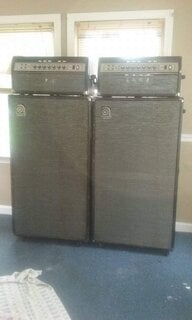
These have volume controls, the problem is even with one of them is that people hear with their eyes and automatically think you're going to be loud. I use SVT's because I love the sound and the punch, I use a variety of cabs with them.
Something for the OP to think about, SVT's are only 300 watt heads but have the rep of being Marshal tamers because of the speakers. Incidentally early SVT's were supposed to be played with both cabs, they were only rated at 240 WRMS. They have 30 watt speakers.
I haven't used this whole set up for 20 years.

I was only going to put in a thumbnail but I guess size matter in this thread. :bassist:


double SVT.jpg
 
Last edited:
  • Like
Reactions: DJ Bebop
In fairness, though: sometimes it's difficult for a drummer to "hold back". It's tough to describe, but I was self-taught and I know when I was drumming, it was near to impossible for me.

Once those cymbals get to banging, well ...

Do like keyboardist do with electric pianos, and get some edrums, Playable, dynamic, studio sound, with volume control
DWE+wood_left+facing+a.png