Those windows behind the backline suggest that the gig was at a restaurant or club in a strip mall. Max capacity 150 seats? Less? I hope you guys had enough firepower.
Just our rehearsal space


TalkBass has been independent since 1998. Add your voice.
Create a free account to reply to discussions, view embedded media, and browse with fewer display ads.
Join free Log in
Want zero display ads or expanded classifieds tools? Compare plans.
Those windows behind the backline suggest that the gig was at a restaurant or club in a strip mall. Max capacity 150 seats? Less? I hope you guys had enough firepower.
Get you a sunn 2000s and a 6x15, perfect for coffee shop gigs… OR ask them to turn down. If they decline, find another guitarist. Good musicians are flexible with volume, playing style, and tone. I mean, I didn’t get a bunch of jazz and rock gigs because I play too loud and I play whatever I want when I want. I got a bunch of gigs because I know when to turn up, turn down, try different tones etc.
 so by all means go big!
I have a good friend who is an outstanding keyboard player, played for about 10 years in a loud but very popular regional band, they were making real money as players. He developed serious hearing issues along with tinnitus, bad enough that it affects his every day life as well as his sleep. He can no longer play music (except quietly and with heavy duty hearing protection). Hearing aids are not a solution (and make things worse), the damage is permanent. I've known the guy since college, really sad to see this happen to a great guy and player.Finding a new band - temporary
Hearing loss - Forever
Walk away fast.
I learned sign language in high school for a lot of my friends where deaf.
Some born that way, others doing exactly what you are up to now.
Un-necessary loud environment!
To many sad outcomes.
Didn't read through all the pages, but I just ask our guitar player to turn down, even though it always annoys guitar players. I don't believe anyone enjoys a loud AF band. I'm a musician and I don't. Time to have some talks cause you shouldn't need a 212 for indoor shows unless the room is huge IMO.

One of my personal reasons for avoiding hearing aids (for now) is that I feel they can potentially make things worse as they amplify the areas of greatest loss, hence, potentially worsening things in the long run.Hearing aids are not a solution (and make things worse)...

shwa....These have volume controls, the problem is even with one of them is that people hear with their eyes and automatically think you're going to be loud. I use SVT's because I love the sound and the punch, I use a variety of cabs with them.
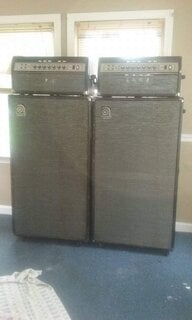
Something for the OP to think about, SVT's are only 300 watt heads but have the rep of being Marshal tamers because of the speakers. Incidentally early SVT's were supposed to be played with both cabs, they were only rated at 240 WRMS. They have 30 watt speakers.
I haven't used this whole set up for 20 years.
I was only going to put in a thumbnail but I guess size matter in this thread.
View attachment 4980827

 And yeah, grab some earplugs but if you're having fun don't quit the band.
Some of us may indeed be older, more experienced and maybe have the benefit of hindsight. In my case, I had the benefit of others hindsight and protected my ears through 40 years of touring pro audio. With MY benefit of hindsight I'm sure glad I listened to my touring elders rather than got disrespectfully snarky about them being "old".Yeesh, tough crowd.
I gotta laugh at the deluge of "quit the band, it's too loud!" comments. If y'all are as old as you sound, you probably grew up hauling tube amps and 810 cabs down basement stairs for rehearsal every week. 9 times out of 10 a single 12 won't keep up with a heavy handed drummer in a rock setting. He's not standing next to a jet plane and hey, isn't rock and roll supposed to be a little dangerous anyway?
No disrespect intended- just a little ribbing intended to point out that there's probably more room between "too loud for a small cabinet" and "too loud to stick around," than the posts here would suggest.Some of us may indeed be older, more experienced and maybe have the benefit of hindsight. In my case, I had the benefit of others hindsight and protected my ears through 40 years of touring pro audio. With MY benefit of hindsight I'm sure glad I listened to my touring elders rather than got disrespectfully snarky about them being "old".
Agreed.No disrespect intended- just a little ribbing intended to point out that there's probably more room between "too loud for a small cabinet" and "too loud to stick around," than the posts here would suggest.

I found a photo of a gig where the drummer was playing his Arbiter Flats (sorry for the thing blocking the view).
If the members are open to the conversation, start mixing yourselves. Tracks always need room to speak. Everyone compromises something for the better of the sound.
Drums:
Just the drums in a room isn't what makes it on the album. The drummer can look at Evans EQ pads or something similar to tame the kick. Something that tames those basketball sounding mids in the 350-400 range and lets the guitar fill in. Tea towels as already suggested will also help. Somewhere in a YouTube video Eric Valentine shows a piece of leather taped to the snare head that acts as a natural gate. On the hit, the leather flies up and then it falls back down and deadens the snare. The goal is to get the drum sound tuned and create room in the sonic landscape for everyone else. Easy with a mixer and EQ, harder on the raw drums. My brother used Evans or Remo rings on the toms for dampening, but he also has a controlled touch. A lighter touch lets the drums speak better. I played with a different drummer who broke cymbals every year and my left ear is still mad at me about the bell on his Zildjian K ride 25 years ago.
Guitars:
Hi-pass that thing or at least roll off the lows. You said you were playing blues. Stylistically, you are probably filling out the low end and he doesn't need the bottom end from his amp. If he's a true guitarist, he'll fight you on it, but give it a shot. It's just like asking a keyboard player to sit on his left hand to stop fighting for the same sonic space. If he is still too bright or too loud, the previously mentioned gobo is a good idea. Sanction him off to his own space since those high frequencies are easier to tame than the lows.
Bass:
As previously brought up, mids are your friend. However, when mixing the articulation is usually brought up in the 1K-1.5K area to get the finger noise and note definition to shine through without a ton more overall volume. If you're running flats, you might need something in the 800hz range. Your Tone Hammer mid is 1K at the top of the range, but if you're already using it for something else you may have to play with something else. A little drive can help as well. The TH has a baked in rise at the low-end and a bit of a taper off at the top. At least the THDI pedal does. The EQ points are the same so I'm assuming the pre/eq is common among the line.
All of that said, you are asking a lot of a single twelve, especially if it's on the ground. But I would still start with the carving out sonic areas and then add cone area if you want to stick with it.
Just a few more things to ponder.
-Matthew
When I asked him to turn down they do, but then the volume creeps back up.