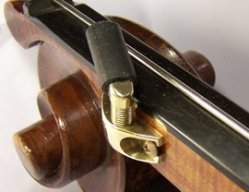
Like a lot of people, I like angled endpins whenever I've played them on other people's basses.
I'm not nuts about drilling my bass because you only get to do it once and I had no idea what I wanted as far as length, angle, or placement.
I tried to find an old Eggpin to solve my problems. Couldn't track one down. Luckily, I have some contacts in the engineering and machine world, so we collaborated on a little endpin side project and custom built something that fit my needs.
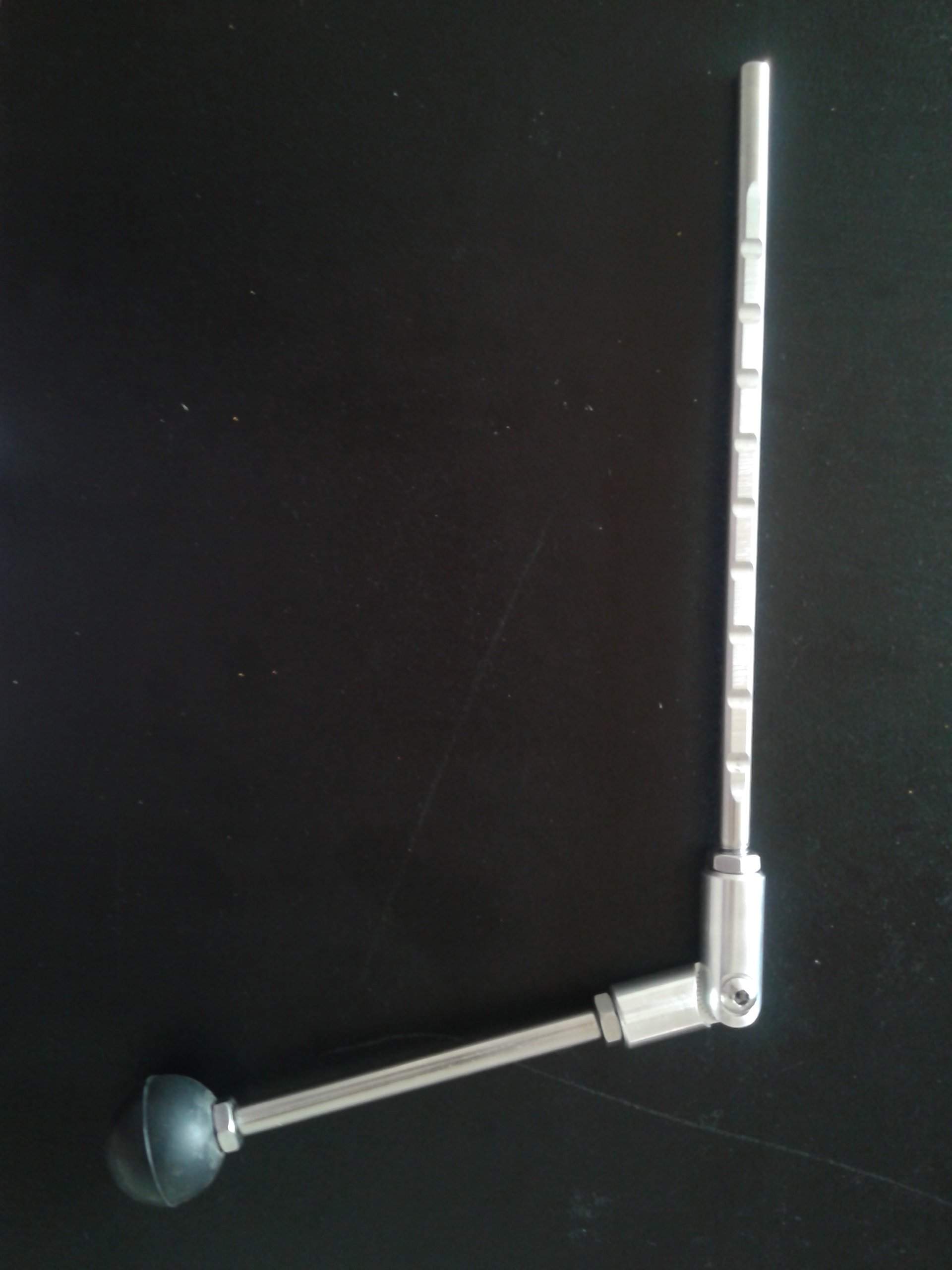
It inserts into a typical 10mm endpin fitting and locks in place with the existing screw. The angle can be modified in three ways:
1. The angle between the two rods is adjustable and locks in place by a gear and screw. Here is a closeup of the gear:
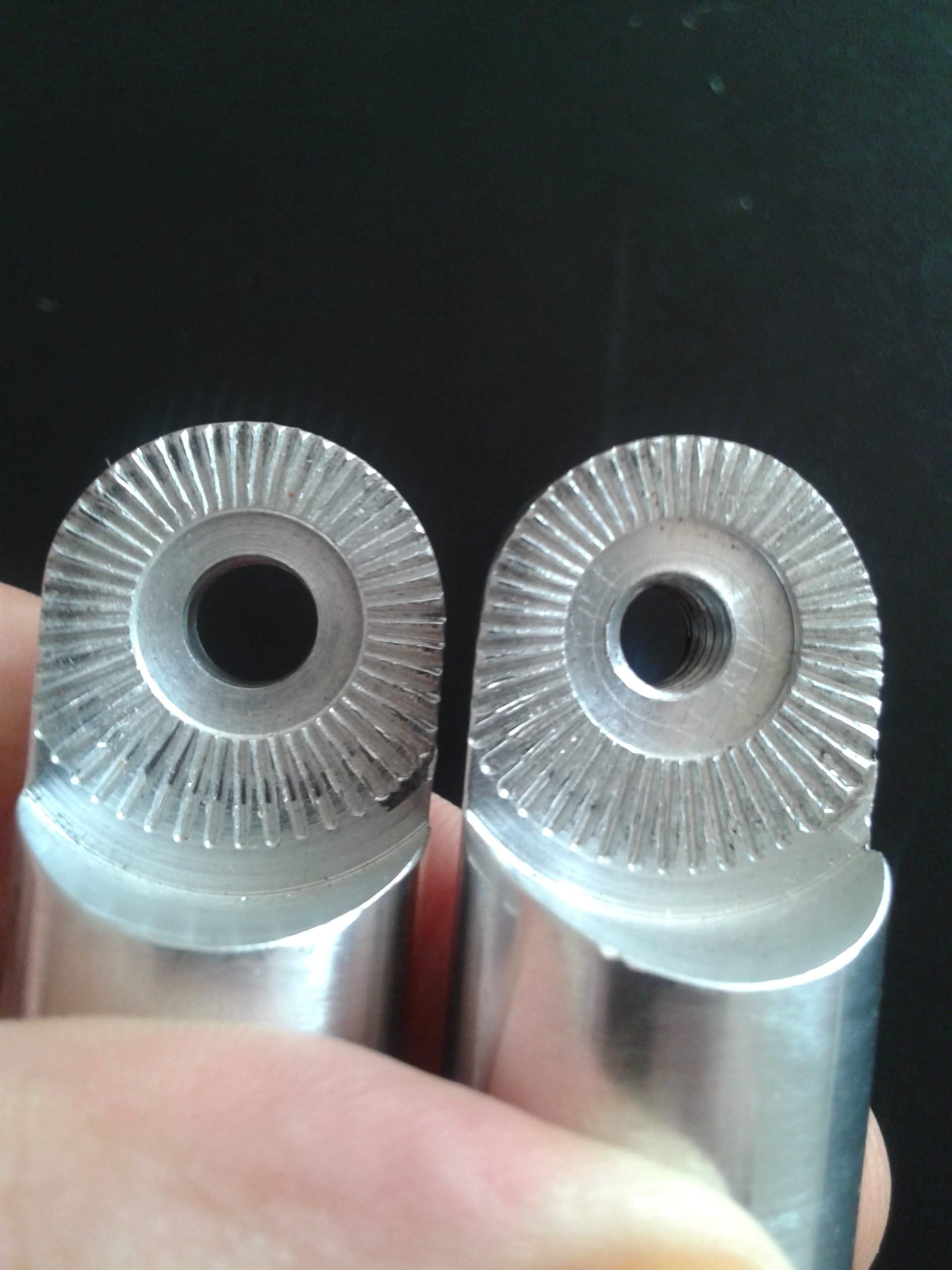
2. The joint itself rotates around the rod that inserts into the bass and locks in place with a nut.
3. The lower rod can be changed to have a longer or shorter length, depending on what the player prefers.
Additionally, the bass can be raised over the entire device like a normal endpin so it offers some possibilities that the drilled Laborie endpin doesn't. The biggest departure is you can have a very short lower rod for a small displacement of weight and raise the height of the bass via the notched upper rod.
I've done a few iterations of these over the past year and tested them out by playing them on my own gigs, letting friends use them, and breaking a few to see what they can take.
I'm considering selling them because people keep asking.
But, I need to get a better feel for what the bass community thinks. Making a couple for myself and bringing them to market for everybody are two very different tasks.
I've gotten some great feedback and encouragement from people with big orchestra jobs and respected luthiers. That's a nice feeling, but if I'm going to sell them I need to get a better feel for what the bass community beyond my little circle thinks.
If you think this is cool, stupid, want one, think I'm crazy, etc. I'd love to hear what you have to say. What are your concerns? If you want one, what is a reasonable price for something like this? What other questions do you have?
Read the whole post before you respond, I have some FAQs below.
My Experience
I love this thing! So glad I decided to pick up the phone and make this happen. I had a few extras made in case I lose or break the device because I wouldn't want to go back to exclusively playing on a straight endpin.
I have discovered that I gravitate to three different setups, two of which are made possible by the flexibility of an adjustable pin.
Frequently Asked Questions:
Have I studied with Rabbath (or a Rabbath student)?
No. The closest I got was a few buddies who studied with him.
I definitely owe a lot to the whole Rabbath concept of the bass and find it very inspiring, but I never formally studied with any of those people, nor am I trying to create a "knock off" version of what they do—just trying to solve some problems and move the bass forward.
How strong is it?
In my stress tests of the current version, it took a 115lbs. load and me yanking on it to get the gears to shear.
Given that number, I wouldn't recommend putting this under a bass that weighs more than 40lbs. This limit fortunately accommodates many instruments.
How heavy is it?
About the same weight as most standard steel endpins. It's a touch lighter than my personal endpin because the gear joint is aluminum. My bass likes this. Some basses prefer more mass, but making a heavier version is pretty straight forward if that's what people want. I already have parts sourced for an all steel version. The current version is a combination of steel and aluminum.
Are there any torque problems?
This endpin will want to spin in the endpin socket. Some people are very concerned with it damaging the bass, block, or endpin fitting.
In practice on my bass, the only issue I have experienced is sometimes the endpin screw will make a little noise as it rubs against the notched section of the pin. My straight endpin sometimes does this too. A little piece of gaffer's tape in the notch keeps it quiet—not a super elegant solution but it works.
The pin making noise was only a problem when I tested very extreme angles that exert a higher torque. My "general purpose" setup has been totally silent. But that's me on my gear. I'd love to hear from some repair people who look at this stuff all day long.
Will this thing bounce around like a standard Laborie endpin?
It all depends how extended it is from the bass. I'm 5'7" so I can keep the rods pretty short (lowest notch, short lower rod) and I get little to no bounce. Some of the taller players I tested this with are well over 6' and had the bass bouncing all over the place. Some people don't care and others are really freaked out by it.
I'm working on a device that solves that problem, but I don't have any built yet to show you. That's a beast to slay another day. I'd like to hear from taller players and their needs in an endpin. I have a smaller frame so it's tricker for me to guess.
What are the next steps?
Making a batch! I have a local machine shop ready to crank these out as soon as I can give them the green light. They were cool enough to do a small batch of samples that came back looking great and cut very accurately.
Everything will be made here in the USA. I've met personally with everybody involved in making these.
Beyond that, I have plans to do versions in even lighter materials and a heavier variation for more portly basses.
Why only 9 notches in the endpin?
As the project grows, we have plans to take it to ten like most endpins and if we need that extra push off the cliff—eleven.
If most endpins go to ten, will eleven make the bass louder?
It's one more, isn't it? Most blokes will be playing at ten.
Why don't I just make ten be the top number and be a bit more?
...these endpins will go to eleven.
Anyway, here are a couple more pictures of the prototypes in action.
On an old, super heavy Italian bass.

Cranked up to eleven. This kind of setup isn't recommended unless you don't mind things getting pretty bouncy. Still working on this problem.

Fun Fact: Below is an earlier variation. I didn't have a source for the rubber ball so I ended up using a dog ball here. You know those Kong balls that are indestructible? Works as an endpin tip in a pinch. I glued a quarter in the middle keep the pin from sliding through the center of the ball.


That's all I have. Hope to hear from you. Feedback from the bass community is super important for it to be a success.
Thank you!
Emilio
P.S. Feel free included Spinal Tap references in your commentary.
I'm not nuts about drilling my bass because you only get to do it once and I had no idea what I wanted as far as length, angle, or placement.
I tried to find an old Eggpin to solve my problems. Couldn't track one down. Luckily, I have some contacts in the engineering and machine world, so we collaborated on a little endpin side project and custom built something that fit my needs.
It inserts into a typical 10mm endpin fitting and locks in place with the existing screw. The angle can be modified in three ways:
1. The angle between the two rods is adjustable and locks in place by a gear and screw. Here is a closeup of the gear:
2. The joint itself rotates around the rod that inserts into the bass and locks in place with a nut.
3. The lower rod can be changed to have a longer or shorter length, depending on what the player prefers.
Additionally, the bass can be raised over the entire device like a normal endpin so it offers some possibilities that the drilled Laborie endpin doesn't. The biggest departure is you can have a very short lower rod for a small displacement of weight and raise the height of the bass via the notched upper rod.
I've done a few iterations of these over the past year and tested them out by playing them on my own gigs, letting friends use them, and breaking a few to see what they can take.
I'm considering selling them because people keep asking.
But, I need to get a better feel for what the bass community thinks. Making a couple for myself and bringing them to market for everybody are two very different tasks.
I've gotten some great feedback and encouragement from people with big orchestra jobs and respected luthiers. That's a nice feeling, but if I'm going to sell them I need to get a better feel for what the bass community beyond my little circle thinks.
If you think this is cool, stupid, want one, think I'm crazy, etc. I'd love to hear what you have to say. What are your concerns? If you want one, what is a reasonable price for something like this? What other questions do you have?
Read the whole post before you respond, I have some FAQs below.
My Experience
I love this thing! So glad I decided to pick up the phone and make this happen. I had a few extras made in case I lose or break the device because I wouldn't want to go back to exclusively playing on a straight endpin.
I have discovered that I gravitate to three different setups, two of which are made possible by the flexibility of an adjustable pin.
a. I prefer a straight endpin when I don't have a ton of space. Lots of jazz gigs and pit work has me crammed in a corner somewhere and there just isn't the room for a bent pin setup. My back usually hurts by the end and that's no fun.
b. My "general purpose" setup uses my endpin with the shortest lower pin I have (about 4") at a modest angle, with a slight rotation to my left. This setup gets some of the weight of the instrument off my body and makes it tend to fall forward into my hands. With a straight pin, my bass tends to fall backwards into my thumb which is frustrating.
This setup also allows me to stand a little more behind the bass when standing. Getting from low positions to very high positions on all four strings is much easier, I can keep equal weight on both feet, and getting to the E string with a German bow feels less cramped.
c. I have a longer lower pin (6") that I set up with no rotation to the left, closer to what Rabbath does. I use the same angle, but pointed straight back. This configuration is nice for long sessions of thumb position work. I can stand up straight and move around with equal weight on both feet and the upper register is right in front of my body, not off to the left like a straight endpin. The balance feels like the bass is floating—very little weight from the instrument is pushing into my body.
b. My "general purpose" setup uses my endpin with the shortest lower pin I have (about 4") at a modest angle, with a slight rotation to my left. This setup gets some of the weight of the instrument off my body and makes it tend to fall forward into my hands. With a straight pin, my bass tends to fall backwards into my thumb which is frustrating.
This setup also allows me to stand a little more behind the bass when standing. Getting from low positions to very high positions on all four strings is much easier, I can keep equal weight on both feet, and getting to the E string with a German bow feels less cramped.
c. I have a longer lower pin (6") that I set up with no rotation to the left, closer to what Rabbath does. I use the same angle, but pointed straight back. This configuration is nice for long sessions of thumb position work. I can stand up straight and move around with equal weight on both feet and the upper register is right in front of my body, not off to the left like a straight endpin. The balance feels like the bass is floating—very little weight from the instrument is pushing into my body.
Frequently Asked Questions:
Have I studied with Rabbath (or a Rabbath student)?
No. The closest I got was a few buddies who studied with him.
I definitely owe a lot to the whole Rabbath concept of the bass and find it very inspiring, but I never formally studied with any of those people, nor am I trying to create a "knock off" version of what they do—just trying to solve some problems and move the bass forward.
How strong is it?
In my stress tests of the current version, it took a 115lbs. load and me yanking on it to get the gears to shear.
Given that number, I wouldn't recommend putting this under a bass that weighs more than 40lbs. This limit fortunately accommodates many instruments.
How heavy is it?
About the same weight as most standard steel endpins. It's a touch lighter than my personal endpin because the gear joint is aluminum. My bass likes this. Some basses prefer more mass, but making a heavier version is pretty straight forward if that's what people want. I already have parts sourced for an all steel version. The current version is a combination of steel and aluminum.
Are there any torque problems?
This endpin will want to spin in the endpin socket. Some people are very concerned with it damaging the bass, block, or endpin fitting.
In practice on my bass, the only issue I have experienced is sometimes the endpin screw will make a little noise as it rubs against the notched section of the pin. My straight endpin sometimes does this too. A little piece of gaffer's tape in the notch keeps it quiet—not a super elegant solution but it works.
The pin making noise was only a problem when I tested very extreme angles that exert a higher torque. My "general purpose" setup has been totally silent. But that's me on my gear. I'd love to hear from some repair people who look at this stuff all day long.
Will this thing bounce around like a standard Laborie endpin?
It all depends how extended it is from the bass. I'm 5'7" so I can keep the rods pretty short (lowest notch, short lower rod) and I get little to no bounce. Some of the taller players I tested this with are well over 6' and had the bass bouncing all over the place. Some people don't care and others are really freaked out by it.
I'm working on a device that solves that problem, but I don't have any built yet to show you. That's a beast to slay another day. I'd like to hear from taller players and their needs in an endpin. I have a smaller frame so it's tricker for me to guess.
What are the next steps?
Making a batch! I have a local machine shop ready to crank these out as soon as I can give them the green light. They were cool enough to do a small batch of samples that came back looking great and cut very accurately.
Everything will be made here in the USA. I've met personally with everybody involved in making these.
Beyond that, I have plans to do versions in even lighter materials and a heavier variation for more portly basses.
Why only 9 notches in the endpin?
As the project grows, we have plans to take it to ten like most endpins and if we need that extra push off the cliff—eleven.
If most endpins go to ten, will eleven make the bass louder?
It's one more, isn't it? Most blokes will be playing at ten.
Why don't I just make ten be the top number and be a bit more?
...these endpins will go to eleven.
Anyway, here are a couple more pictures of the prototypes in action.
On an old, super heavy Italian bass.
Cranked up to eleven. This kind of setup isn't recommended unless you don't mind things getting pretty bouncy. Still working on this problem.
Fun Fact: Below is an earlier variation. I didn't have a source for the rubber ball so I ended up using a dog ball here. You know those Kong balls that are indestructible? Works as an endpin tip in a pinch. I glued a quarter in the middle keep the pin from sliding through the center of the ball.
That's all I have. Hope to hear from you. Feedback from the bass community is super important for it to be a success.
Thank you!
Emilio
P.S. Feel free included Spinal Tap references in your commentary.
Last edited: