

Enjoy the benefits of a premium membership!
Upgrade Account
-
TalkBass has been independent since 1998. Add your voice.
Create a free account to reply to discussions, view embedded media, and browse with fewer display ads.
Join free Log in
Want zero display ads or expanded classifieds tools? Compare plans.
You are using an out of date browser. It may not display this or other websites correctly.
You should upgrade or use an alternative browser.
You should upgrade or use an alternative browser.
New bass build
- Thread starter CholisGuitars
- Start date
More options
Who Replied?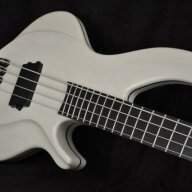
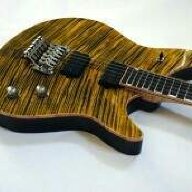
I began today by lightly sanding the body with 400 grit to level the sealer. Unfortunately, the mahogany didn't fill all of the pores.

So, more grain filler. Yay, delayed one day. I gave it two more coats of water based grain filler. After around 30 minutes, I used a razor blade to level the surface. No more pores showing. I prefer the razor blade when leveling because as long as you're getting white shavings, you know you're not into the wood. And it leaves it glass smooth.
With the extra time on my hands, I decided to mill a new neck to test out the logo, since I had forgotten to do it in the other test. I'll be inlaying more green abalone in the pockets.

And you can't go wrong with Hipshot lolli's.

So, more grain filler. Yay, delayed one day.
I gave it two more coats of water based grain filler. After around 30 minutes, I used a razor blade to level the surface. No more pores showing. I prefer the razor blade when leveling because as long as you're getting white shavings, you know you're not into the wood. And it leaves it glass smooth. With the extra time on my hands, I decided to mill a new neck to test out the logo, since I had forgotten to do it in the other test. I'll be inlaying more green abalone in the pockets.
And you can't go wrong with Hipshot lolli's.



An ambigram. Very cool way of doing a signature.
I had to look up Ambigram. Yes, that is "way cool"
I had to look up Ambigram. Yes, that is "way cool"
Question. talking about the logo, do you find it difficult to read/see it as "Cholis"?
I saw cholis right away, but I did wonder why the dot below the "h"
Nice touch is what I think.
The history of the Ambigram is pretty cool too!
Nice touch is what I think.
The history of the Ambigram is pretty cool too!
I don't think you have answered this yet, but what CNC do you have and what software do you use?
lowsound
lowsound
I saw cholis right away, but I did wonder why the dot below the "h"
Nice touch is what I think.
The history of the Ambigram is pretty cool too!
Cool glad to hear. Yeah, I've heard the dot below the h before, but wanted to keep it a true ambigram, so I kept the dot.
I don't think you have answered this yet, but what CNC do you have and what software do you use?
lowsound
The machine is a simple table top cnc router from fineline automation. Model fla-100. it works well for guitars, which I primarily build, but the 34 inch scale neck is very close to its x axis limit. Like I'm sure most of us are with tools sometimes, bigger and faster is better, so I hope to get a second bigger faster machine soon.
A friend of mine had gotten me into rhino after giving me an older workstation of his that contained rhino and rhino cam. That was a big help in getting me into cnc.
I had spent a great deal of time learning how everything works together, which was a lot of fun. My background is in software development, so a lot of this techy stuff comes naturally to me. Well worth it.


Very, very nice! As a former CNC programmer, I can appreciate this! Love how this is turning out!

Thanks for the info, from googling around it seems like you could be up and running for around $3500ish. I don't have that kind of coin to spend, but I sure would love to have one to play with. I work with CAD all day long, so I don't think there would be much of a learning curve.The machine is a simple table top cnc router from fineline automation. Model fla-100. it works well for guitars, which I primarily build, but the 34 inch scale neck is very close to its x axis limit. Like I'm sure most of us are with tools sometimes, bigger and faster is better, so I hope to get a second bigger faster machine soon.
A friend of mine had gotten me into rhino after giving me an older workstation of his that contained rhino and rhino cam. That was a big help in getting me into cnc.
I had spent a great deal of time learning how everything works together, which was a lot of fun. My background is in software development, so a lot of this techy stuff comes naturally to me. Well worth it.
lowsound
Thanks for the info, from googling around it seems like you could be up and running for around $3500ish. I don't have that kind of coin to spend, but I sure would love to have one to play with. I work with CAD all day long, so I don't think there would be much of a learning curve.
lowsound
Before I committed to purchasing the more substantial machine, I actually designed and built a small cnc from the ground up to make sure I didn't hit any road blocks. It cost me around 300 dollars, and was great for learning the ins and outs of getting everything to work. I was obsessed with CNC for a couple of years before I pulled the trigger, and I couldn't imagine going back to doing stuff the old way.
It's a nice feeling to be able to scrutinize every piece of the instrument in the computer until you get it just the way you want it, and then have the machine replicate it for you over and over. For example, I always had a hard time hand shaping the back of necks to a level of consistency I was happy with. Now I can ensure that every single neck feels exactly the same.
Another example, when I chamber the body, in the computer, I cut the body along the center line and compute the volume of each half including the control cavities, etc. I then chamber the side opposite the control cavity so that each half of the body will weigh the same. Cutting the specific chambers I have would be annoying by hand.
Anyways, if you already have CAD software, you're a third of the way there. Starting to look into CNC is a dangerous thing.
 You get to a point where you just have to have one.


