• TalkBass has been independent since 1998. Add your voice.
    Create a free account to reply to discussions, view embedded media, and browse with fewer display ads.
    Join freeLog in
    Want zero display ads or expanded classifieds tools? Compare plans.

New board: which pedal order?

Which pedal order - A or B?

  • A

    Votes: 54 73.0%
  • B

    Votes: 20 27.0%

  • Total voters
    74
Putting together a small pedal board and would love to hear from others with similar set ups. A or B?
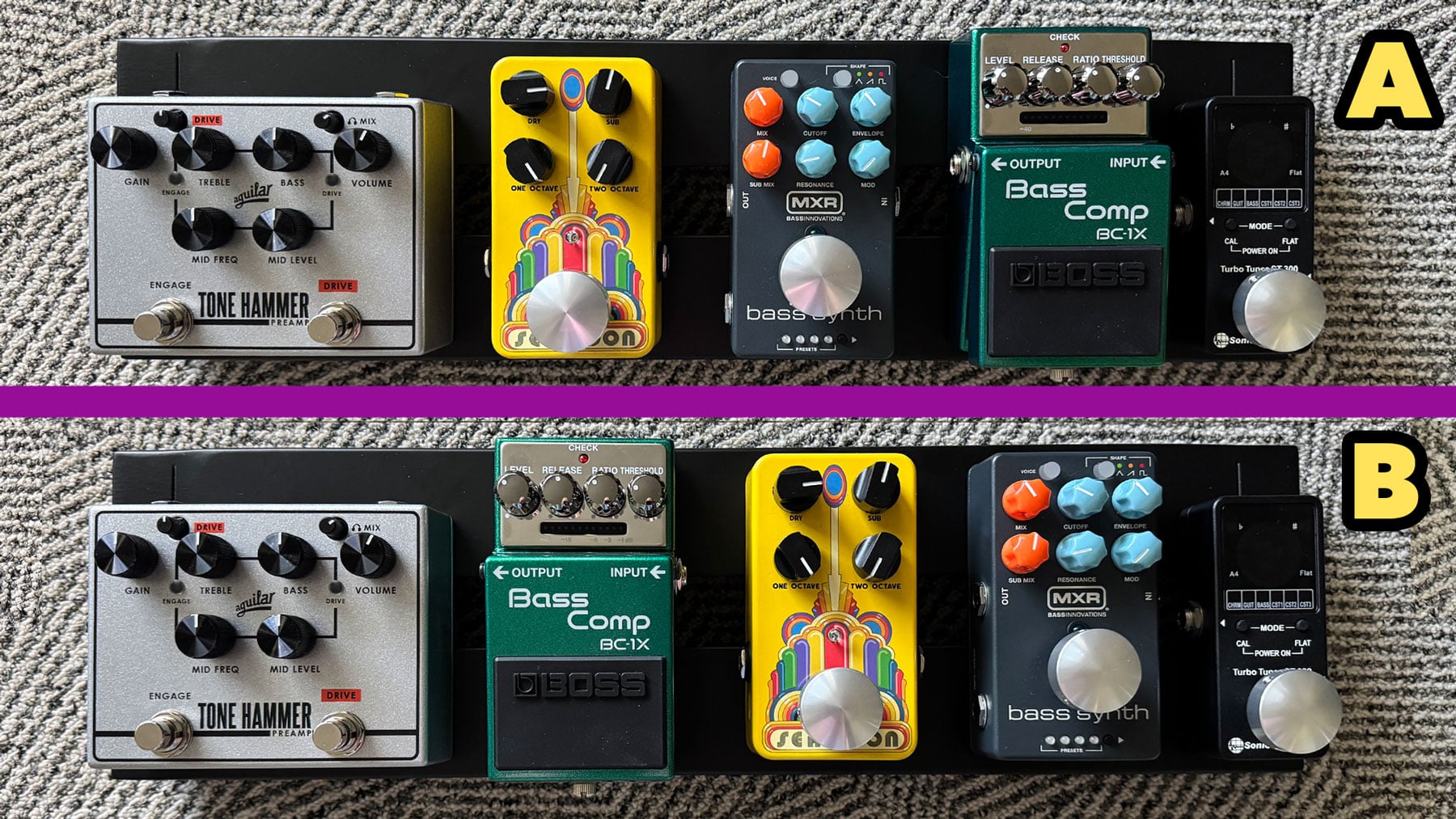
pedalboard.jpg
 
What do you want the Seamoon and Bass Synth to do? I have not used either, but typically that type of effect responds to signal level. Comp before will give you a more even response from them, but less control. Comp after will let you use the touch sensitivity of the pedals, but relies on you to get a consistent effect when you want it to be consistent. Both are acceptable answers; just depends what you want.
 
What do you want the Seamoon and Bass Synth to do? I have not used either, but typically that type of effect responds to signal level. Comp before will give you a more even response from them, but less control. Comp after will let you use the touch sensitivity of the pedals, but relies on you to get a consistent effect when you want it to be consistent. Both are acceptable answers; just depends what you want.
Great question; I suppose I want to be sure the Bass Synth and Octaver are responding optimally; not glitching, delaying or behaving inconsistently if I'm consistent. Wondering if anyone here has experience to share?
 
You can arrange them however you want…the order you plug them is the important thing for functionality.
You would never guess my signal chain by looking at the order that my pedals show up on my board.
 
I would try C: tuner -> seamoon -> bc-1x -> mxr. That way your seamoon will get full instrument dynamics to play with, and the bc-1x will be there to tame it if needed. And the bc-1x will still be in front of the mxr to help improve tracking a bit.

But in reality there is no wrong answer, and you should experiment until you find what works best for you :)
 
I'd go with B. Put the comp at the end (before the preamp).

Even if your sound meter tells you that the volume is the exact same when you play clean versus engage a pedal, your ear will perceive volume fluctuations when you turn and off pedals. When that happens, I like to use a compressor at the end to try to tame that. I'm not sure why you'd really need to send an even/compressed signal through a synth or an octave; I don't think you'd get as much benefit out of that.
 
Slightly off topic but somewhat relevant question:

Assuming they're not purposely trying to achieving something by placing the analog octave pedal after digital synth pedal, wouldn't it make more sense to swap the order?

I used to have a digital POG and an analog OC2. I never used them together, but I always placed the OC2 before, thinking that since the POG is digital and therefore tracks better, the OC2 should go before. And the POG was buffered.

Did my logic make sense or did I overthink it? If it did make sense, would it have mattered if the POG was true bypass?
 
Slightly off topic but somewhat relevant question:

Assuming they're not purposely trying to achieving something by placing the analog octave pedal after digital synth pedal, wouldn't it make more sense to swap the order?

I used to have a digital POG and an analog OC2. I never used them together, but I always placed the OC2 before, thinking that since the POG is digital and therefore tracks better, the OC2 should go before. And the POG was buffered.

Did my logic make sense or did I overthink it? If it did make sense, would it have mattered if the POG was true bypass?
I would stay "analog" for as long as possible. Once you go digital, the signal has been digitally processed and the analog signal is done.
 
Envelopes after comps do weird things. the compressor squeezes transients above a threshold, and releases at a preset rate. so the envelope filter will follow that profile instead of the natural attack and decay of a played note. by all means try it out but im surprised so many people voted A. i would go with B or option C mentioned above.
oh, the seamoon is an octave pedal. A makes somewhat more sense now. i don't know, you just gotta try em out both ways, see which tracks better
 
  • Like
Reactions: Dusky Bass
Thanks for the discussion, friends. I tried all suggested configurations and for my current needs, I've gone with set up B: (signal path: Bass > Tuner > MXR Bass Synth > Seamoon Octotron > Boss BC-1X Compressor > Aguilar Tone Hammer Pre Amp). This path gives me good tracking with both the MXR Bass Synth and the Seamoon Octotron independently. I would rarely run them at the same time, but this path lets me add a subtle extra bass texture with the Octotron following the Bass Synth; almost like a perceived boost (e.g. in the chorus of a song) while my "always on" Compressor is grabbing everything at the end and keeping things pretty even. This works for today's needs 😊🙏🏽
 
In my uninformed opinion wouldn't you want the compressor as far to the end of the chain as possible? The whole point of it is to even out your overall tone, and if you have it early on then a bunch of pedals changing the dynamics of your signal you are effectively making it somewhat pointless to even have one.

The only way i could see it not mattering as much is depending on how that syth pedal is or if the yellow pedal (not sure what it is) is a fuzz since in theory they would have natural compression to your signal anyways - however id still want the compressor after that anyways especially if you plan on having it always on.
 
  • Like
Reactions: Dusky Bass