• TalkBass has been independent since 1998. Add your voice.
    Create a free account to reply to discussions, view embedded media, and browse with fewer display ads.
    Join freeLog in
    Want zero display ads or expanded classifieds tools? Compare plans.

Well done DURRL!!!

I saw just a handful of them but I like how many of the teachers emphasize one point: there are numerous ways to do it but a big sound involves mass. This either by already having it as a big person (including the McBride vid in the other thread) or changing up the technique so that it's there. Right off the bat, Rufus uses a reinforced single finger, and Lynn does the "wave".
 
  • Like
Reactions: Chris Fitzgerald
I saw just a handful of them but I like how many of the teachers emphasize one point: there are numerous ways to do it but a big sound involves mass. This either by already having it as a big person (including the McBride vid in the other thread) or changing up the technique so that it's there. Right off the bat, Rufus uses a reinforced single finger, and Lynn does the "wave".

[nerd out trigger warning]
Agree. Also interesting that Emma uses two fingers together. I haven't met her in person but her website bio mentions that she decided to play the double bass soon after she was told she was too small to do so. I can get with that kind of attitude. With the exception of her and David, I am the slightest of build of all the people in the video. But I learned a lot about what a bass could sound like watching guys with more powerful frames pull a huge sound. Probably not surprising, then, that the whole concept of arm weight and playing from the core became a central concept, especially when you factor in all the experience in Aikido and Jiu Jitsu where I saw smaller people channeling enough power from there to hold their own with much larger ones.

And mass isn't all there is to the equation. There's also length/leverage and fluidity. Marco is strongly built but not long-limbed. When he plays at the end of the board, his right arm is mostly extended, so there isn't as much room to "drop" the elbow/arm as with a longer armed person. But he's got a beautiful flowing snap motion at the beginning of each note that makes the attack just jump out of the bass. You have to hear it in person to appreciate it - it's incredibly authoritative and I bet drummers love the clarity of time they get from sitting next to that.

I really like the sound Marco/Doug/Emma seem to get getting. Also like how Doug offers playing at different places on the fingerboard to achieve a desired tone, rather than simply locking into one place.

I love it that those three got grouped together. Marco and Doug are built powerfully, like linemen in football with broad frames and hands. Emma gets that sound (I think) in part because she turns 2 smaller fingers into one big one. She's also got a lot of arm in her stroke (check out her youtube video where she's playing Sonnymoon for two live to see what I mean) . I haven't had a chance to talk to her about this, but I'm guessing that channeling all of that energy through one very small finger would not be sustainable or get as big of a sound as what she's doing now, so it morphed into a two finger approach out of necessity.

Fascinating to watch the differences and similarities between players.
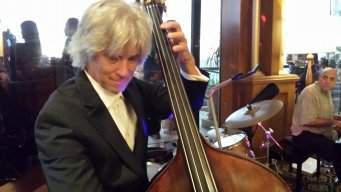
Agree. The similarities point out almost universal commonalities, and the differences just go to show that there are many ways to successfully get the job done. What part is sonic concept and what part is body mechanics, we'll probably never know for sure.
 
Wow, a big mahalo (thanks) for this video Chris. So much to digest. I was struck with all the different body types, the actual height of the bass in relation to the height of the player, how each bassist addressed the bass in relation to their body, possible string height, how each player used or placed their hand/fingers on the strings (their stroke) and certainly the nuanced differences in time feel even though all players were playing the same first blues chorus. For me, I'm still working on the height of the bass. At a certain height it is very easy to play at the end of the board. However, if my bass is too high, my left arm/hand tires easily. I'm also trying to work through some first finger pain issues. Probably playing too hard. Anyway, this was excellent. Thanks so much to you and all the bassists involved. Can I share this video with a few bassists?
 
Thanks, Trey. Please do share... that's what the series is there for!

You bring up some good points. People with smaller wingspans have some bass positioning decisions to make that affect both the right and left hands together. As a player with long arms I don't have to worry much about this, but as a teacher I need to help students with these issues all the time. Also, one of the interesting things for me about putting the video together was noticing the different feels that the same line at the same tempo could have both in terms of time feel and articulation depending on who was playing. There are obviously many different ways to skin the same cat!
 
  • Like
Reactions: Treyzer
Great video Chris! Although the focus of the video is on walking some players also mention two finger and solo techniques. Especially liked the remark at 47:00 that the speed dictates the angle of the fingers on the string. When you play really fast solo lines like Eddie Gomez or Scott Lafaro the angle changes and you play with less meat and more perpendicular to the string. I see that also with Dave Holland for example. The trick is to change fluently from one type of attack to the other.
 
Last edited:
For me, I'm still working on the height of the bass. At a certain height it is very easy to play at the end of the board. However, if my bass is too high, my left arm/hand tires easily. I'm also trying to work through some first finger pain issues. Probably playing too hard.

I tried raising the endpin by one notch a while back and noticed some stress on the wrist and lowered it right away. A couple months ago I lost track of how many notches I'd set the pin and accidentally had it too high again. Played like this for about a month without noticing other than some chronic wrist pain that was starting to worry me. Noticed it, lowered it, and problem gone.

Too high meant too much break angle and made the wrist unhappy. I could raise my elbow even higher to match but at that point it gets uncomfortable. I can't see how classical players can have it set up with the bass sky high. Looks painful to me but I think I'm the outlier here.


Back to the RH finger thing: took a look at all the techniques I use now after all the years seeing everybody elses approach and developing my own. Alternating fingers, single finger (both index or middle), slap, slap style pizz without an anchored thumb, along-the-string-meat, perpendicular plucking/punching, chicken wing and no-chicken wing. Just using whatever I felt like just makes it a lot of fun!

There's a few more I've never seen other people talk about.
* Wrist rotation along the axis of the forearm, esp with a two finger approach. It's just a very slightest of twists. Great for rakes too. Like turning a doorknob in either direction.
* Hand rotation, as if doing a karate chop without the forearm. This one I've only seen one teacher do, esp using the middle finger combined with a push/punching approach with a lot of meat.
 
Last edited:
  • Like
Reactions: Chris Fitzgerald
[extremely nerdy observation]
Height of the bass is an incredibly important parameter even for a long armed person. There's an aspect of bass technique that regards the amount of bend in the elbows that I am coming to appreciate more as I get older. Assuming that a reasonable wrist shape can be maintained at whatever height the bass is set, I'm finding that having the elbow too closed up (i.e. - too bent with the forearm and bicep too close together) can cause pain at the elbow joint. In my case, the 74" wingspan helps in a lot of areas, but can also cause the left arm to fold in too tight if I'm not careful. This causes an old biceps tendon injury to flare up if I take a coupe of days off and then jump right back in.

As a seated player, the antidote to this is to tilt the torso back when playing in the lower positions so as to allow the arm to remain more open. I have been practicing this at extreme slow tempos lately. It works for the arm stress/pain, but is also forcing me to recalibrate the distance a bit in terms of intonation. Ultimately, it will be a trade off that is more than worth the trouble. But I've been thinking a lot about what a rabbit hole bass technique can be!
[/nerd rant]
 
Otoh, experimenting with Red Mitchell's high up on the board approach, playing without the thumb anchored in the side made a huge difference in sound.

Esp now that I'm playing weichs, I can get a similar vibe. Something about the change in mass of the band or similar.
 
Just a short video to update viewers about upcoming videos and to welcome topic requests. There will be a new video on Bossa Nova bass lines and Brazilian styles coming out very soon featuring Brazilian bassist Hamilton Pinheiro. It's been a long year, but I'm happy to be back recording again!

 
Really.. You hold the bass and it's just dying to be played and the audience watching wants to hear it soooo bad, and you just talk. Some tease.. :smug:

Can you please just do another 1 minute video of you just playing that bass in the chair like that?

Actually, it's like my security blanket.... I feel kind of naked without it. Going on camera without my bass and then watching the video is like hearing my voice on the voicemail message. :vomit:

There will be plenty of playing in the videos that are coming out - at least one full length duo with Hamilton in three of them.... can't remember if we played a tune on the fourth one.

I'm looking forward to all those videos, and to meeting you at Aebersold camp! I'll be there the second week. If I can be of any help with the video, I'm happy to volunteer (I'm a pretty competent tech-head).


Definitely come introduce yourself at the end of the first master class if i don't see you at your audition. It's always great to put faces to names. And thanks for the offer to help, but I've been going pretty low tech with the camp videos the past couple of years - just an iPad on a mic stand and turn the subject loose. It's worked out fine so far.

But on another note, are you a video shoot tech head in general? I'm looking for two small lights that can live on their stands and set up and fold down quickly. I shot the little video above on my phone and I think it looks pretty good but would look better with better light. I have an inexpensive lighting kit that I use for most of the longer videos these days, but it's a PITA to set up and I'd love to have something like a couple of LED boxes that live on their stands that I could set up in 5 minutes or less for when the mood strikes. If anybody knows of anything like this, I'm all ears!

Last, here's a little video of Hamilton to whet the whistle for those who like electric Brazilian bass:


He's a great guy and an absolute beast on the BG!
 
  • Like
Reactions: Joshua
@Tom Lane He'll be creating a video online learning resource for Brazilian music and jazz, with some free content but then a subscription service to more extended lesson packages. I'm sure he'll also be playing a teaching and lot, but I know he'll do a great job with the online series because he's so hyper organized and focused. The work needs more people like him.
 
  • Like
Reactions: Tom Lane