
Enjoy the benefits of a premium membership!
Upgrade Account
-
TalkBass has been independent since 1998. Add your voice.
Create a free account to reply to discussions, view embedded media, and browse with fewer display ads.
Join free Log in
Want zero display ads or expanded classifieds tools? Compare plans.
You are using an out of date browser. It may not display this or other websites correctly.
You should upgrade or use an alternative browser.
You should upgrade or use an alternative browser.
New Markbass Vintage Pre
- Thread starter Stranger Danger
- Start date
More options
Who Replied?


How would you describe the overall tone? Is it inherently open sounding or pretty dark? Warm and round or punchy and full?

I ordered mine from GC on November 29th, 2020... It was listed as "back ordered" until today, now it says "processing". I spoke with someone there, who told me they are supposed to start shipping this week.. I hope so, I'm really excited to try this one!!!
I bought it because I want to give my sound a little tube warm and more gain, if needed... If it doesn't fill my needs, I'll probably wait for the FMC Retrobass 2.0. if the things are going well in the FMC HQ
I bought it because I want to give my sound a little tube warm and more gain, if needed... If it doesn't fill my needs, I'll probably wait for the FMC Retrobass 2.0. if the things are going well in the FMC HQ
Big ol sucker but it looks cool.
And I suppose I'm in the minority, but I find it exciting to have S/PDIF and optical/ADAT; my Focusrite interface has both inputs, and if one can track direct that way, DI to a studio preamp such as a 1073 (or BLA B173 in my case, AND run output to a head x mic'd cab.... that's a whole lot of signal control, and without the potential bugs that sometimes come with adding a USB connection.
And I suppose I'm in the minority, but I find it exciting to have S/PDIF and optical/ADAT; my Focusrite interface has both inputs, and if one can track direct that way, DI to a studio preamp such as a 1073 (or BLA B173 in my case, AND run output to a head x mic'd cab.... that's a whole lot of signal control, and without the potential bugs that sometimes come with adding a USB connection.
Last edited:

I ordered one today.
Me too. Gonna see how it stacks up to the SLO I'm currently using.

I wish I had the experience/vocab to answer this, but I don’t. It’s my first pedal/preamp. Hopefully down the road I’ll be able to give a better answer.How would you describe the overall tone? Is it inherently open sounding or pretty dark? Warm and round or punchy and full?
This is one of the reasons I got it. But I’m curious what difference using the spdif will make vs the DI line out into my audio interface. I assume it would be down to the AD conversion happening in the pedal or in my audio interface, correct? Or would the added gain stage of analogue out or the pedal to analogue in on my interface do something to the color/fidelity? Would it be worth it to upgrade my interface (Steinberg UR22) to one with a digital in (NI Komplete Audio 6 is the cheapest one I can find)?Big ol sucker but it looks cool.
And I suppose I'm in the minority, but I find it exciting to have S/PDIF and optical/ADAT; my Focusrite interface has both inputs, and if one can track direct that way, DI to a studio preamp such as a 1073 (or BLA B173 in my case, AND run output to a head x mic'd cab.... that's a whole lot of signal control, and without the potential bugs that sometimes come with adding a USB connection.
I Dont know. How can i find it out ?Does this tube operate at high plate voltages or is it starved plate?
This is one of the reasons I got it. But I’m curious what difference using the spdif will make vs the DI line out into my audio interface. I assume it would be down to the AD conversion happening in the pedal or in my audio interface, correct? Or would the added gain stage of analogue out or the pedal to analogue in on my interface do something to the color/fidelity? Would it be worth it to upgrade my interface (Steinberg UR22) to one with a digital in (NI Komplete Audio 6 is the cheapest one I can find)?
I'd say it's a benefit that can be derived for either practical or spurious reasons (mine probably being on the spurious side), but isn't one that needs investment to achieve. Meaning, if you've got a quality analogue input for recording, you're going to record sounds that are most excellent.
I have a fantastic analogue path via the Black Lion Audio B173, and have happily recorded lines direct thru it alone. I've also recorded a cabinet mic thru the Focusrite without the BLA, also to excellent effect because modern technology is really that amazing now. Adding the ADAT or S/PDIF path would be pretty much a reference/superclean channel that studio engineers like, but that can also be achieved in the analogue domain. Stuff like noise floor is a matter of the gear in the player's hands, not the recording equipment, these days.

Does anyone have any feedback on how the Flat/Scoop/Old control sounds (particularly in comparison to the classic MB VLE and VPF)? I've always loved those controls on MB amps (probably the only EQ I actually use when I have them available), and if these can mimic that feature, I'd be quite interested.
~NvN
~NvN
I believe mine is out for delivery today so I'll check it out.

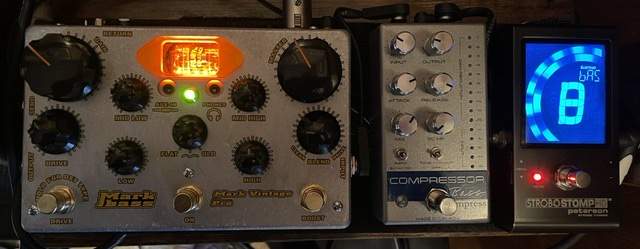
Well it fits nicely on a Pedaltrain Nano with two other pedals.
If anyone could make an audio clip that would be cool.
I will get audio clips up here: Tube Preamp/DI Sound Samples — Noble, Oracle, P-15, Super Stack, REDDI, Tonecraft, Jule...

Here are some audio clips.
Clip 1: Flat which means all EQ at noon; drive and blend all the way counterclockwise; EQ dial in Flat position. Gain at 11:00
Clip 2: Flat (same as clip 1) but bass at 2:00
Clip 3: Flat (same as clip 1) but mid low at 2:00
Clip 4: Flat (same as clip 1) but mid high at 2:00
Clip 5: Flat (same as clip 1) but mid low at 10:00
Clip 6: Flat (same as clip 1) but mid high @10:00
Clip 7: Flat (same as clip 1) but bass at 2:00 and treble at 2:00
Clip 8: Flat (same as clip 1) but bass at 10:00 and treble at 10:00
Clip 9: Flat (same as clip 1); Here a rotate the bass control starting at noon and then rotating clockwise and then fully counterclockwise returning to noon.
Clip 10: Flat (same as clip 1); Here a rotate the mid low control starting at noon and then rotating clockwise and then fully counterclockwise returning to noon.
Clip 11: Flat (same as clip 1); Here a rotate the mid high control starting at noon and then rotating clockwise and then fully counterclockwise returning to noon.
Clip 12: Flat (same as clip 1); Here a rotate the high control starting at noon and then rotating clockwise and then fully counterclockwise returning to noon.
Clip 13: Flat (same as clip 1) with EQ switch in middle position
Clip 14: Flat (same as clip 1) with EQ switch in old position
Clip 15: Flat (same as clip 1) with distortion option #1 enabled; Drive at noon; Clean blend at noon
Clip 16: Flat (same as clip 1) with distortion option #1 enabled; Drive at noon; Clean blend at 3:00
Clip 17: Flat (same as clip 1) with distortion option #2 enabled; Drive at noon; Clean blend at noon
Clip 18: Flat (same as clip 1) with distortion option #2 enabled; Drive at noon; Clean blend at 3:00
Clip 19: Starting flat (same as clip 1); Here I sweep the drive and blend with distortion option #1 and adding various EQ
Clip 20: Starting flat (same as clip 1); Here I sweep the drive and blend with distortion option #2 and adding various EQ
Clip 21: Starting flat (same as clip 1); Here I rotate various EQ dials to give a sense of the different tones
There are many more tonal options with different EQ/switch positions and gain/drive configurations. This is just a variety to help communicate the idea of what the Markbass Vintage Pre is capable of.
Clip 1: Flat which means all EQ at noon; drive and blend all the way counterclockwise; EQ dial in Flat position. Gain at 11:00
Clip 2: Flat (same as clip 1) but bass at 2:00
Clip 3: Flat (same as clip 1) but mid low at 2:00
Clip 4: Flat (same as clip 1) but mid high at 2:00
Clip 5: Flat (same as clip 1) but mid low at 10:00
Clip 6: Flat (same as clip 1) but mid high @10:00
Clip 7: Flat (same as clip 1) but bass at 2:00 and treble at 2:00
Clip 8: Flat (same as clip 1) but bass at 10:00 and treble at 10:00
Clip 9: Flat (same as clip 1); Here a rotate the bass control starting at noon and then rotating clockwise and then fully counterclockwise returning to noon.
Clip 10: Flat (same as clip 1); Here a rotate the mid low control starting at noon and then rotating clockwise and then fully counterclockwise returning to noon.
Clip 11: Flat (same as clip 1); Here a rotate the mid high control starting at noon and then rotating clockwise and then fully counterclockwise returning to noon.
Clip 12: Flat (same as clip 1); Here a rotate the high control starting at noon and then rotating clockwise and then fully counterclockwise returning to noon.
Clip 13: Flat (same as clip 1) with EQ switch in middle position
Clip 14: Flat (same as clip 1) with EQ switch in old position
Clip 15: Flat (same as clip 1) with distortion option #1 enabled; Drive at noon; Clean blend at noon
Clip 16: Flat (same as clip 1) with distortion option #1 enabled; Drive at noon; Clean blend at 3:00
Clip 17: Flat (same as clip 1) with distortion option #2 enabled; Drive at noon; Clean blend at noon
Clip 18: Flat (same as clip 1) with distortion option #2 enabled; Drive at noon; Clean blend at 3:00
Clip 19: Starting flat (same as clip 1); Here I sweep the drive and blend with distortion option #1 and adding various EQ
Clip 20: Starting flat (same as clip 1); Here I sweep the drive and blend with distortion option #2 and adding various EQ
Clip 21: Starting flat (same as clip 1); Here I rotate various EQ dials to give a sense of the different tones
There are many more tonal options with different EQ/switch positions and gain/drive configurations. This is just a variety to help communicate the idea of what the Markbass Vintage Pre is capable of.
Last edited:


