Have fun (~:=] I have found Phil Lesh isolated soundboard tracks on YouTube that give you a good idea on his playing feel. Check out the legend of the cursed keyboard position. They went through something like 7 keys players because they kept dying.Just getting into the Dead (bought a Starfire II and could not resist). This thing is insane!

Enjoy the benefits of a premium membership!
Upgrade Account
-
TalkBass has been independent since 1998. Add your voice.
Create a free account to reply to discussions, view embedded media, and browse with fewer display ads.
Join free Log in
Want zero display ads or expanded classifieds tools? Compare plans.
You are using an out of date browser. It may not display this or other websites correctly.
You should upgrade or use an alternative browser.
You should upgrade or use an alternative browser.
New Pedal: Osiris PHILter
- Thread starter JBflats87
- Start date
More options
Who Replied?
Check out Dark Star his bass really shines in that song. When Phil was alive he had a more recent series on YouTube called "neverending Dark Star" or something close to that if you wanted a modern twist on his classic tone.Can anyone point to some examples of the Phil Lesh sound”, please?

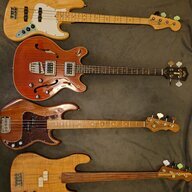
I'm not sure anyone can! Lol which is to say that Phil played several basses and modified his gear throughout 60 years of life and creation.. I would approach it chronologically.. but, here is a great version of this song with Phil using his Alembic "Mission Control" bass, which had two of the aforementioned filter channels, one for each pick-up, wired in parallel as opposed to series.
If anyone has experience with an SF2 or practical knowledge with similar filter sets I would be curious and open to suggestions and applications/settings useful for achieving Phil-lish tones and/or generally judicious and experimental tones I could achieve i.e set to BP at 100hz with high Q for Morning Dew tone and/or use Notch filter at 330hz to tame mud? (Hypotheticals)

I do not have this unit yet. I have a Series 1 bass and using the Broughton Resonant filter. Im sure the circuits in Osiris are more the real deal.
As stated on their page, you can 'mix' (w the 2 volumes) in big bass with the lpf, more highs w the hpf. Having a series 1, using the
lpf between 1 and 1.5 with a resonant boost. Gets me a nice woody attack. Agree cutting around 300, With some nice bottom I get pretty close to the sound. I also have some tubes in the signal path. My ears arent what they used to be, but I have 250 shows, and 1000s of listen hours into Phil . Am definitely considering this box. I can see that Notch filter being real useful to tame a freq for the room. So much flexibility here, but must choose 1 feature.
As stated on their page, you can 'mix' (w the 2 volumes) in big bass with the lpf, more highs w the hpf. Having a series 1, using the
lpf between 1 and 1.5 with a resonant boost. Gets me a nice woody attack. Agree cutting around 300, With some nice bottom I get pretty close to the sound. I also have some tubes in the signal path. My ears arent what they used to be, but I have 250 shows, and 1000s of listen hours into Phil
. Am definitely considering this box. I can see that Notch filter being real useful to tame a freq for the room. So much flexibility here, but must choose 1 feature.
Last edited:
This is an awesome response, thanks! I am under the impression that the Series 1 at least has LPF and Q controls onboard..? I got the RFE with Alembic electronics in mind but when this box became available I just had to make it mine! I haven't messed with mixing the Filter/Direct volumes very much yet, mostly keeping Direct at full and filter full open or dialed back to about 7ish, but I know the possibilities are there.. nor have I set the LPF so low, but I bet that is pretty woody! I haven't quite advanced to using the NF to tame any room either as I have mostly played into my interface (roommates) but I find the NF way louder than the rest and gets me some thick grit on it.. I am running through an Ampeg PF50t, btw
This is also why I have been messing with using my Broughton HP/LP afterwards set at 40hz/5Khz and running the PHILter through it for any sculpting I might desire.. however, I have concerns about cascading filters in series as it will change the slope and center frequency some.. trying to learn how to accommodate this usage as well, seeing as how this box can only employ one filter mode at a time, but my Broughton HP/LP acts as a BP already, right?

deepestend
Commercial User
- Feb 21, 2003
- 6,249
- 8,171
- Disclosures
- Website and Social Media at Sadowsky
Yes the S1 has the LPF and Q toggle..3 choices of amount to boost at the cut freq 0, 6, 9db I think. Osiris gives you full analog range (0-15db?) IF the Q on the lpf behaves the same way. I 'think' if both direct and filter are open your are 'mixing' them 50% each. I understand Q is a bandwidth, but thats the term used here to specified the dbs idkThis is an awesome response, thanks! I am under the impression that the Series 1 at least has LPF and Q controls onboard..? I got the RFE with Alembic electronics in mind but when this box became available I just had to make it mine! I haven't messed with mixing the Filter/Direct volumes very much yet, mostly keeping Direct at full and filter full open or dialed back to about 7ish, but I know the possibilities are there.. nor have I set the LPF so low, but I bet that is pretty woody! I haven't quite advanced to using the NF to tame any room either as I have mostly played into my interface (roommates) but I find the NF way louder than the rest and gets me some thick grit on it.. I am running through an Ampeg PF50t, btw
Last edited:
I 'think' this box behaves like the SF2, where the Filter volume is full at 7 and will exceed Direct volume when open all the wayYes the S1 has the LPF and Q toggle..3 choices of amount to boost at the cut freq 0, 6, 9db I think. Osiris gives you full analog range (0-15db?) IF the Q on the lpf behaves the same way. I 'think' if both direct and filter are open your are 'mixing' them 50% each. I understand Q is a bandwidth, but thats the term used here to specified the dbs idk
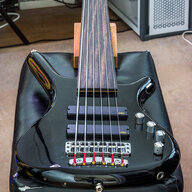
Not exactly. SF-2 has two filters, which can be parallel, series or stereo. Additionally, there is the option to engage a preamp. If the preamp is not engaged, Direct gain will modify the instrument level from 0 to unity. If the Direct gain is at unity (10), the Filter gain will be a similar level at 7. One can choose to mix Direct and Filter gains anywhere on the respective spectrum. For example, they could be equal to each other at 5 and 3, and 10 and 7 with the difference being combined output level.I 'think' this box behaves like the SF2, where the Filter volume is full at 7 and will exceed Direct volume when open all the way
The SF-2 is very useful, but probably difficult to find. I have used it with my electric cello as well as my basses.
Can anyone point to some examples of the Phil Lesh sound”, please?
i'm particularly fond of this jam.
if you are feeling antsy, go ahead and jump to around 25 min for some Phil magic.
RIP Phil!
Have fun (~:=] I have found Phil Lesh isolated soundboard tracks on YouTube that give you a good idea on his playing feel. Check out the legend of the cursed keyboard position. They went through something like 7 keys players because they kept dying.
I think it was 4 keys players who died: pigpen, Keith, Brent, Vince
Tom is still alive, as is Bruce Hornsby
lot's of hard livin back then....
Can anyone point to some examples of the Phil Lesh sound”, please?
Tone evolved over the years.... many choices here.....
Grateful Dead Internet Archive: Digital Library of Free & Borrowable Texts, Movies, Music & Wayback Machine
edwinhurwitz
Supporting Member
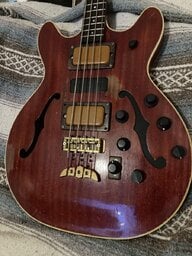
I just received one of these last week (SN16!). It's pretty awesome. I have an SF-2, a Series II equipped, Starfire, and decades ago, I built a Craig Anderton Super Tone Control.
This is very similar to a single channel SF-2 with the addition of the notch filter, although it feels like it has a wider variation in Q and can get much tighter. You can easily put it in bandpass mode and make it so that it only boosts one note. In comparison to my onboard Series II filters, it's much, much quieter and has a greater range. Of course, my SII electronics are from the early 70s, so they aren't state of the current art, although they still sound great.
The Anderton STC is based on the same idea, a state variable filter, but is quite a different beast. I put mine together ca. 1983 or 84 and decided to build it into my bass at the time. Instead of having a single filter output and then being able to blend it with the direct tone, it has three outputs, for below the filter, filter output, and above the filter, essentially making it a three band eq and a bandpass or notch filter. However, by setting the frequency and Q, you can get to the same place as a high pass or band pass filter. The filter range is insanely wide and the you can crank up the Q so high that the filter self-oscillates. Pretty cool stuff, but much less wieldy while trying to play the bass live. Ultimately, I took it out.
I think the Philter is a great box, although it does have a pretty steep learning curve. I've used it not only with my modded Starfire, but also with a Jazz and P bass and it is a fantastic addition to both. I've also been trying out the new Grace Design M303 DI box and the two could be a rig on their own with a power amp. I've played tons of DI boxes and at first, I though it was like most other DIs, perhaps a bit cleaner, but when going to other DI options, it sounds like a blanket is thrown over my tone. The low end is also really deep and clear. It's a great combination, given how deep and dynamic the Philter can be.
Alembic also came out with their version that has another setting, which is called bandpass+. It's a bit more expensive, but has some other features, including BP+
Here's the frame of 35mm film I got when I ordered the GD movie when it came out on DVD. The filter's in there somewhere!
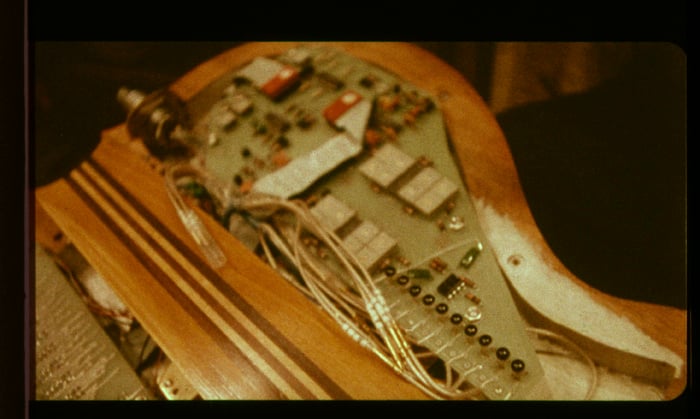
This is very similar to a single channel SF-2 with the addition of the notch filter, although it feels like it has a wider variation in Q and can get much tighter. You can easily put it in bandpass mode and make it so that it only boosts one note. In comparison to my onboard Series II filters, it's much, much quieter and has a greater range. Of course, my SII electronics are from the early 70s, so they aren't state of the current art, although they still sound great.
The Anderton STC is based on the same idea, a state variable filter, but is quite a different beast. I put mine together ca. 1983 or 84 and decided to build it into my bass at the time. Instead of having a single filter output and then being able to blend it with the direct tone, it has three outputs, for below the filter, filter output, and above the filter, essentially making it a three band eq and a bandpass or notch filter. However, by setting the frequency and Q, you can get to the same place as a high pass or band pass filter. The filter range is insanely wide and the you can crank up the Q so high that the filter self-oscillates. Pretty cool stuff, but much less wieldy while trying to play the bass live. Ultimately, I took it out.
I think the Philter is a great box, although it does have a pretty steep learning curve. I've used it not only with my modded Starfire, but also with a Jazz and P bass and it is a fantastic addition to both. I've also been trying out the new Grace Design M303 DI box and the two could be a rig on their own with a power amp. I've played tons of DI boxes and at first, I though it was like most other DIs, perhaps a bit cleaner, but when going to other DI options, it sounds like a blanket is thrown over my tone. The low end is also really deep and clear. It's a great combination, given how deep and dynamic the Philter can be.
Alembic also came out with their version that has another setting, which is called bandpass+. It's a bit more expensive, but has some other features, including BP+
Here's the frame of 35mm film I got when I ordered the GD movie when it came out on DVD. The filter's in there somewhere!
What a gorgeous housing, too. This seems like waaaaaay to many options for me, but super fun! I'm now trying to think of a way to describe the Lesh tone and I just can't. Kind of cool you can use this filter to get a phil-like tone from a completely different bass. Thanks! Can you post some sound samples?
 ..it ain't perfect and mixed high but headphones are still advised.. what do you all think? Of course, playing on flatwounds with a pick is probably a large part of the tone here...
Passinwind
I know nothing.
- Dec 3, 2003
- 23,045
- 45,909
- Disclosures
- Designer/Toaster Tech @ Passinwind Electronics
i'm particularly fond of this jam.
if you are feeling antsy, go ahead and jump to around 25 min for some Phil magic.
RIP Phil!
I attended that show, it was quite swell.

Sound nice! smooth round, but In a live setting I go to that LPF somewhere tween 1 and 1.8 depending on the bass with maybe 6db resonsant boost, get that PHil attack, and to cut through the mix clearly.View attachment 7100341 Here's a take with my P-bass on the studio version of 'Ship of Fools' I have the Broughton HP/LP on and the PHILter on NF set at ~330hz and Q at 75%.. why not?
Thanks! I had the Broughton HP/LP set around 40/3Khz and used the filter to Notch at 330, but good to know I can take that LP lower, though it seems counter-intuitive that less highs help you cut through better live, I'm sure it's tried and true. I am somewhat confused about Bandpass mode on the PHILter.. does it create two resonant peaks, and how far do they extend? Or one?Sound nice! smooth round, but In a live setting I go to that LPF somewhere tween 1 and 1.8 depending on the bass with maybe 6db resonsant boost, get that PHil attack, and to cut through the mix clearly.


