

Enjoy the benefits of a premium membership!
Upgrade Account
-
TalkBass has been independent since 1998. Add your voice.
Create a free account to reply to discussions, view embedded media, and browse with fewer display ads.
Join free Log in
Want zero display ads or expanded classifieds tools? Compare plans.
You are using an out of date browser. It may not display this or other websites correctly.
You should upgrade or use an alternative browser.
You should upgrade or use an alternative browser.
New Pedal That Delivers Alembic Style Filters For Bassists
- Thread starter 57pbass
- Start date
More options
Who Replied?
After a full week I’m absolutely loving this pedal. I think I need one or two more because there are so many settings that are just awesome.

Got mine today. I am curious ... but it will have to wait as I am rather busy at work right now.
It is smaller than expected though. Good.
It is smaller than expected though. Good.

Is there anyone interested in the SF-2's anymore?
I owned one for over 25 years and loved everything it did, still think it is one of the best kept secrets in the How Can I Achieve Jaw-Droppingly Amazing Bass Tone? search ...but I must confess, I barely used it for the last decade or so that I owned it, and I wound up selling it just because I was in the middle of decommissioning a lot of my studio equipment and the SF-2 fetched an excellent price.
I never would have discovered it if it hadn't been so ridiculously cheap when I bought mine 2nd-hand -- I'm pretty sure some clown at Guitar Center got fired because he put the decimal place several digits away from the intended location on the sale tag -- and I would never buy a new SF-2 at their current prices.
But if these new pedals can do what a genuine SF-2 can, I'd say they're well worth it, and I may spring for one in the near future.
I use it all the time.Is there anyone interested in the SF-2's anymore?

Thanks for the reminder that I need to troubleshoot my rack…was on vacation for the last week.Is there anyone interested in the SF-2's anymore?
I like my SF-2, and think it’s a great way to easily dial in some great tones.

Received my Freq Distiller today, and spent the better part of an hour running simulations. I put my SF-2 in a bypass looper, since it lacks an off switch, so I can more easily compare it to the new FD. Fed the SF-2 through he instrument preamp input, instead of the line input, for a better matched comparison.
Frequency Distiller is awesome.
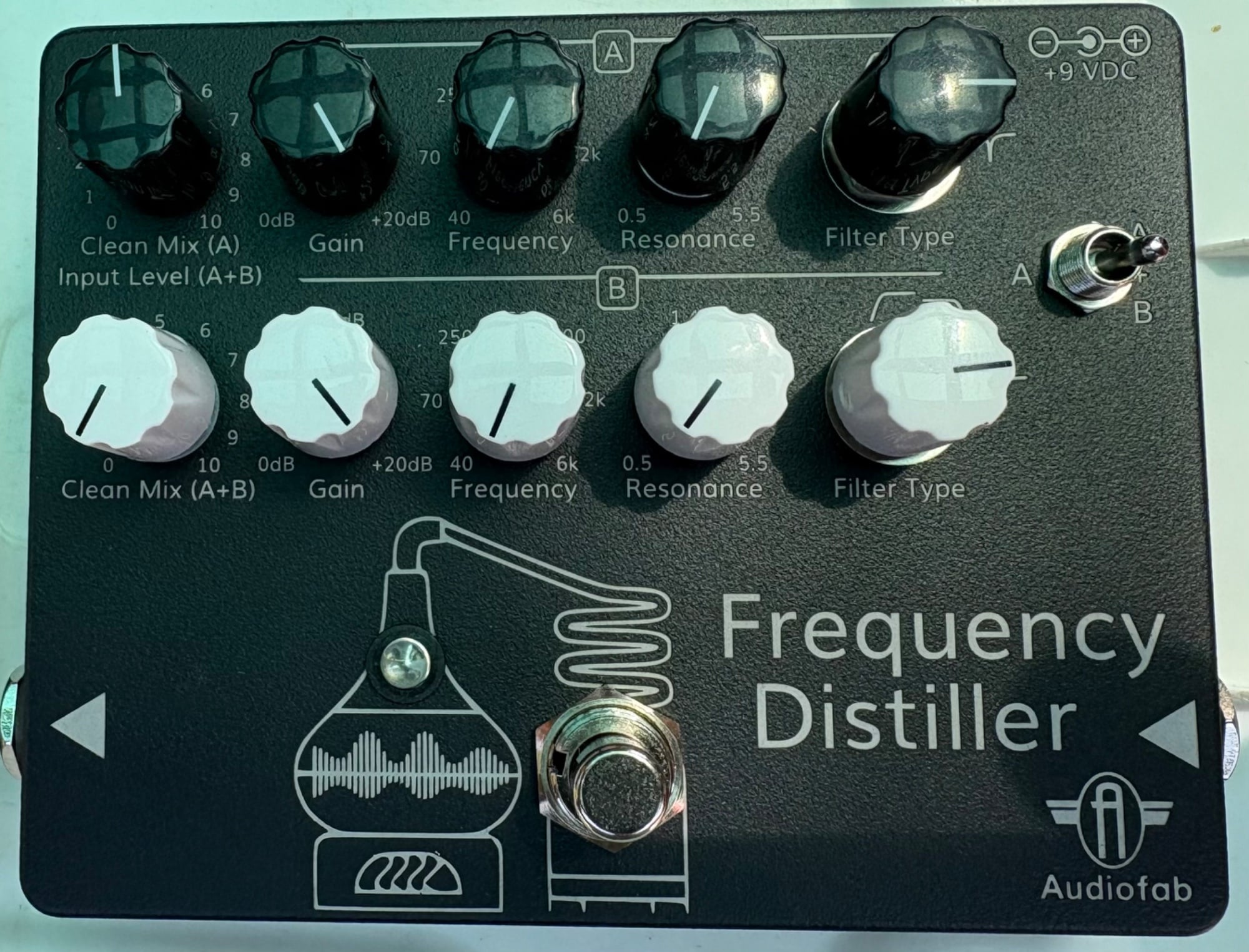
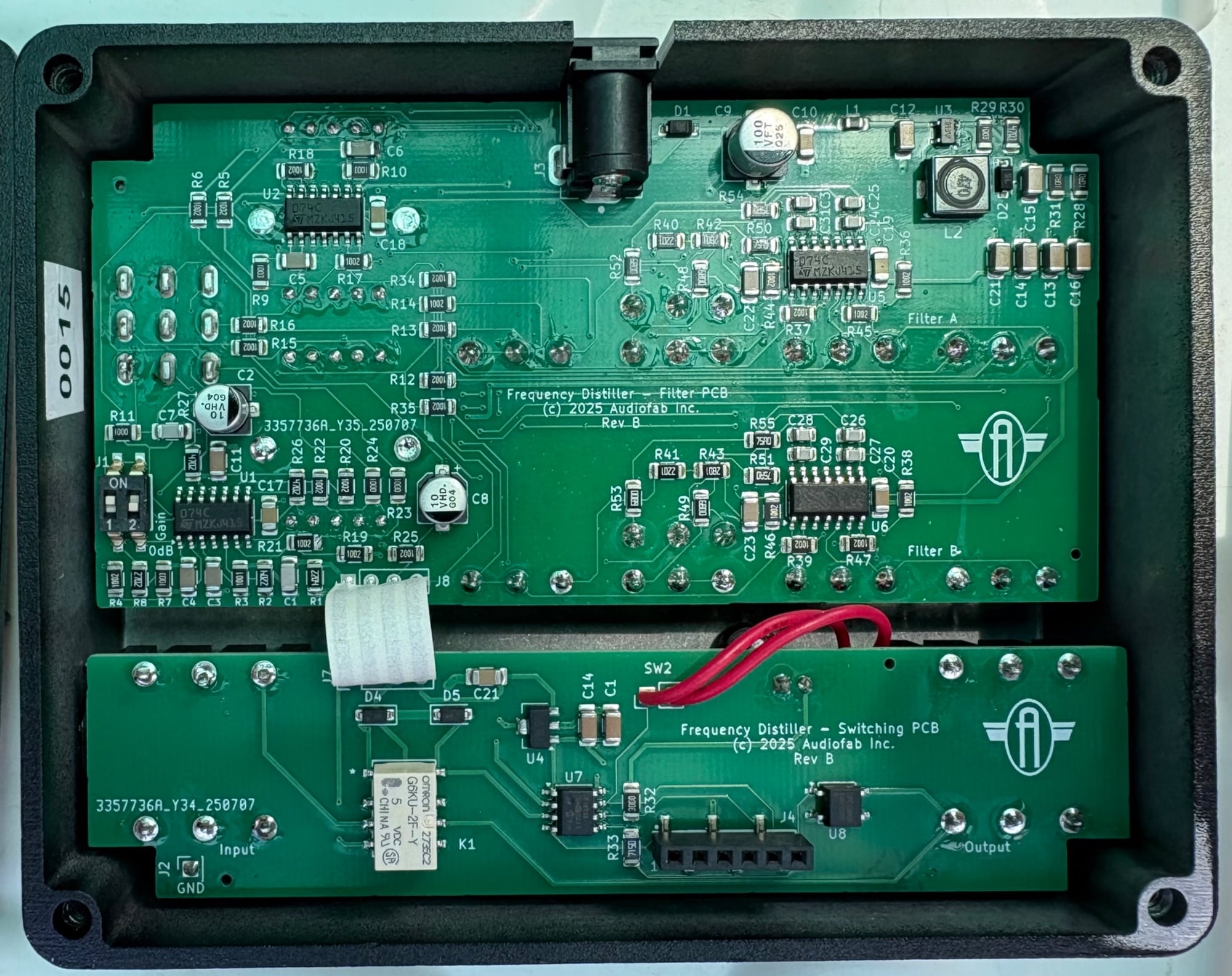
The build and Aesthetics suit me. It provides a clear path to the exquisite realm occupied by the SF-2. Starting with the signal flow, a 3 channel, parallel mixer, Clean, Filter A, and Filter B, like the SF-2, this opens a cornucopia of manipulations for sculpting the EQ. The most attractive aspect in my experience with Resonant, State Variable filters, is how, with very little effort, you can locate profoundly bombastic results, in all the frequencies, that avoid the obfuscation and muddling, or ice pick in the ear effect that other EQ schemes can induce. (I was just trying out some extreme compression after a highly boosted scooped setting..... Oh my goodness).
As a stand alone evaluation, The Frequency Distiller is a powerful, facile, wondrous sounding device, that can elevate the impact of any instrument, in any genre. There is significant overlap in the results achieved with the Frequency Distiller and the Superfilter 2.
When compared directly to my SF-2, a couple of differences stand out.
Firstly, the SF-2 with just the clean mixed in at unity, has a very subtle something. Almost not there, but at the same time, better inline than bypassed.
The biggest difference is the response of the "Damping" (Alembic nomenclature), and "Resonance" (Audiofab nomenclature).
When you raise the Damping Ratio, it creates a boost at the cutoff frequency, and everything gets louder.
When you raise the Resonance, it also creates a boost at the cutoff frequency, but the overall level SEEMS to drop, to compensate for the boost at the cutoff. To be clear, I don't really know why they sound different when boosted, but it feels like that is what is going on. I tried to illustrate this with a graphic.
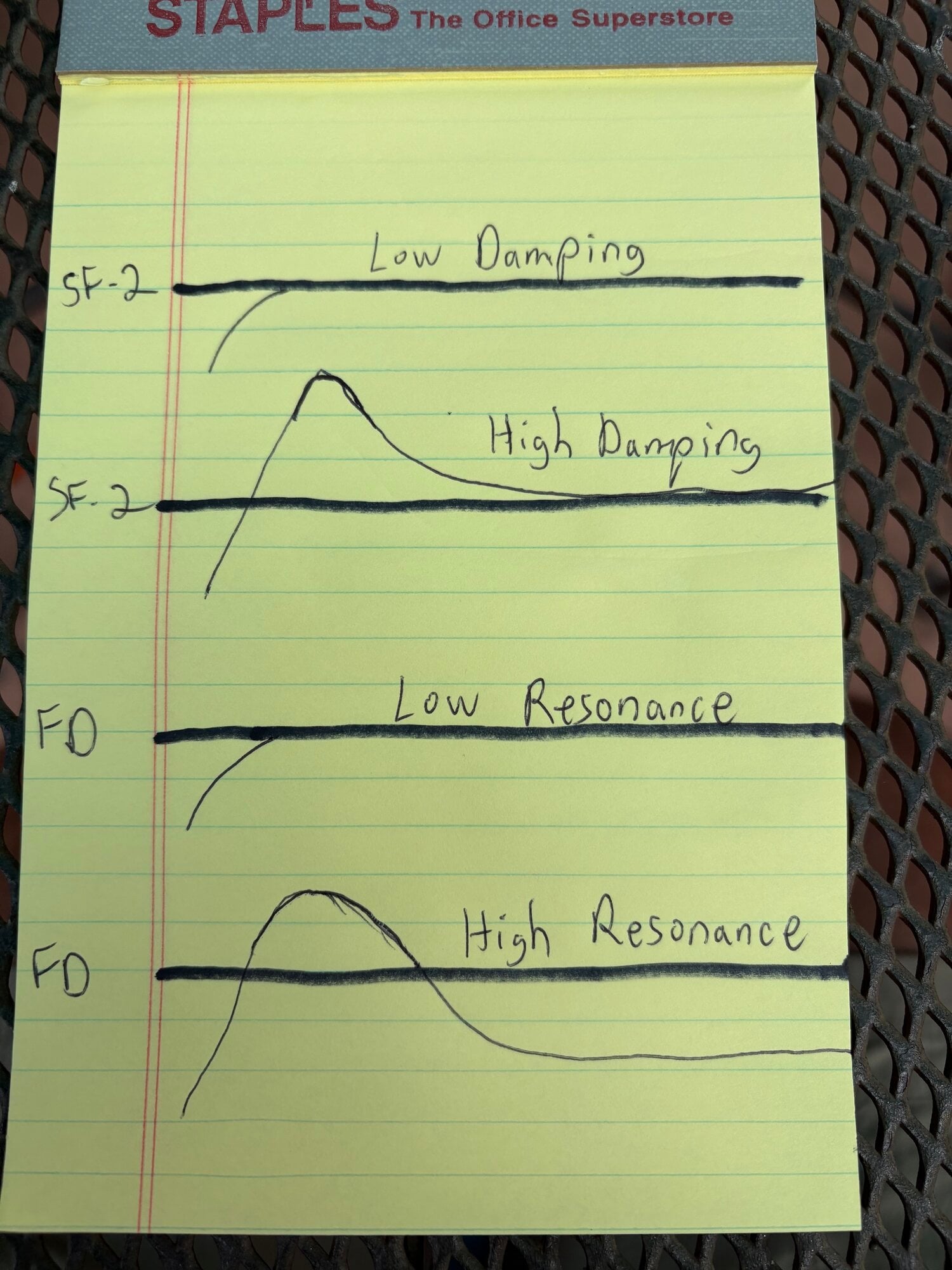
I won't claim one is better than the other, they share significant overlap, but they are not the same. The function of the Resonance on the FD just works differently. When trying to compare like settings, the two units diverge as you boost the damping/resonance. But I find that if I compensate for the apparent volume difference, (level match after resonance adjust), then they converge back to a more similar sound.
I highly recommend the Frequency Distiller. Once you have played around with State Variable Filters, in this three channel parallel configuration, you become hooked for life.
@davelowell2
Frequency Distiller is awesome.
The build and Aesthetics suit me. It provides a clear path to the exquisite realm occupied by the SF-2. Starting with the signal flow, a 3 channel, parallel mixer, Clean, Filter A, and Filter B, like the SF-2, this opens a cornucopia of manipulations for sculpting the EQ. The most attractive aspect in my experience with Resonant, State Variable filters, is how, with very little effort, you can locate profoundly bombastic results, in all the frequencies, that avoid the obfuscation and muddling, or ice pick in the ear effect that other EQ schemes can induce. (I was just trying out some extreme compression after a highly boosted scooped setting..... Oh my goodness).
As a stand alone evaluation, The Frequency Distiller is a powerful, facile, wondrous sounding device, that can elevate the impact of any instrument, in any genre. There is significant overlap in the results achieved with the Frequency Distiller and the Superfilter 2.
When compared directly to my SF-2, a couple of differences stand out.
Firstly, the SF-2 with just the clean mixed in at unity, has a very subtle something. Almost not there, but at the same time, better inline than bypassed.
The biggest difference is the response of the "Damping" (Alembic nomenclature), and "Resonance" (Audiofab nomenclature).
When you raise the Damping Ratio, it creates a boost at the cutoff frequency, and everything gets louder.
When you raise the Resonance, it also creates a boost at the cutoff frequency, but the overall level SEEMS to drop, to compensate for the boost at the cutoff. To be clear, I don't really know why they sound different when boosted, but it feels like that is what is going on. I tried to illustrate this with a graphic.
I won't claim one is better than the other, they share significant overlap, but they are not the same. The function of the Resonance on the FD just works differently. When trying to compare like settings, the two units diverge as you boost the damping/resonance. But I find that if I compensate for the apparent volume difference, (level match after resonance adjust), then they converge back to a more similar sound.
I highly recommend the Frequency Distiller. Once you have played around with State Variable Filters, in this three channel parallel configuration, you become hooked for life.
@davelowell2

Awesome!The biggest difference is the response of the "Damping" (Alembic nomenclature), and "Resonance" (Audiofab nomenclature).
When you raise the Damping Ratio, it creates a boost at the cutoff frequency, and everything gets louder.
When you raise the Resonance, it also creates a boost at the cutoff frequency, but the overall level SEEMS to drop, to compensate for the boost at the cutoff. To be clear, I don't really know why they sound different when boosted, but it feels like that is what is going on. I tried to illustrate this with a graphic.
I won't claim one is better than the other, they share significant overlap, but they are not the same. The function of the Resonance on the FD just works differently. When trying to compare like settings, the two units diverge as you boost the damping/resonance. But I find that if I compensate for the apparent volume difference, (level match after resonance adjust), then they converge back to a more similar sound.
I want to tag @Taudio for insight about your damping and resonance thing.
Thanks for the thoughtful review and detailed feedback @davelowell2 !Awesome!
I want to tag @Taudio for insight about your damping and resonance thing.
I really appreciate you taking the time to compare the FD with the SF-2 — your notes on the resonance/damping behavior are especially interesting. I’ll dig into that and will follow up with more details soon.
By the way, for anyone who’s been waiting, Frequency Distillers are now back in stock.
I made some measurements and ran a quick simulation to double-check what’s going on -- see the frequency responses below. The way the Resonance control behaves is a result of the state variable filter design used in the Frequency Distiller. When you crank the resonance, you’ll see passband gain changes, but as you pointed out, you can compensate with the Filter Gain controls and land close to an SF-2.
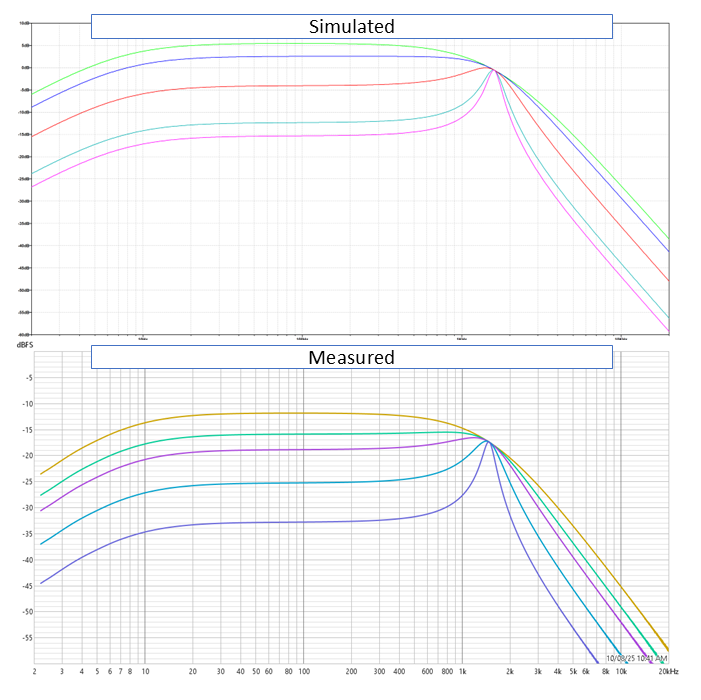
It is no secret that the core of the Frequency Distiller is based on mauman’s design from fInvalid Link Removed. He was generous enough to offer it to me. I made a few key changes (mainly to the power supply, switching and mechanical layout) to make it pedal-friendly, but the heart of the design (including the state variable filter) is the same.
@davelowell2 – thanks again for your super-helpful feedback! And honestly, a big shout-out to the whole TalkBass community – the encouragement, ideas, and suggestions I’ve gotten here have been awesome.
I’ve got a list of possible tweaks for a future version of the Frequency Distiller … stay tuned!
It is no secret that the core of the Frequency Distiller is based on mauman’s design from fInvalid Link Removed. He was generous enough to offer it to me. I made a few key changes (mainly to the power supply, switching and mechanical layout) to make it pedal-friendly, but the heart of the design (including the state variable filter) is the same.
@davelowell2 – thanks again for your super-helpful feedback! And honestly, a big shout-out to the whole TalkBass community – the encouragement, ideas, and suggestions I’ve gotten here have been awesome.
I’ve got a list of possible tweaks for a future version of the Frequency Distiller … stay tuned!

Can somebody elaborate on how the switch affects the Clean Mix knobs? When it's set to A, you get the A channel plus the dry signal. If it's set to A+B, do you only get A and B? Or do you get A, B, and the dry signal too?
All three are available in A and B mode.Can somebody elaborate on how the switch affects the Clean Mix knobs? When it's set to A, you get the A channel plus the dry signal. If it's set to A+B, do you only get A and B? Or do you get A, B, and the dry signal too?

I'm pretty sure the Moog MF101 LPF does the same when you push the Resonance, which makes it difficult on that pedal to get unity gain at some settings since there is no master volume control to make up for the lost gain.I made some measurements and ran a quick simulation to double-check what’s going on -- see the frequency responses below. The way the Resonance control behaves is a result of the state variable filter design used in the Frequency Distiller. When you crank the resonance, you’ll see passband gain changes, but as you pointed out, you can compensate with the Filter Gain controls and land close to an SF-2.
View attachment 7300223
It is no secret that the core of the Frequency Distiller is based on mauman’s design from fInvalid Link Removed. He was generous enough to offer it to me. I made a few key changes (mainly to the power supply, switching and mechanical layout) to make it pedal-friendly, but the heart of the design (including the state variable filter) is the same.
@davelowell2 – thanks again for your super-helpful feedback! And honestly, a big shout-out to the whole TalkBass community – the encouragement, ideas, and suggestions I’ve gotten here have been awesome.
I’ve got a list of possible tweaks for a future version of the Frequency Distiller … stay tuned!
Nice. How lovely to confirm that my 66 year old, retired audio professional ears/brain still got the juice. Taudio’s graphs look exactly like what I thought was happening.I made some measurements and ran a quick simulation to double-check what’s going on -- see the frequency responses below. The way the Resonance control behaves is a result of the state variable filter design used in the Frequency Distiller. When you crank the resonance, you’ll see passband gain changes, but as you pointed out, you can compensate with the Filter Gain controls and land close to an SF-2.
View attachment 7300223
It is no secret that the core of the Frequency Distiller is based on mauman’s design from fInvalid Link Removed. He was generous enough to offer it to me. I made a few key changes (mainly to the power supply, switching and mechanical layout) to make it pedal-friendly, but the heart of the design (including the state variable filter) is the same.
@davelowell2 – thanks again for your super-helpful feedback! And honestly, a big shout-out to the whole TalkBass community – the encouragement, ideas, and suggestions I’ve gotten here have been awesome.
I’ve got a list of possible tweaks for a future version of the Frequency Distiller … stay tuned!
For anyone following this thread — we've released an updated version of the Frequency Distiller, the Frequency Distiller Special Blend. It offers simplified channel switching, some updates to the filter design, and a stereo mode.
Packy Lundholm did a YouTube demo of the new pedal that you can watch here:
Happy to answer any questions!
Packy Lundholm did a YouTube demo of the new pedal that you can watch here:
Happy to answer any questions!

Just posted by Frequency Distiller in the classifieds. It's the original version.

For sale AudioFab Frequency Distiller
Mint Condition
- s_wood (+69 /0 /-0)
- Updated
- Views: 239
- Reaction score: 2
- Category: For Sale: Effects and Pedals
$450.00
1 watching
Special Blend inbound. Not sure how I missed the FD durimg my SF-2 search for so long. The SF-2 will have a place of honor racked up with my F1-X. The FD will live on my highly used pedal board with other sundry goodies 
Off to camp for a few days and then let the Audio mayhem begin again.
Off to camp for a few days and then let the Audio mayhem begin again.

Still regret selling my SF2 years ago, they now go for 2-3x the price...
anyone check out the Lutisand F1? F1 (Studio Filter Preamp) - Lusithand Devices doesn't seem as full featured as the AudioFab unit, but it is cheaper (doesn't have a clean blend which is vita to me).
I also own the Broughton SBF and while it sounds fine to me it doesn't sound as good as the Alembic, but its been a few years as well.
anyone check out the Lutisand F1? F1 (Studio Filter Preamp) - Lusithand Devices doesn't seem as full featured as the AudioFab unit, but it is cheaper (doesn't have a clean blend which is vita to me).
I also own the Broughton SBF and while it sounds fine to me it doesn't sound as good as the Alembic, but its been a few years as well.


