

Enjoy the benefits of a premium membership!
Upgrade Account
-
TalkBass has been independent since 1998. Add your voice.
Create a free account to reply to discussions, view embedded media, and browse with fewer display ads.
Join free Log in
Want zero display ads or expanded classifieds tools? Compare plans.
You are using an out of date browser. It may not display this or other websites correctly.
You should upgrade or use an alternative browser.
You should upgrade or use an alternative browser.
New Rickenbacker Colors
- Thread starter johnson79
- Start date
-
- Tags
- rickenbacker
More options
Who Replied?
Rickenbackers already have narrower spacing than Fenders.If I remember correctly, you convert 4-string Rics to 5, yes? And if so, do you find yourself having to use 5-string bridges with narrower string spacing than, say, a bridge spaced for Fenders?

As someone owning multiple copies of both Ric and Alembic basses I've never had any problems with either Ric or Alembic bridges not having individual saddle height adjustments. I can, however, state the traditional (or vintage-style) Ric bridge is not terribly functional in comparison to the Alembic bridge, a statement I understand is respectfully contrary to opposing views.Something more like this, perhaps?
View attachment 1157622
Neither does the Alembic bridge, but I have never heard anyone complain about that.
Because the Ric saddles are not firmly mounted to the bridge the intonation tends to change ever so slightly every time one changes the strings; not a lot, but enough to annoy. Although not recommended for anything but fingerboard cleaning and fret dressing, taking all the strings off a Ric with a vintage-style bridge will certainly lead to having to intonate the Ric because the saddles come off. The physical task of intonating a RIC is a royal PITA due to access issues. Finally, the amount of adjustment on the Ric bridge isn't quite enough for perfection. As a connoisseur of Rics, I'm sure you've noticed virtually every one of the 4000-series basses that is close to being properly intonated has the E string saddle jammed all the way to the longest stop (closest to the tail), such as the one in your last photograph and the two photographed in the OP. Further, many players have the D and G saddles turned 180 degrees to get better intonation, such as the one in your last photograph. (The two photographed in the OP has the D and G saddles turned in the stock direction.)
I'm absolutely not bashing the Ric. I like them quite a lot. Looking at it objectively, however, there is a reason we so often hear negative commentary about the Ric bridge. In short, the negativity toward the bridge was earned by Rickenbacker's steadfast refusal to improve the functionality while retaining the cool look. They work, but they could be improved upon.
Because my early '70s 4001 could not be properly intonated with the stock bridge, I had it replaced in the mid-70s (long before it became a "vintage bass") with a Starz bridge, the only alternative available at the time. The Starz bridge looks a bit weird, but it allows for far more accurate intonation, more stability during string changes and is easier to work on. I've kept and played that bass for over 40 years and love it. I have an Autumn Glo from the same period I bought over 30 years ago. It has the stock bridge because it looks cool. Because it doesn't intonate quite right, it doesn't get much play time. As far as what I play everyday? I use one of three Alembic Elans. The stock Alembic bridge, for the record, is the very definition of simplicity to use, has all pieces firming mounted so intonation doesn't change at all when the strings are changed. Although it doesn't look quite as cool as the Ric bridge, it ain't bad. So: Im not bashing; rather, I'm suggesting Ric would do it's followers a favor by improving upon their cool design.
Last edited:

Well said. I think that the bridge is just part of the fun of the ever elusive Rick bass. Atleast it's better than a Hofner's "close enough" bridge. I'm sure if RIC upgraded the bridge it wouldn't be well received and people would swap out the new bridge for an old style one. I know I would. It's just up to someone's personal taste of form vs. function.As someone owning multiple copies of both Ric and Alembic basses I've never had any problems with either Ric or Alembic bridges not having individual saddle height adjustments. I can, however, state the traditional (or vintage-style) Ric bridge is not terribly functional in comparison to the Alembic bridge, a statement I understand is respectfully contrary to opposing views.
Because the Ric saddles are not firmly mounted to the bridge the intonation tends to change ever so slightly every time one changes the strings; not a lot, but enough to annoy. Although not recommended for anything but fingerboard cleaning and fret dressing, taking all the strings off a Ric with a vintage-style bridge will certainly lead to having to intonate the Ric because the saddles come off. The physical task of intonating a RIC is a royal PITA due to access issues. Finally, the amount of adjustment on the Ric bridge isn't quite enough for perfection. As an connoisseur of Rics, I'm sure you've noticed virtually every one of the 4000-series basses that is close to being properly intonated has the E string saddle jammed all the way to the longest stop (closest to the tail), such as the one in your last photograph and the two photographed in the OP. Further, many players have the D and G saddles turned 180 degrees to get better intonation, such as the one in your last photograph. (The two photographed in the OP has the D and G saddles turned in the stock direction.)
I'm absolutely not bashing the Ric. I like them quite a lot. Looking at it objectively, however, there is a reason we so often here negative commentary about the Ric bridge. In short, the negativity toward the bridge was earned by Rickenbacker's steadfast refusal to improve the functionality while retaining the cool look. They work, but they could be improved upon.
Because my early '70s 4001 could not be properly intonated with the stock bridge, I had it replaced in the mid-70s (long before it became a "vintage bass") with a Starz bridge, the only alternative available at the time. The Starz bridge looks a bit weird, but it allows for far more accurate intonation, more stability during string changes and is easier to work on. I've kept and played that bass for over 40 years and love it. I have an Autumn Glo from the same period I bought over 30 years ago. It has the stock bridge because it looks cool. Because it doesn't intonate quite right, it doesn't get much play time. As far as what I play everyday? I use one of three Alembic Elans. The stock Alembic bridge, for the record, is the very definition of simplicity to use, has all pieces firming mounted so intonation doesn't change at all when the strings are changed. Although it doesn't look quite as cool as the Ric bridge, it ain't bad. So: Im not bashing; rather, I'm suggesting Ric would do it's followers a favor by improving upon their cool design.

Yes! that right there's lovely, inlays don't go all the way across the fretboard just how I like em. Is this a custom job? It looks like a 70's 4001 by the looks of that skunk stripe and inlays, but that checkered binding and 60's pups are throwing me in a loop.Something more like this, perhaps?
View attachment 1157622
Neither does the Alembic bridge, but I have never heard anyone complain about that.
Yes. And I'm sort of halfway looking for a good 5-string bridge with a narrower spacing than the Fender spacing. I bought a 5-string BadAss II for a Korean Ibanez bass, and the spacing was way too wide for the bass.Rickenbackers already have narrower spacing than Fenders.

Except for the RI horseshoe pickup that is a totally stock July '73 4001. I had the vintage style knobs on it for many years; the stock bridge pickup is back on that bass, and it is with a good friend of mine these days.Yes! that right there's lovely, inlays don't go all the way across the fretboard just how I like em. Is this a custom job? It looks like a 70's 4001 by the looks of that skunk stripe and inlays, but that checkered binding and 60's pups are throwing me in a loop.

I normally despise black hardware, just not my thing. But that burst is the shiz-nit! I would buy that in a second (...if I had money  ).
).
).
I lost interest in Rics back around '73 when they dropped the checkered binding. That binding was the icing on the cake, a nice display of attention to detail on an already handsome bass.
So naturally I voted for the Fireglo with the black trim. Classy and understated, despite its striking appearance. If I was in charge, I'd change the black guard to a matte finish, instead of glossy black, just for continuity.
I notice it has an ebony board, too. Nice touch. If the pearl slash markers were dark gray instead of white, I might have to have one, based solely on looks. (let's face it, much of the Ric appeal is how they look)
I also think the black trim treatment might look good with some other finishes too.
So naturally I voted for the Fireglo with the black trim. Classy and understated, despite its striking appearance. If I was in charge, I'd change the black guard to a matte finish, instead of glossy black, just for continuity.
I notice it has an ebony board, too. Nice touch. If the pearl slash markers were dark gray instead of white, I might have to have one, based solely on looks. (let's face it, much of the Ric appeal is how they look)
I also think the black trim treatment might look good with some other finishes too.
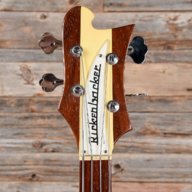
Pink ones are on CME's website now and for $250 less than they quoted me in an email right before they listed them, go figure.

Michael Schreiber
Commercial User
Pink ones are on CME's website now and for $250 less than they quoted me in an email right before they listed them, go figure.
Thank you!
Nice to see, they're in the normal price range.
Same as the Japanese models; for Japanese/European market, considering import taxes etc., that is.
Nice to read that CME is still up to their old tricks.Pink ones are on CME's website now and for $250 less than they quoted me in an email right before they listed them, go figure.

Yeah, had they appeared on the website for the same price or a bit more I would likely have pulled the trigger on one but that kind of soured me on the whole deal so I am passing those by.Nice to read that CME is still up to their old tricks.

To each their own and I am not badmouthing them, the price they listed is very fair for a limited model.

they realised they don't have checkered binding so they can't charge the same as the noirs
Wow, that's pretty scummy, remind me to not buy from them in the future...Pink ones are on CME's website now and for $250 less than they quoted me in an email right before they listed them, go figure.

The pictures on Rickenbacker's facebook page look a lot more pink than on CME's website...I wonder which picture is closer to real life?
I searched for other examples of plumglo Rics from older runs and they look darker still.
I searched for other examples of plumglo Rics from older runs and they look darker still.

Gaolee
Official leathers tester and crash dummy
I like the binding on that burst one a whole lot. The black hardware? Not as much. If they made one with a black pickguard and TRC, the checkerboard binding, that burst, and chrome hardware, I might have to think about owning a Ric again.
Pink is pretty great, too.
Pink is pretty great, too.


